Freshly Printed - allow 7 days lead
Couldn't load pickup availability
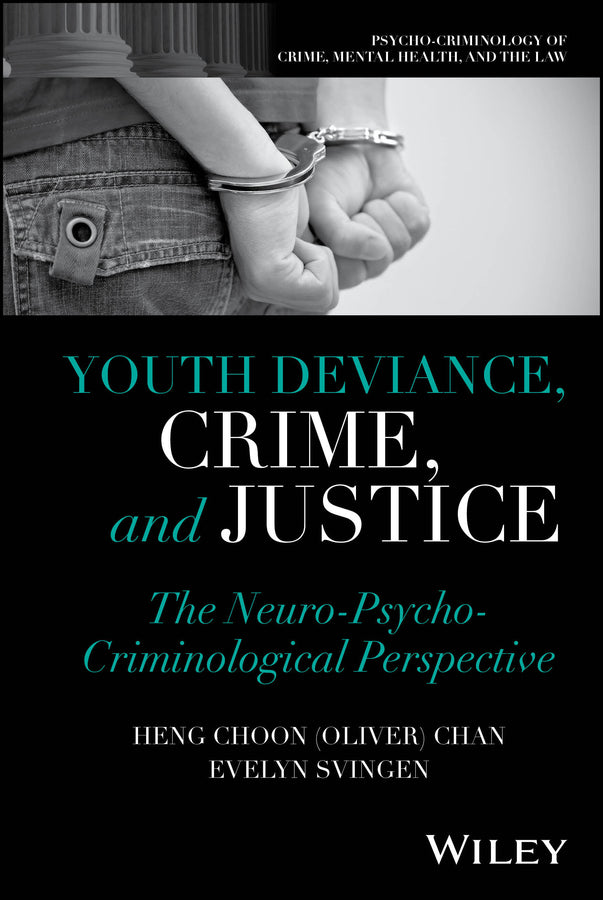
Youth Deviance, Crime, and Justice
The Neuro-Psycho-Criminological Perspective
Heng Choon (Oliver) Chan (Edited by), Evelyn Svingen (Edited by)
9781394251490, Wiley
Hardback, published 10 December 2025
320 pages
22.9 x 16 x 2.5 cm, 0.635 kg
A GROUNDBREAKING EXPLORATION OF YOUTH CRIME THROUGH NEUROSCIENCE, PSYCHOLOGY, AND CRIMINOLOGY Why do some young people engage in deviant and criminal behaviour, while others do not? What role do brain development, personality traits, and social influences play in youth crime? Youth Deviance, Crime, and Justice: The Neuro-Psycho-Criminological Perspective offers an innovative and comprehensive look at youth offending by integrating neuropsychology and criminology. With an interdisciplinary approach to understanding youth offending, this volume examines both the biological and social mechanisms that shape youth delinquency. With contributions from leading scholars and practitioners from the US, the UK, the Netherlands, Canada, and Iran, this book presents cutting-edge research on topics such as cognitive neuroscience, moral intelligence, peer influences, and the neurobiological underpinnings of antisocial behaviour. Structured into two sections—Theory and Research, and Policy and Practice—it bridges the gap between scientific inquiry and practical applications, offering valuable insights for both researchers and professionals in the field. Youth Deviance, Crime, and Justice: The Neuro-Psycho-Criminological Perspective is an essential resource for academics, students, and field practitioners, including neuroscientists, forensic psychologists, legal professionals, and policymakers. Whether used in courses on forensic psychology, neurocriminology, or juvenile justice, or as a reference for professionals working with at-risk youth, this text provides the latest research and best practices to inform effective interventions and policies.
List of Figures xiii List of Tables xv Biography of the Editors xvii Biography of the Contributors xxi Endorsements xxv Foreword xxvii 1 Introduction: Exploring Youth Deviance, Crime, and Justice from a Neuro-psycho-criminological Perspective 1 Introduction 1 The Approach Adopted in This Book 2 The Structure of the Book 3 Advancing Our Understanding of Youth Deviance, Crime, and Justice from a Neuro-psycho-criminological Approach 5 References 6 Part 1 Theory and Research 9 2 Biosocial Criminology: Key Findings and Contributions 11 Introduction 11 Behavioral Genetics 12 Genetic Foundations to Antisocial Behavior in Adolescence 15 Connecting Behavioral Genetic Research to the Larger Biosocial Literature 19 Future Directions and Conclusions 21 Main Takeaway Points 22 References 22 3 “The Youth Is Streetwise, Criminally Sophisticated, and Dangerous”: Stepping Stones for Pathological Criminal Behavior 29 Introduction 29 Childhood Psychopathology 30 Behavioral Disorders 32 Developmental and Life-Course Criminology/Criminal Careers 35 Conclusion 37 Main Takeaway Points 39 References 40 4 An Online-Mediated Model of Criminal Motivation: Understanding Youth Deviance, Crime, and Delinquency using Reinforcement Sensitivity Theory 47 Introduction 47 Reinforcement Sensitivity Theory 48 Neurological Underpinnings of RST 50 Three Pathways of Online-Mediated Youth Deviance 50 BAS: Approach Motivation as a Response to Deviant Content Online 50 BAS Liking 52 BAS Wanting 53 BIS: Reactive Approach Motivation as a Motivator of Youth Deviance 54 Environmental Influence 55 Social Power and BAS Activation 55 Online Disinhibition and BAS Activation 57 Three Pathways to Youth Deviance 58 Conclusions 59 Main Takeaway Points 60 References 61 5 Psychological and Neuroscientific Approaches to Understanding the Role of Youth Morality in Rule-Breaking Decision-Making 69 Introduction 69 The Individual-Level (Psychological) Morality Component of the Situational Action Theory of Crime 71 Beyond Criminological Research: The Use of Neuroscientific and Psychological Literature to Better Understand Morality and Rule-Breaking 75 The Cautionary Use of Neuroscience to Advance Social Scientific Understanding 75 The Historical Neglect of Emotion Over Reason in Moral Decision-Making 76 Brain Injury, Atypical Moral Decision-Making, and Crime 78 Implications for Youth Moral Decision-Making and Intervention Applications 80 Conclusion 81 Main Takeaway Points 81 References 82 6 Biosocial Etiology of Antisocial Behavior in Children: The Role of Autonomic Activity and Coordination 89 Introduction 89 Biosocial Interactions 89 Physiological Arousal 90 Sympathetic (Re)activity 92 Parasympathetic (Re)activity 93 Potential Explanations for Inconsistencies in the Literature 94 Autonomic Coordination 95 Conclusion 97 Main Takeaway Points 98 References 99 7 Resting-State fMRI Networks in High-Risk Youth with Antisocial Traits: Exploring Neuroconnectivity and Implications for Understanding Disruptive Behavior 109 Introduction 109 Current Review 112 Resting-State Networks (RSNs) in Youth with Antisocial Traits 113 Deficits in Behavioral Processes in Youth with Antisocial Traits 115 Resting-State Networks (RSNs) Alterations in Individuals with Antisocial Traits 118 Default Mode Network Deficits in Antisocial Behavior 118 Salience Network Deficits in Antisocial Behavior 120 Early Identification and Intervention 122 The Road Ahead 123 Conclusion 125 Main Takeaway Points 125 References 126 Part 2 Policy and Practice 141 8 Inside the Black Box of the Tit-for-Tat: Exploring the Neuropsychology of Revenge Behaviors in Adolescents 143 Introduction 143 Age-Related Changes 145 The Neurophysiology of Revenge 146 Implicated Regions 146 Amygdala Activation in Response to Perceived Threat 146 The Anterior Cingulate Cortex (ACC) and Evaluation of Emotional Responses 148 Striatum and Gratification 149 Prefrontal Cortex and Decision-Making 150 Neurotransmitter Systems and Retaliatory Behaviors 153 Serotonin and Aggression 154 Dopamine and Reward Processing 155 Social Influences 156 Peer Relationships and Retaliatory Behaviors 156 Family Environment and Upbringing 157 Intervention Strategies 159 Cognitive-Behavioral Interventions 159 Peer Mediation Programs 160 Family-Based Interventions 161 Conclusion 162 Main Takeaway Points 163 References 163 9 Neurobiological Underpinnings of Treatment Success for High-Risk Children Displaying Antisocial Behavior 181 Introduction 181 Cognitive Constructs Associated with Antisocial Behavior 182 Self-Control 182 Emotion Processing 183 Trauma 185 The Interaction of Risk Factors 185 Brain Plasticity 186 Treatment Programs for Children with AB 187 The SNAP Model 188 The Brain–Behavior Relationship and Intervention Success 189 Conclusion 190 Main Takeaway Points 191 References 191 10 The Neurocognitive Perspective of Youth’s Criminal and Deviant Behavior: Exploring the Role of Moral Intelligence 201 Introduction 201 Conceptualization 203 Analyzing Moral Intelligence in Criminal Perception 206 Levels of Moral Intelligence Development 209 Conclusion 212 Main Takeaway Points 213 References 213 11 The Neurobiological and Psychological Nature of “Adultification”: Implications for Legal Decision-Making in Cases Involving Adolescents 217 Introduction 217 The U.S. Juvenile Justice System 218 Developmental Differences Between Adults and Adolescents 219 The Adultification of Youth 222 The Risks of Adultification and Developmental Vulnerabilities in Court Processes 224 Conclusions 229 Main Takeaway Points 230 References 231 12 The Neuroscience of the Age–Crime Curve: Implications for Juvenile Justice Policy and Practice 237 Introduction 237 Heightened Sensitivity to Rewards in Risk-Taking Behaviors 238 Inhibited Self-Control 240 Bridging the Gap and Uncovering Within-Group Variations 241 Policy Implications: Raising the Minimum Age of Criminal Responsibility 244 Policy Implications: The Limits of Individualized and Necessity of Informal Juvenile Justice Interventions 246 Conclusion 250 Main Takeaway Points 252 References 252 13 Concluding Remarks 261 Index 271
Heng Choon (Oliver) Chan and Evelyn Svingen
Bridget Joyner-Carpanini and Kevin M. Beaver
Matt DeLisi
Neil Shortland and Michael Palmieri
Neema Trivedi-Bateman
Liat Kofler and Yu Gao
Carmen-Silva Sergiou
Evelyn Svingen
Areti Smaragdi, Thea Johsefine Austevik, Sarah Woods, and Leena K. Augimeri
Arian Petoft and Sepidehsadat Tabatabaei
Isabella Polito and Colleen M. Berryessa
Laura Kelly and Evelyn Svingen
Evelyn Svingen and Heng Choon (Oliver) Chan
Subject Areas: Psychology [JM]