Special Order - allow 2+ weeks lead
Couldn't load pickup availability
Yalta 1945
Europe and America at the Crossroads
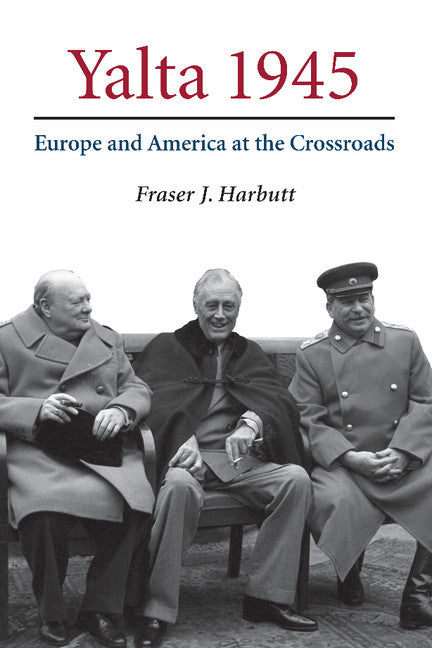
This book argues that the Yalta conference was a pivotal moment that signaled a shift from a pre-existing 'Europe/America' framework to an 'East/West' conception in 1945.
Fraser J. Harbutt (Author)
9780521673112, Cambridge University Press
Paperback / softback, published 1 May 2014
470 pages
23.4 x 15.6 x 2.6 cm, 0.72 kg
'This is an absolutely brilliant piece of work. It is not just that the that the book is well-crafted, that the argument is based on a mass of hitherto scarcely-exploited archival evidence, and that Harbutt's analysis throws new light on the Yalta Conference and on its historical meaning. Its importance lies in the fact that it allows you to see allied wartime diplomacy in an essentially new way: it helps you understand, better than any other book I know of, how the post-World War II world came into being.' Marc Trachtenberg, University of California, Los Angeles
This revisionist study of Allied diplomacy from 1941 to 1946 challenges Americocentric views of the period and highlights Europe's neglected role. Fraser J. Harbutt, drawing on international sources, shows that in planning for the future Churchill, Roosevelt, Stalin, and others self-consciously operated into 1945, not on 'East/West' lines but within a 'Europe/America' political framework characterized by the plausible prospect of Anglo-Russian collaboration and persisting American detachment. Harbutt then explains the destabilizing transformation around the time of the pivotal Yalta conference of February 1945, when a sudden series of provocative initiatives, manipulations, and miscues interacted with events to produce the breakdown of European solidarity and the Anglo-Soviet nexus, an evolving Anglo-American alignment, and new tensions that led finally to the Cold War. This fresh perspective, stressing structural, geopolitical, and traditional impulses and constraints, raises important new questions about the enduringly controversial transition from World War II to a cold war that no statesman wanted.
1. The confusions of Yalta
2. The two arenas: Europe and America
3. The persistence of Europe, 1942–3
4. The making of the Moscow order
5. Consolidation
6. Roosevelt's America: a world apart
7. The Yalta crossroad
8. Aftermath
9. Reflections.
Subject Areas: International relations [JPS], Postwar 20th century history, from c 1945 to c 2000 [HBLW3]