Freshly Printed - allow 10 days lead
Couldn't load pickup availability
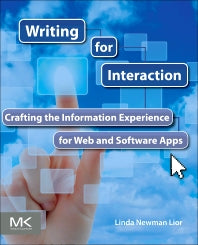
Writing for Interaction
Crafting the Information Experience for Web and Software Apps
Learn the skills, processes, and writing principles for creating an information experience that guides your customers, helping them successfully interact with and use your application.
Linda Newman Lior (Author)
9780123948137, Elsevier Science
Paperback, published 16 April 2013
292 pages
23.4 x 19 x 1.9 cm, 0.68 kg
"Here [Lior] explains how to design and create the content that customers rely on to interact with a software application successfully — such as the labels on virtual buttons to click, or step-by-step instructions displayed on pages. The information would be useful for technical writers and instructional designers, or whoever on the development team is responsible for writing, editing, or reviewing the user interface text." --Reference & Research Book News, October 2013
Writing for Interaction focuses on the art of creating the information experience as it appears within software and web applications, specifically in the form of user interface text. It also provides strategies for ensuring a consistent, positive information experience across a variety of delivery mechanisms, such as online help and social media. Throughout this book, you'll learn simple techniques for writing consistent text with the right tone, how to select content delivery mechanisms, and how straightforward, clear layouts help your customer interact with your application. Divided into five sections, the book completely covers the information experience design process from beginning to end. You'll cover everything from understanding your users and their needs, to creating personas, designing the IX strategy, creating your information, and evaluating the resulting information experience. This is your one-stop reference for information experience!
Section 1: Introducing the Information ExperienceChapter 1. What is the information experience? Chapter 2. Design and development models Section 2: Understanding your users and their information needsChapter 3. Getting to know your usersChapter 4. Gathering data about your usersChapter 5. Creating Your Personas Section 3: Designing your IX StrategyChapter 6. Understanding User Reading PatternsChapter 7. Applying Usability PrinciplesChapter 8. Creating Style Guidelines Section 4: Creating the information experienceChapter 9. Designing your Information StrategyChapter 10. Writing the User Interface TextChapter 11. Writing for Diverse Audiences Section 5: EvaluationChapter 12. Evaluating the IX Experience
Subject Areas: Human-computer interaction [UYZ]