Freshly Printed - allow 7 days lead
Couldn't load pickup availability
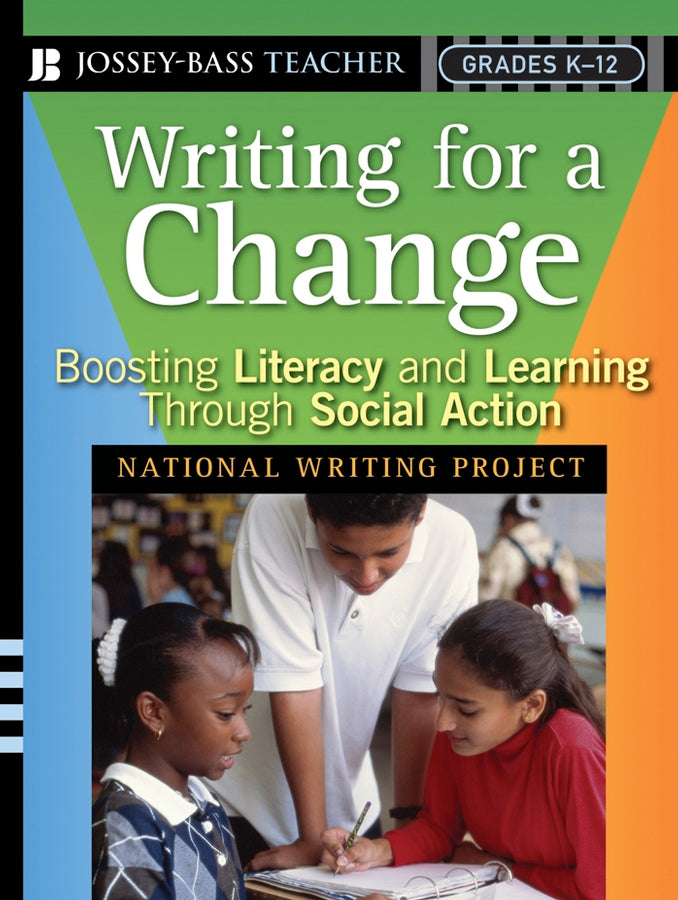
Writing for a Change
Boosting Literacy and Learning Through Social Action
"This is the book educators have been waiting for: practitioner guidance on combining literacy education and community problem solving to create a powerful form of service-learning in which students can master critical academic and civic competencies." "An excellent book, celebrating and demonstrating practical social action approaches that support children and young people to make change happen in their schools, in their communities, and in their lives. A timely and vital challenge to educationalists in formal and informal settings on both sides of the Atlantic, invigorating education for empowerment and social change, showing that citizenship can only be learned through doing." "A perfect combination of inspiration and practical advice. Chock-full of ideas and activities that eat away a sense of powerlessness and turn angst into action."
—Betsey McGee, former senior program officer, Academy for Educational Development
—Bill Badham, development officer, The National Youth Agency (England)
—Wendy Saul, professor of education and international studies, University of Missouri—St. Louis
(Author), Kristina Berdan (Edited by), Ian Boulton (Edited by), Elyse Eidman-Aadahl (Edited by), Jennie Fleming (Edited by), Launie Gardner (Edited by), Iana Rogers (Edited by), Asali Solomon (Edited by), Richard Sterling (Foreword by)
9780787986575, Wiley
Paperback / softback, published 10 October 2006
192 pages
23.3 x 17.9 x 1.3 cm, 0.32 kg
"This informative paperback discusses the development of teacher-facilitated and student-driven social action projects." (Childhood Education, Fall 2007) "This book engages with an integrative framework of literacy acceleration and critical social action." (PsycCritiques, 09/06/2007)
Writing for a Change shows teachers how to engage students in “real world” problem-solving activities that can help them to acquire voice, authority, and passion for both reading and writing practice. Written in collaboration with the Center for Social Action in England, the book describes the innovative Social Action process for encouraging students to collaborate on problems of their own choosing—to analyze options, develop action plans, discover solutions, and finally to reflect on their work. Featuring stories by teachers who have successfully used the method, the book shows that first graders as well as high-school students can enjoy this exciting and educational process. Practical guidance for applying the process to any curricular area is provided along with an extensive list of classroom activities.
Foreword, Richard Sterling xi Sponsors xiii Preface xv Editors and Contributors xxi ONE Exploring Student-Driven Learning and Literacy Through Social Action 1 PART ONE Social Action in Practice 9 TWO Power Play 11 THREE Lending Student Voice to Curriculum Planning 19 FOUR The Story of the Youth Dreamers: In Their Own Words 25 FIVE Reflections on the Youth Dreamers 31 SIX Community Action in a Summer Writing Institute 43 SEVEN Changing Our World 51 EIGHT Poetry and Power in the Creative Writing Workshop 57 NINE Shall We Dance? 63 TEN The March on John Philip Sousa 67 ELEVEN Social Action and Parent Involvement 73 PART TWO Getting Started with Social Action 79 TWELVE Learning from Social Action: Reflections on Teaching and Social Action 81 THIRTEEN Principles for Practice: What Is Social Action? 87 FOURTEEN Recommendations for the Classroom: Before You Start 97 PART THREE Stuff You Can Try: Activities for Social Action 107 Metro Map 111 Naming the Group 113 Community Vocabulary 115 Devising the Vision 117 How We Behave in Groups 119 Movie Poster 121 Four Faces 124 But Why? 127 Codes 132 Changing Your Mind 134 Sculpts 136 The Three C’s 138 SWOT 140 Ideal Specimen 142 Force Field Analysis 144 Worst Nightmare 147 Now/Soon/Later 149 The Swimming Pool 151 Messages 153 References 155 Resources for Further Reading 157 Index 159
Paula Laub
Dietta Poston Hitchcock
Mildred Harris, Chantel Morant, Shanta Crippen, Chris Lawson, Chekana Reid, Cierra Cary, Tiffani Young-Smith
Kristina Berdan
Chinwe “La Tanya” Obijiofor
Lori Farias, Critics of Society Class
Maggie Folkers
Connie Ellard Bunch
Elizabeth A. Davis
Mildred Serra
Jennie Fleming, Ian Boulton
Jennie Fleming, Ian Boulton
Subject Areas: Education [JN]