Freshly Printed - allow 10 days lead
Couldn't load pickup availability
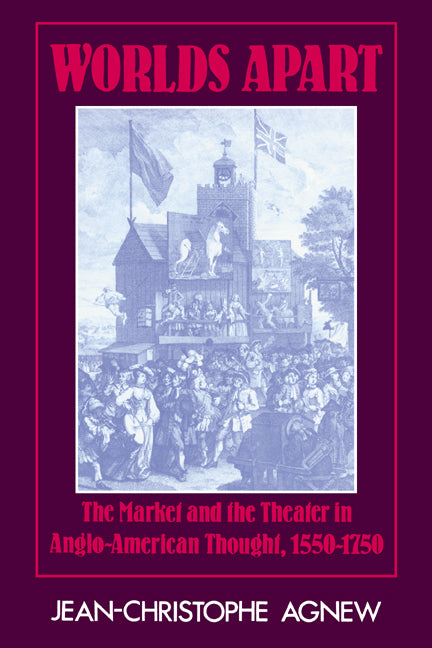
Worlds Apart
The Market and the Theater in Anglo-American Thought, 1550–1750
Focusing on Britain and America in the years 1550 to 1750, the book discusses the forms and conventions that structured both commerce and theatre.
Jean-Christophe Agnew (Author)
9780521379106, Cambridge University Press
Paperback / softback, published 28 October 1988
280 pages
22.8 x 15.2 x 1.5 cm, 0.385 kg
"...an important and original work...Agnew is able to demonstrate far more powerfully than previous writers why the new forms assumed by Elizabethan and Jacobean theater were so disturbing to contemporaries and of such enduring power....succeed[s] magnificently in establishing this theater as a prime source of the metaphors out of which a discourse upon capitalism was eventually constructed." The Nation
Drawing on a variety of disciplines and documents, Professor Agnew illuminates one of the most fascinating chapters in the formations of Anglo-American market culture. Worlds Apart traces the history of our concepts of the marketplace and the theatre and the ways in which these concepts are bound together. Focusing on Britain and America in the years 1550 to 1750, the book discusses the forms and conventions that structured both commerce and theatre. As marketing practice broke free of its traditional boundaries and restraints, it challenged longstanding popular assumptions about the constituents of value, the nature of identity, the signs of authenticity, and the limits of liability. New exchange relations bred new legal and commercial fictions to authorise them, but they also bred new doubts about the precise grounds upon which the self and its 'interests' were to be represented. Those same doubts, Professor Agnew shows, animated the theatre as well. As actors and playwrights shifted from ecclesiastical and civic drama to professional entertainments, they too devised authenticating fictions, fictions that effectively replicated the bewildering representational confusions of the new 'placeless market'.
Preface
Acknowledgments
Prologue: commerce and culture
1. The threshold of exchange
2. Another nature
3. Artificial persons
4. The spectacle of the market
Epilogue: confidence and culture
Notes
Index.
Subject Areas: History of ideas [JFCX]