Freshly Printed - allow 7 days lead
Couldn't load pickup availability
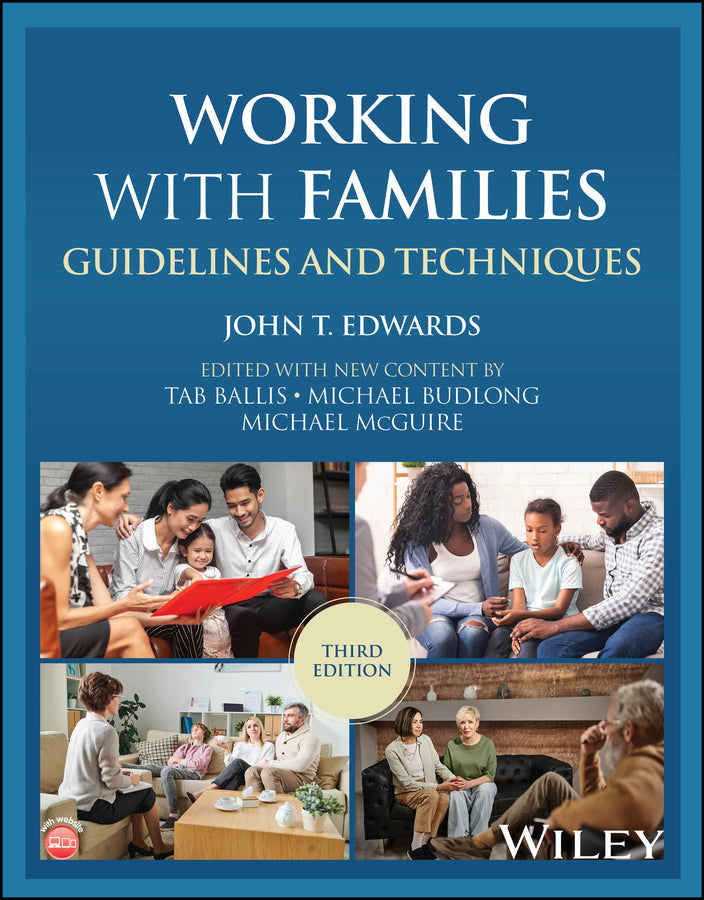
Working with Families
Guidelines and Techniques
John T. Edwards (Author), Tab Ballis (Author), Michael Budlong (Author), Michael E. McGuire (Author)
9781394258123, Wiley
Paperback / softback, published 4 May 2026
304 pages
27.4 x 21.6 x 1.8 cm, 0.794 kg
The most up-to-date edition of the gold standard reference in family therapy Clinician-focused and highly practical, this essential resource emphasizes hands on application over abstract theory. Building on the legacy of John T. Edwards, the newly revised Third Edition addresses contemporary challenges facing families—including addiction and the opioid crisis, trauma, social isolation, cultural complexity, and the impact of technology—by providing concrete tools clinicians can use immediately in practice. Designed as a true “how to” resource manual, the book demystifies family systems theory and translates it into clear clinical models, interventions, and case examples. Its content is applicable across a wide range of settings, including mental health, substance use treatment, education, child welfare, and criminal justice. While preserving Edwards’ accessible and practical voice, this edition incorporates updated language, reorganized content for improved usability, and expanded attention to cultural humility, special populations, therapist use of self, and clinical supervision. A hallmark of the Third Edition is its multimodal, practice ready design, featuring session-by-session templates to guide clinicians in conducting both couples and family therapy, along with updated case material, field tested techniques, editorial commentary, highlighted quotes from John T. Edwards, an extensive video catalog, interviews, and previously unpublished content. Readers will find: Ideal as a primary or supplementary text for graduate programs in social work, counseling, psychology, and marriage and family therapy, Working With Families also serves as an indispensable desk reference for practitioners seeking practical, authoritative, and hope‑centered clinical guidance.
Introduction to the Third Edition viii Preface to Second Edition x About the Second Edition xi Acknowledgments from the Second Edition xii About the Companion Website xiii Chapter 1: Systems Orientation 1 Introduction 2 Assumptions of a Family Systems Model 3 The Systems Orientation in Theory 4 The Systems Orientation in Practice 5 The Systems Orientation in Concepts 6 Levels of Systems Interventions 7 Cause and Effect in Systems 10 The Systems- Oriented Program Assessment 11 Working Alongside the Medical Model 12 Concluding Thoughts 13 Chapter 2: Fundamentals of Family Work 14 Introduction 15 Learning Family Counseling 16 Why Family Work 17 Rationales for This Approach 18 Uses of Family Counseling 20 Forms of Family Work 21 Bedrock Beliefs About Families 22 A Theory of Change 23 Children Raise Adults 26 Neglected Relationships in Family Counseling 27 Getting a Grip on the Obvious 29 Too Many Variables 30 Too- Brief Family Counseling 31 Traveling Pairs of Concepts 32 Concluding Thoughts 35 Chapter 3: Structuring Family Sessions 36 Introduction 37 Five Basic Tools for Family Counseling 38 General Guidelines for Family Sessions 41 Session- by- Session Guidelines 46 Session Checklist for Family Counseling 48 Review Lists for Family Counselors 49 Family Work in Different Settings 53 Family Counseling Online 57 Shared Goals 59 Concluding Thoughts 61 Chapter 4: Engaging Families 63 Introduction 64 Recruiting Families 66 Family Questions in Individual Counseling 69 Conducting the Initial Family Interview: The ReSPECT Sequence 70 Tips for the First Family Interview 73 Family Resistance 74 Difficult Parents 78 Child Assessment in Plain Language 80 Concluding Thoughts 82 Chapter 5: Case Conceptualization 83 Introduction 84 Guiding Principles 85 Family Mapping 86 The MIGS Sheet 89 Therapeutic Themes by Family Type (Child-Identified Patient) 94 Working with Adolescents and Children 99 Concluding Thoughts 110 Chapter 6: Use of Self 111 Introduction 112 Self- Awareness 114 Fear of Family Work 115 Experience Is Primary 116 Inexperienced Versus Experienced Family Counselors 117 A Novice’s First Family Interview 118 Counselor Development as a Systems Practitioner 121 Clinical Self- Assessment 124 Induction/Countertransference 127 Conscious Use of Self 129 Colleague Consultation 132 Concluding Thoughts 133 Chapter 7: Cultural Perspective in Family Work 135 Introduction 136 Cultural Awareness 137 Dynamic Diversity 140 Special Populations 143 Concluding Thoughts 146 Chapter 8: Systemic Techniques 147 Introduction 148 Tools of the Trade 150 Alter Ego 151 Brief Network Intervention (BNI) 153 Chair Work 156 Circular Questions 157 Colleague Teamwork 158 Drawings 159 Guardrail 162 New Talk 164 Paradox 165 Parent’s Childhood 166 Reflecting Team 168 Reframing 169 Relabeling 172 Safe Rebellion 174 Sculpting and Movement 176 Sibling Talk 179 Strategic Child Assessment 181 Strategic Predictions 182 Toybox 184 Worried Child 185 Summary of Systemic Techniques 187 A Sequential Model of Family Therapy 189 Concluding Thoughts 193 Chapter 9: Working with Couples 194 Introduction 195 General Guidelines 196 Couples Counseling: Additional Tips 199 Couples Work for Substance Use Disorder 200 Couples Counseling Clinical Model of Practice 202 Concluding Thoughts 205 Chapter 10: Working with Multiple Family Groups 206 Introduction 207 Multiple Family Group Counseling 208 Suggested Procedures for Multiple Family Groups 209 Family Recruitment for Multiple Family Groups 210 Clinical Tips 211 Therapeutic Activities 212 Who’s Missing? 214 Elemental Schema for Multiple- Family Group Therapy 215 Multiple Family Groups in Action 217 Concluding Thoughts 218 Chapter 11: Working with Addiction in Families 219 Introduction 220 Defining Substance Use Disorder 222 Useful Approaches to Problematic Substance Use 225 Common Patterns in Families with Substance Use Disorders 227 Adolescents with Problematic Substance Use 236 Codependency 238 Engaging Families with Substance Use Problems 240 Family Counseling for Substance Use Disorders 242 Concluding Thoughts 243 Chapter 12: John T Edwards Biography 244 Chapter 13: The Green Book 249 Green Book Table of Contents 250 Introduction to the Green Book 250 Part One: An Odd Assortment of Musings, Quips, Perceptions, Considerations, Witticisms, and Philosophy for Family Therapists 252 Part Two: Learning How to Live— A Selection of John’s Journal Entries 270 Index 272 Video Link Index 275
Subject Areas: Psychology [JM]