Freshly Printed - allow 8 days lead
Couldn't load pickup availability
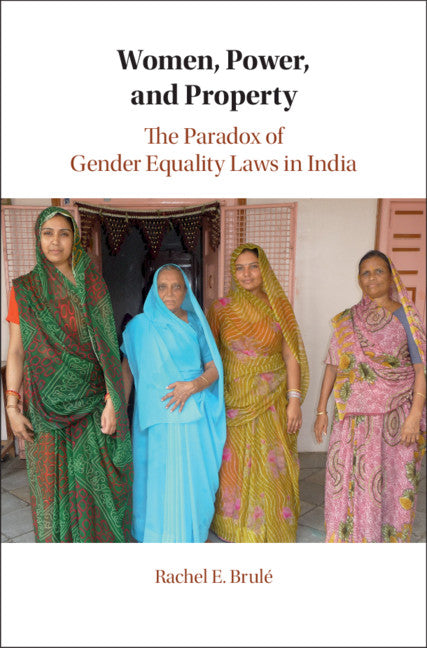
Women, Power, and Property
The Paradox of Gender Equality Laws in India
Cutting-edge research from India finds bargaining power predicts whether electoral quotas can empower women to upend economic inequality.
Rachel E. Brulé (Author)
9781108835824, Cambridge University Press
Hardback, published 22 October 2020
433 pages, 47 b/w illus.
16 x 23.5 x 3 cm, 0.74 kg
'… this book offers a conceptually nuanced and methodologically innovative analysis of gendered land rights. It thereby adds a new dimension to understandings of the determinants of the quality of democracy in India, and potentially elsewhere too.' Narendra Subramanian, Perspectives on Politics
Quotas for women in government have swept the globe. Yet we know little about their capacity to upend entrenched social, political, and economic hierarchies. Women, Power, and Property explores this question within the context of India, the world's largest democracy. Brulé employs a research design that maximizes causal inference alongside extensive field research to explain the relationship between political representation, backlash, and economic empowerment. Her findings show that women in government – gatekeepers – catalyze access to fundamental economic rights to property. Women in politics have the power to support constituent rights at critical junctures, such as marriage negotiations, when they can strike integrative solutions to intrahousehold bargaining. Yet there is a paradox: quotas are essential for enforcement of rights, but they generate backlash against women who gain rights without bargaining leverage. In this groundbreaking study, Brulé shows how well-designed quotas can operate as a crucial tool to foster equality and benefit the women they are meant to empower.
1. Introduction
2. A theory of political representation and economic agency
3. Property and power: a political history of the Hindu joint family
4. Where are the women? Investigating reform's roots
5. The politics of property rights enforcement
6. The long arm of resistance: refusal to care for parents
7. Representation and violence: gender equality and sex selection
8. Conclusion.
Subject Areas: Comparative politics [JPB], Politics & government [JP]