Freshly Printed - allow 7 days lead
Couldn't load pickup availability
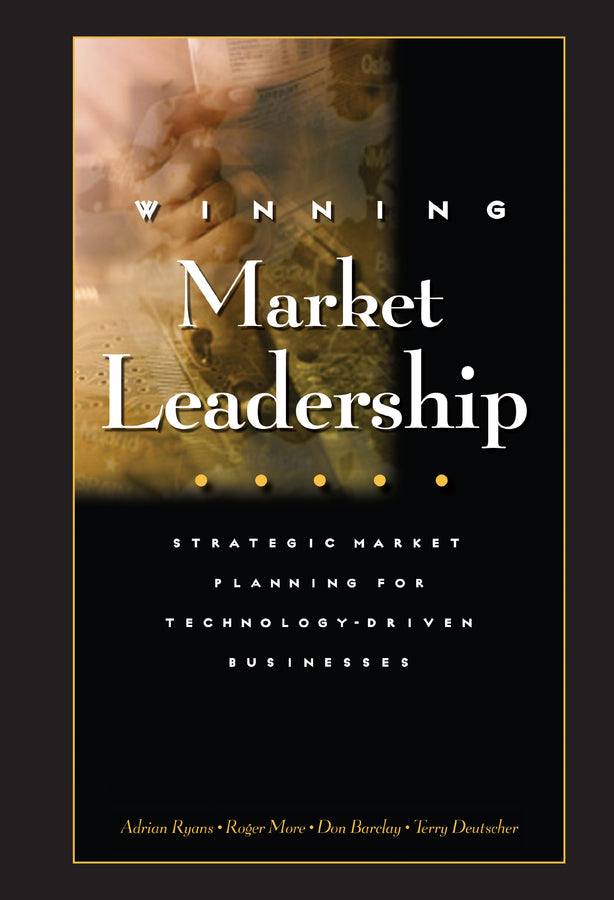
Winning Market Leadership
Strategic Market Planning for Technology-Driven Businesses
"There are many killer technologies that never translate into market success. This book maps out an integrated strategic marketing process that technology-intensive businesses can use to achieve clear market leadership." (Stephen Nicolle, Vice President, Nortel Networks) "Achieving market leadership is what most companies strive for, but few achieve, especially on a sustainable basis. And for those in technology-driven businesses, the challenge is all the more formidable because of the continuous and rapid change in technology as well as the marketplace. The authors are right on target in their emphasis on the need for strategic market planning in this kind of environment--and give a multitude of examples to prove their points." (John M. Thompson, Senior Vice President Group Executive, IBM Corporation) "Winning Market Leadership presents marketing concepts that work. As you read this book, you will feel that you have the master teacher at your side giving you confidence to tackle any marketing obstacle. I think that this book will be one that every business leader is going to want on his or her shelf." (Fred Hume, President and CEO, Data I/O Corporation) "The Winning Market Leadership process has become part of National's mindset. It has helped the Analog Group to identify attractive market opportunities and leverage scarce resources to achieve some big wins in the market." (Patrick J. Brockett, Executive Vice President of the Analog Products Group, National Semiconductor Corporation) "In Winning Market Leadership, the concepts of 'market chains' and 'market webs' are ones that all high-technology executives will want to understand. They are the backbone of a planning process that will allow strategic thinking to replace strategic plans." (David Churchill, Vice President and General Manager, Oscilloscope Division, Tektronix Inc.) "Winning Market Leadership provides an excellent, disciplined methodology for analyzing business opportunities. A cross-functional common denominator embraceable by all functional groups." (Joe Greulich, President, Solvay Engineered Polymers) "Winning Market Leadership emphasizes what every marketing or general management executive must learn--the only proven business success model comes from 'outside-in' thinking. An understanding of market segments, competition, dynamics of product acceptance, and the problems the customer needs to solve--the outside world--are more important than technological elegance for its own sake." (Richard Levy, President and CEO, Varian Medical Systems)
Adrian Ryans (Author), Roger More (Author), Donald Barclay (Author), Terry Deutscher (Author)
9780471644309, Wiley
Hardback, published 9 February 2000
336 pages
23.6 x 16.1 x 2.3 cm, 0.595 kg
Im High-Tech Sektor wird die Marketingplanung häufig zu einer frustrierenden Aufgabe, denn ständige Innovation ist die Norm und drastische Veränderungen entstehen nahezu über Nacht. Dieses Buch - verfaßt von einem Autorenteam der angesehenen Richard Ivey School of Business - beschreibt einen dynamischen Neuansatz für die strategische Marketingplanung. Dieser Ansatz hat bereits vielen Spitzenunternehmen im High-Tech-Bereich geholfen, sich als Marktführer zu etablieren oder zu behaupten. Anhand von Beispielen führender Unternehmen wie Intel, Compaq und General Electric lernen Sie, wie Sie schneller planen, entwickeln und funktionsübergreifende Teams erfolgreich aufstellen, wie Sie "lebendige Pläne" erarbeiten, die sich rasch an neue Marktbedingungen und veränderte Wettbewerbsdynamik anpassen, wie Sie sich auf Cash Flow und Rentabilität konzentrieren und vieles andere mehr.
Preface xv Acknowledgments xvii Chapter 1: Introduction 1 The Environment in Which Technology-Intensive Businesses Operate 3 Complex and Dynamic Market Chains 3 Network Effects 5 Speed of Change is High 6 Blurred Market Boundaries 7 Markets and Competition Are Global 8 Strategic Market Planning in a Technology-Intensive Business 10 Who Should Be Involved in the Process? 10 Planning Builds Mental Models 10 Planning Process Must Be Iterative and Continuous 11 Planning Process Must Be Integrative 12 Winning Market Leadership: An Integrated Approach 12 Choose the Arena 13 Identify Potentially Attractive Opportunities 14 Understand the Market 16 Assess Resources and Competencies 16 Understand the Competitive Challenge 17 Make Tough Strategic Choices 19 Plan Key Relationships 21 Complete the Winning Strategy 22 Understand the Profit Dynamic 23 Implement the Chosen Strategy 23 What Is Different About This Book? 24 Integrated Planning Process 24 Process Applies to New or Existing Business Opportunities 24 Process Is Designed for Managers 25 Chapter 2: Choose the Arena 27 Introduction 27 Crucial First Step in the Planning Process 29 Strategic Business Unit (SBU) 29 Existing Market Opportunities 30 New Market Opportunities 31 Define the Arena 34 Customers Served 34 Applications/Functionality Provided 36 Technologies/Competencies Used 36 Value-Adding Role 37 Strategic Drivers and Strategic Paths 37 Driving Force 37 Strategic Path 38 Next Step: Identify the Potentially Attractive Opportunities in the Business Arena 40 Chapter 3: Identify Attractive Opportunities 43 Introduction 43 Identifying Potential Market Opportunities 43 Benefits of Thinking About Market Segments Early in the Process 46 Segmenting a Market 46 Possible Segmentation Bases 47 Segmentation Process 51 Targeting Issues 52 Market Segment Attractiveness 54 Determining the Attractiveness of a Market Segment 55 Understanding Choices Among Market Chain Opportunities 65 Market-Driving Opportunities 66 Exploiting Environmental Change 67 Sources of Discontinuities or Breakpoints 68 Next Step: Developing a Deeper Understanding of the Market Opportunities 70 Chapter 4: Understand the Market 71 Introduction 71 Adoption of New Products 72 Types of Innovations 73 Technology Adoption Life Cycle 74 Adopter Categories 75 Driving the Adoption Process 77 Achieving Market Leadership 82 Whole Product or Complete Solution 83 Understanding Buyer Choice/Rejection Behavior 84 Decision-Making Unit 85 Choice Criteria 86 The Choice/Rejection Process 88 Market Chains 93 Choices Among Market Chains 93 Market Chain Dynamics 96 Market Chains as a Series of Choice/Rejection Processes 98 Next Step: Assessing Your Resources and Competencies 99 Chapter 5: Assess Resources and Competencies 103 Introduction 103 The Process of Assessing Resource/Competency Fit 104 Core Competencies 105 What Is a Core Competency? 105 What Is a Constraining Incompetency? 108 Identifying Core Competencies 109 Identifying Your Organization’s Core Competencies 110 Managing Core Competencies 111 Should You “Make” or “Buy” Strategic Activities Associated with Core Competencies? 112 Customer Value and Profit Creation Model 113 Mapping Competencies and Customer Requirements 114 Assessing a Market Opportunity: Fit With Core Competencies 115 Next Step: Understanding the Competitive Challenge 120 Chapter 6: Understand the Competitive Challenge 123 Introduction 123 Process of Competitive Analysis 125 Issues in the Competitive Analysis Process 126 Identification of Competitors 126 How Do They Compete? 128 How Are They Doing Now? How Will They Do in the Future? 134 Analysis of Strategy Driving Forces 137 Pulling the Competitive Information Together 141 Actions-Consequences-Evidence (ACE) Framework 141 Next Step: Making the Tough Choices 142 Chapter 7: Make Tough Strategic Choices 145 Introduction 145 Strategic Issues 147 What Is a Strategic Issue? 147 How Many Strategic Issues? 148 Types of Strategic Issues 148 Developing a Winning Strategy for an Opportunity 149 Cost Leadership 149 Differentiation 151 Strategic Breakpoint 153 Risks of Adopting a Differentiation Strategy 155 Sustaining the Competitive Advantage 157 Convergence of Cost Leadership and Differentiation 158 Selecting the Portfolio of Opportunities 159 Balance Market Attractiveness and Ability to Win 159 Displaying the Portfolio of Opportunities 160 Making Clear Strategic Choices 163 Next Step: Managing Critical Relationships 165 Chapter 8: Manage Critical Relationships 167 Introduction 167 Why Are Relationships Critical? 168 The Market Web 170 A Generic Market Web and an Example 171 A Managerial Perspective on Market Webs 174 Market Webs as Value-Creating Systems 174 Evolution of the Market Web 175 Managing Critical Relationships 176 Market Chain Strands 177 Customer and Supplier Relationships 177 Off-Market Chain Strands 178 Formal and Informal 178 Collaborative Product Development Alliances 179 Co-Marketing Alliances 179 Horizontal Selling Alliances 180 Knowledge and Influence Strands 181 Knowledge Strands: Learning From Others in the Web 181 Influence Strands: Affecting Choice/Rejection Processes 182 Value-Added Partnerships: A Key Relationship Form 183 Partnering Success Factors 184 Managing “Sticky” Strands in the Web 187 Relationships and the Market Opportunity 189 The Opportunity 189 The Winning Strategy 190 Next Step: Completing the Winning Strategy 190 Chapter 9: Complete the Winning Strategy 193 Introduction 193 A Framework 193 Define a Clear Competitive Position in the Opportunity 195 Complete the Total Product/Service Solution 196 Plan to Gain Market Chain Commitment 198 Basic Issues 199 Work Through Pricing Challenges 200 The Impact of Context 201 Pricing Objectives 202 Other Challenges 206 Plan to Influence Customers and End Users 209 Customer Interface Strategies 209 Advertising and Promotion 212 Apply Strategic Thinking to Emerging Challenges 213 Evaluate the Current Strategy 214 Are You Going After an Attractive Market Opportunity? 215 Can You Win with Your Proposed Strategy? 216 If You Win, Will It be Worth It? 218 Other Considerations 219 Detail and Use the Plan 220 Next Step: Understanding the Profit Dynamic 221 Chapter 10: Understand the Profit Dynamic 223 Introduction 223 The Profit Dynamic 224 The Drivers of Positive Cash Flow: Total Margin Generated 225 Negative Cash Flow Drivers: Fixed Costs and Investments 226 Cash Flow Profiles 227 The Profit Dynamic 228 An Alternative Form of the Profit Dynamic 230 Locating Key Sensitivities in the Profit Dynamic 231 New Product Opportunities and the Profit Dynamic 234 The Critical Importance of Adoption Rate 235 Applying the Profit Dynamic to Individual Customers 238 Product-Service Integration and the Profit Dynamic 239 Integrated Product-Service Opportunities 239 Management of the Integrated Product-Service Profit Dynamic 241 Managing the Profit Dynamic in Market Chains: Creating Strategic Leverage 242 Identifying Points of Strategic Leverage 242 Strategic Leverage and Adoption Rates 244 Next Step: Implementing the Strategy 244 Chapter 11: Implement the Winning Strategy 247 Introduction 247 A Process for Managing Implementation 252 The Case for Change 254 The Need for Strategic Change 254 Types of Change 256 Specification of the Implementation Plan 259 The Questions 260 The Challenge 263 Communicating Implementation 264 Monitoring Implementation 267 Conclusion 268 Chapter 12: The System that Makes the Process Happen 271 Introduction 271 Planning Systems 272 Need for Planning Systems 274 Design of a Planning System 276 Factors Influencing the Design of a Planning System 276 Major Planning System Design Decisions 278 No One Right Planning System 282 Balanced Interaction 284 Planning System in a Large, Sophisticated Company 285 Overview of the Planning System 286 Cycle One: Develop Options for SBU 286 Cycle Two: Detailed Planning for Selected Option 288 Cycle Three: Develop Budgets and Detailed One-Year Operating Plan 289 Implementation and Monitoring 289 An Effective Strategic Market Planning Process 290 Is Both Integrated and Iterative 290 Is Question Driven 291 Combines Hard Data with Soft Intuitive Judgment 291 Focuses on Implementation 291 Recognizes That the Process Is as Important as the Plan 292 Encourages Managers to Say No 292 Challenges Industry and Company Norms 294 Key Success Factors in an Effective Planning System 294 Effective Teams 295 Supportive Corporate Culture 297 Integration with Other Key Processes 298 Key Support Systems in Place 299 Conclusion 300 Index 303
Subject Areas: Business & management [KJ]