Freshly Printed - allow 7 days lead
Couldn't load pickup availability
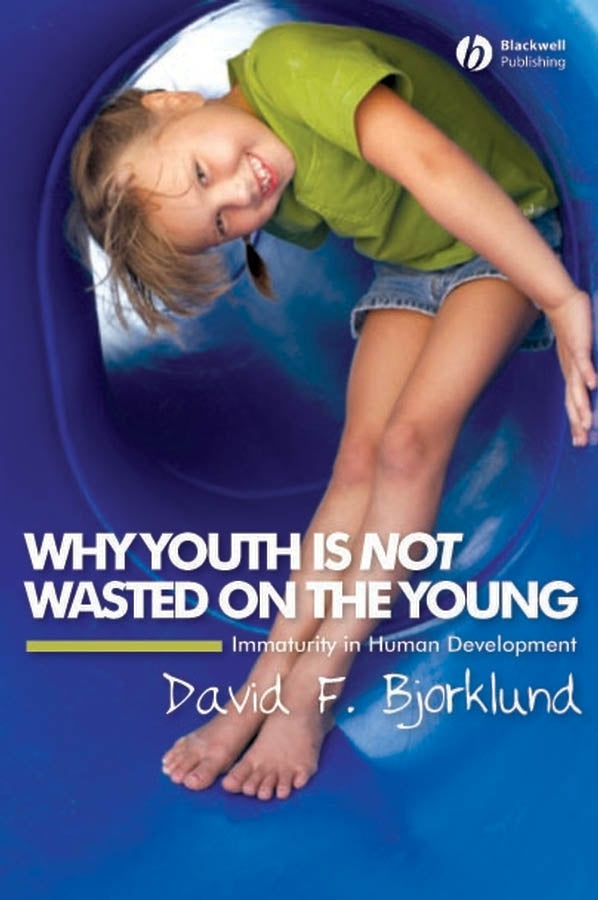
Why Youth is Not Wasted on the Young
Immaturity in Human Development
David F. Bjorklund (Author)
9781405149525, Wiley
Paperback / softback, published 15 March 2007
288 pages
23 x 15.4 x 1.7 cm, 0.426 kg
"What is childhood? What is it for? The usual answer is that the purpose of childhood is to set the stage for bigger things to come. Why Youth is Not Wasted on the Young turns this view on its head. In this clear and beautifully written account of the role of immaturity in human development and evolution, Bjorklund argues that children’s minds are qualitatively different from those of adults. Indeed, children have special ways of learning and knowing that enable unique mastery of skills and invention of knowledge. This book should be required reading for anyone who is struggling with the question of how best to structure their children’s lives in today’s frantic world." "Dave Bjorklund's book is a must read for parents and others who have an interest in kids, families, and schools. Based on current and sound scientific research, Bjorklund explains in very clear and readable, though not simplistic, language the long term importance of childhood qualities, such as play time and being "immature"- qualities that are under siege in many quarters of contemporary society." "In this accessible and provocative work, David Bjorklund argues that childhood is not just a training for adulthood. Rather, it serves important adaptive functions that we need to acknowledge and value." “A lively, insightful analysis of human behavior from a novel, evolutionary standpoint; this is essential reading for anyone seeking to truly understand childhood and today's children.” "David Bjorklund, one of the world’s leading developmental psychologists, has provided us with an intriguing and accessible treatment of some of the most important questions in the behavioral sciences today. Why does it take so long for humans to grow up? And, what is the evolutionary function of children’s activities while they are growing up? The book will be of interest to development scientists and to parents and educators wishing to better understand their children" "In short, the answer to the question of who should read this book is a simple one: anyone who has an interest—personal, professional, or both—in how children develop." PsycCRITIQUES “Bjorklund is a major contributor to the literature on evolutionary approaches to understanding child development. His connections … are original and well supported. Highly recommended.” “That rare sort of science book that will be interesting to researchers as well as to laypeople … . Bjorklund is a beautifully smooth writer.”
Bruce J. Ellis, University of Arizona
Anthony D Pellegrini, University of Minnesota
Michael Rutter, author of "Genes and Behavior"
Glenn Weisfeld, Wayne State University
David C. Geary, University of Missouri
Choice Reviews
American Scientist
Why Youth is Not Wasted on the Young examines the nature of childhood through an evolutionary lens and argues that childhood is an essential stage of development with its own unique purposes, separate from those of adulthood; a time of growth and discovery that should not be rushed.
Preface vii Acknowledgments xi 1 The Benefits of Youth 1 Rushing through Childhood 3 Views of Development 5 A Darwinian Perspective 14 I Come Not to Praise Immaturity 20 2 The Youngest Species 21 A Brief Look at Human Evolution 23 The Evolution of Childhood 36 Timing is Everything 44 The Youngest Species 52 3 The Slow Rate of Growing Up 55 The Gamble of Delayed Development 56 Big Brains, Social Complexity, and Slow Development 58 Cooperating and Competing 62 Family Matters 63 Slow Growth and Brain Plasticity 65 Developmental Plasticity and Evolution 83 When Slow is Fast Enough 84 4 Adapting to the Niche of Childhood 87 The Benefits of Limitations 89 See Things My Way 93 Learning Language 101 How Do Adults View Children’s Immature Thinking? 106 Adapting to Childhood 109 5 The Advantages of Thinking You’re Better than You Are 111 Some Benefits of Less-Than-Perfect Metacognition 128 When We Deal with Children 135 Know Thyself, But Not Too Well 136 6 Play: The Royal Road through Childhood 139 What is Play? 142 The Adaptive Value of Play 144 Children Playing, Children Learning 147 Play it Again, Kid 161 7 The Most Educable of Animals 163 The Myth of “Earlier is Better” 169 Prenatal Learning 172 Early (Postnatal) Learning 176 Developmentally Appropriate Practices in Early Education 182 Stress in the Schoolhouse 189 Old Brain, New Curriculum 197 8 The Changing Face of Childhood 199 Pushing Children through Childhood 201 A Brief History of Childhood 204 The Costs of Ignoring Immaturity: The Well-being of America’s Children 211 The Independent Human Juvenile: A New View of Childhood? 216 Racing to Adulthood, Prolonging Adolescence 218 Epilogue: Homo Juvenalis 221 Revisiting Childhood 222 Visiting Adulthood 223 Notes 227 References 239 Index 267
The Development of Metacognition – Knowing What We Know 113
Subject Areas: Psychology [JM]