Freshly Printed - allow 10 days lead
Couldn't load pickup availability
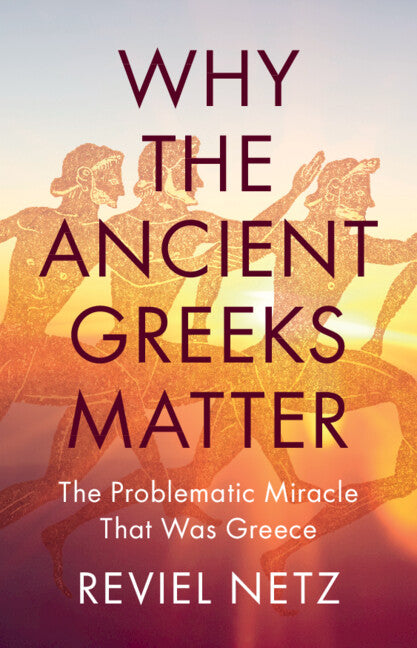
Why the Ancient Greeks Matter
The Problematic Miracle that was Greece
The Greeks were consequential, not by creating 'timeless values' but by questioning them, thereby laying the foundations of modern science.
Reviel Netz (Author)
9781009505598, Cambridge University Press
Hardback, published 6 February 2025
206 pages, 2 b/w illus.
22.2 x 14.9 x 1.6 cm, 0.37 kg
'In Why the Ancient Greeks Matter, Reviel Netz offers a lively and original discussion, interrogating the notions of the 'Greek miracle' and the Greek canon. As always, Netz is erudite, insightful, and engaging. Here he is also intentionally provocative, asking important and timely questions.' Liba Taub, University of Cambridge
The ancient Greeks were exceptional and they were consequential. This innovative, engrossingly written book addresses head-on the problematic question of the Greek Miracle. It will appeal to anyone interested in the ancient world and its modern meaning. Reviel Netz boldly argues that the traditional understanding of the Greek legacy as a store of timeless values is false to the Greek literary canon itself. The latter is in fact made up of contradictory texts, sharing no common core of beliefs. This is precisely, for the author, the canon's significance: by presenting a system of works-in-polemic, it created a template for a culture of open debate, leading all the way down to modern civil society. The most lasting result of this practice of open discourse was in science, where Greek disputations paved the way for an autonomous scientific culture and opened the door both to the scientific revolution and the modern world.
List of Figures and Captions
Acknowledgements
Preface
1. The problematic Greek miracle
2. A less problematic miracle: Greek science
3. A less problematic canon: from the polis of letters to civil society
4. Post-miracle
Bibliography
Index.
Subject Areas: Ancient history: to c 500 CE [HBLA]