Freshly Printed - allow 7 days lead
Couldn't load pickup availability
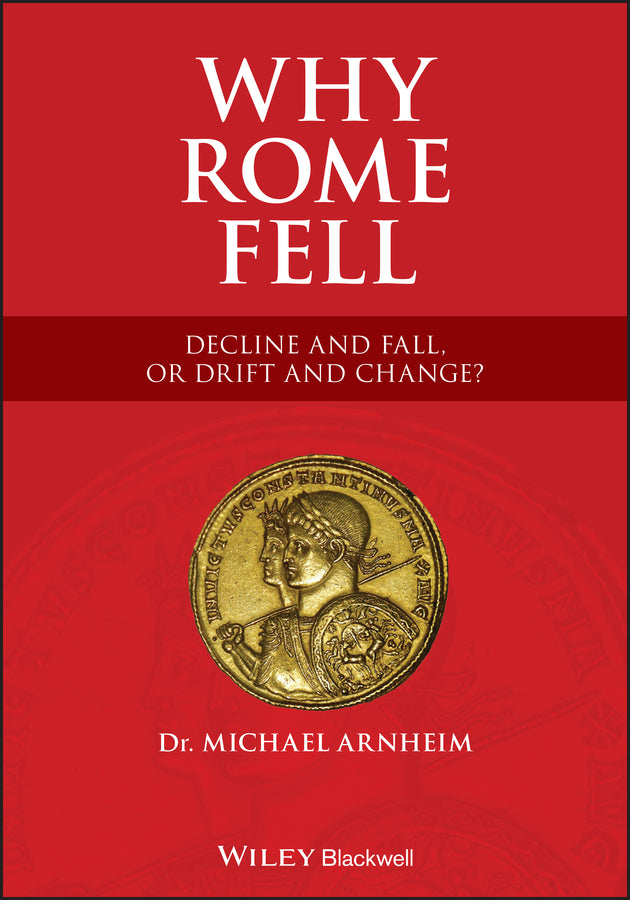
Why Rome Fell
Decline and Fall, or Drift and Change?
Michael Arnheim (Author)
9781119691372, Wiley
Paperback / softback, published 10 March 2022
496 pages
25.2 x 17.8 x 3.3 cm, 0.998 kg
Explore an insightful and original discussion of the causes of the fall of the Roman Empire In Why Rome Fell: Decline and Fall, or Drift and Change?, celebrated scholar of Roman history Dr. Michael Arnheim delivers a fascinating and robust exploration of the causes of and reasons for Rome’s fall in the West. Steeped in applications of elite theory to the later Roman Empire, the author discusses several interconnected issues that influenced the decline of Rome, including monarchy, power structure, social mobility, religion, and the aristocratic ethos. Incisive comparisons of the situation in Rome to those in the Principate and the Byzantine Empire shed light on the relative lack of “indissoluble union and easy obedience” (in Gibbon’s phrase) in the later Roman Empire. Instead, the book reveals the divided loyalties of a fractured society that characterized Rome in its later years. Why Rome Fell also includes: An indispensable resource for students, scholars and the general reader with an inquiring mind about history, Why Rome Fell deserves a place on the bookshelves of anyone with an interest in a sophisticated and original take on historical continuity and change.
About the Author ix Preface xii Introduction 1 Part I: Transition From The Ancient To The Medieval World And Beyond 11 1. Rome: From Monarchy to Monarchy 13 2. Diocletian: Hammer of the Aristocracy 60 3. Constantine the Reformer 83 4. The Christian Empire 118 5. Continuity and Change 149 6. Two Models of Government 197 Part II: Conflicting Theories 261 Prologue to Part II 263 7. Varieties of History 273 8. Gibbon’s The Decline and Fall of the Roman Empire 299 9. The Malaria Hypothesis 308 10. The Role of Religion 315 11. The Pirenne Thesis 344 12. “Late Antiquity” 357 13. Assassination or Accommodation? 379 Part III: Envoi 409 14. Conclusion 411 Glossary 433 List of Primary Sources and Abbreviations 435 Select Bibliography 439 Index 452
Subject Areas: History [HB]