Special Order - allow 2+ weeks lead
Couldn't load pickup availability
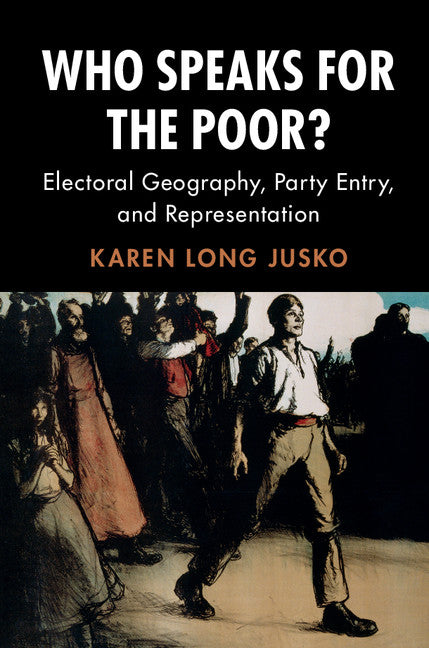
Who Speaks for the Poor?
Electoral Geography, Party Entry, and Representation
Explains cross-national differences in the political and partisan representation of low-income voters, focusing attention on the electoral geography of income.
Karen Long Jusko (Author)
9781108419888, Cambridge University Press
Hardback, published 29 August 2017
216 pages
23.5 x 15.8 x 1.6 cm, 0.44 kg
'Demonstrating how the changing electoral geographies of the late 19th and early 20th centuries created incentives for political entrepreneurs to form and mobilize low-income constituencies, Jusko provides an innovative account of the origins of cross-national differences in the political representation of low-income citizens. Jusko's work provides a new, innovative explanation for the current absence of a low-income party constituency in the US. Highly Recommended.' J. M. Trayhan, Choice
Who Speaks for the Poor? explains why parties represent some groups and not others. This book focuses attention on the electoral geography of income, and how it has changed over time, to account for cross-national differences in the political and partisan representation of low-income voters. Jusko develops a general theory of new party formation that shows how changes in the geographic distribution of groups across electoral districts create opportunities for new parties to enter elections, especially where changes favor groups previously excluded from local partisan networks. Empirical evidence is drawn first from a broadly comparative analysis of all new party entry and then from a series of historical case studies, each focusing on the strategic entry incentives of new low-income peoples' parties. Jusko offers a new explanation for the absence of a low-income people's party in the USA and a more general account of political inequality in contemporary democratic societies.
1. Who speaks for the poor?
2. How electoral geography matters
3. New parties and the changing electoral geography of contemporary democracies, 1880–2000
4. The populists and 'third-party men' in America
5. Canadian electoral geography and the strategic entry of the CCF and social credit
6. The implications of electoral geography for British Labour
7. The Swedish Social Democratic Party, and the long-term implications of electoral reform
8. 'It didn't happen here': the general implications of electoral geography for the political representation of the poor.
Subject Areas: Political economy [KCP], Public administration [JPP], Comparative politics [JPB], Politics & government [JP]