Freshly Printed - allow 10 days lead
Couldn't load pickup availability
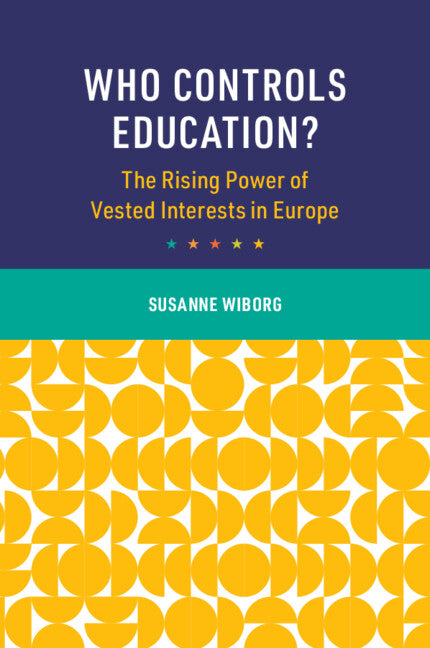
Who Controls Education?
The Rising Power of Vested Interests in Europe
Examines the rise of vested interests in European education and the consequences this has for users of education.
Susanne Wiborg (Author)
9781009581127, Cambridge University Press
Paperback / softback, published 3 April 2025
248 pages
22.9 x 15.2 x 1.4 cm, 0.411 kg
'Susanne Wiborg's analyses provide a fantastic basis for deepening our understanding of the role and strategies of interest groups in the field of education. The analyses support the development of theories on vested interests and provide a basis for all researchers and students with an interest in education policy issues.' Rita Nikolai, Professor for Comparative Education, University of Augsburg, Germany
Why are interest groups on the march in Europe? How do they become so powerful? Why do reformers struggle with plans to overhaul education systems? In Who Controls Education?, Susanne Wiborg investigates the dynamics of educational interest groups across four European countries: England, France, Germany and Sweden, alongside their counterparts in the European Union. She delves into why some groups wield more power than others and how they gain access to policymaking venues to shape education reforms. The book reveals a gap between reformers' intentions and policy outcomes, often attributed to group politics, with significant consequences for education users, historically a weak organisational group. Wiborg shows that addressing the role of vested interest is crucial for creating an education system where all children benefit.
1. Battle for influence: interest group politics in education
2. Getting entrenched: influencing multi-level governance structures, 1960–1980
3. Shifting power: losing power centrally but making gains locally and in the EU, 1980–2000
4. Domination: exercising influence at all levels, 2000–2020
5. Conclusion: controlling education from both the top and the bottom.
Subject Areas: Comparative politics [JPB]