Special Order - allow 2+ weeks lead
Couldn't load pickup availability
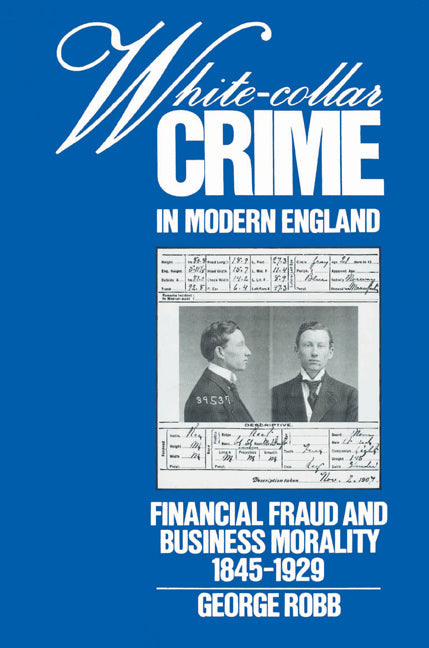
White-Collar Crime in Modern England
Financial Fraud and Business Morality, 1845–1929
A vivid and lucid account of white-collar crime, yielding new insights into modern scandals.
George Robb (Author)
9780521526128, Cambridge University Press
Paperback / softback, published 18 July 2002
264 pages
22.9 x 15.3 x 1.9 cm, 0.427 kg
In the period between the 1840s and the 1920s the British economy was transformed, from small-scale capitalism dominated by individual traders and partnerships to a complex financial structure dominated by large, joint-stock companies. The tremendous growth of big business created a world of new opportunities for criminal exploitation. The promotion and management of public companies and the trading of commercial securities proved vulnerable to the white-collar crimes of fraud and embezzlement. Problems of financial fraud were exacerbated by a climate of laissez-faire which championed the most permissive commercial legislation in the world, and white-collar crime wreaked havoc on the modern British economy. This new book examines the spread of white-collar crime from the Victorian period to the early twentieth century and offers a new perspective on modern scandals.
List of tables
Acknowledgments
Introduction
1. The new economy: transformation of finance and opportunities for crime
2. The railway mania
3. Banking and credit fraud
4. Stock fraud
5. Company fraud: promotion
6. Company fraud: management
7. Company law and the courts
8. Business ethics and professionalization
Conclusion
Notes
Bibliography
Index.
Subject Areas: Early modern history: c 1450/1500 to c 1700 [HBLH], British & Irish history [HBJD1]