Special Order - allow 2+ weeks lead
Couldn't load pickup availability
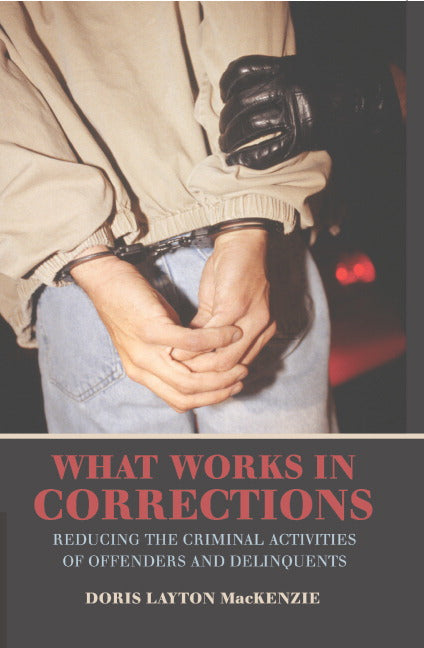
What Works in Corrections
Reducing the Criminal Activities of Offenders and Deliquents
Through her extensive research, in this 2006 book MacKenzie provides an intensive review of correctional interventions and programs.
Doris Layton MacKenzie (Author)
9780521001205, Cambridge University Press
Paperback / softback, published 17 July 2006
404 pages, 31 tables
22.8 x 15.3 x 2.5 cm, 0.55 kg
"Anyone seeking to understand what works in contemporary corrections policy will welcome this scholarly, wide-ranging book and its evidenced-based perspective. I highly recommend it to policymakers, practitioners and academics. The data presented should help us target our scarce resources to those programs most likely to succeed." -Joan Petersilia, Stanford Law School
What Works in Corrections, first published in 2006, examines the impact of correctional interventions, management policies, treatment and rehabilitation programs on the recidivism of offenders and delinquents. The book reviews different strategies for reducing recidivism and describes how the evidence for effectiveness is assessed. Thousands of studies were examined in order to identify those of sufficient scientific rigor to enable conclusions to be drawn about the impact of various interventions, policies and programs on recidivism. Systematic reviews and meta-analyses were performed to further examine these results. This book assesses the relative effectiveness of rehabilitation programs (e.g., education, life skills, employment, cognitive behavioral), treatment for different types of offenders (e.g. sex offenders, batterers, juveniles), management and treatment of drug-involved offenders (e.g., drug courts, therapeutic communities, outpatient drug treatment) and punishment, control and surveillance interventions (boot camps, intensive supervision, electronic monitoring). Through her extensive research, MacKenzie illustrates which of these programs are most effective and why.
Part I. Strategies for Reducing Crime: 1. Strategies for reducing recidivism
2. Assessing the evidence
3. Incapacitation
4. Perspectives on rehabilitation
Part II. The Effectiveness of Rehabilitation Programs: 5. Academic education and life skills training
6. Vocational education, correctional industries and employment programs
7. Cognitive behavioral therapy programs
Part III. Targeting Specific Types of Offenders: 8. Sex offender treatment
9. Juveniles
10. Domestic violence
Part IV. Management and Treatment of Substance Abusers: 11. Drug courts
12. Outpatient and incarceration-based drug treatment
Part V. Control, Discipline and Punishment: 13. Correctional boot camps
14. Intensive supervision and electronic monitoring
Part VI. Conclusions: 15. What works?
Subject Areas: Sociology & anthropology [JH]