Freshly Printed - allow 10 days lead
Couldn't load pickup availability
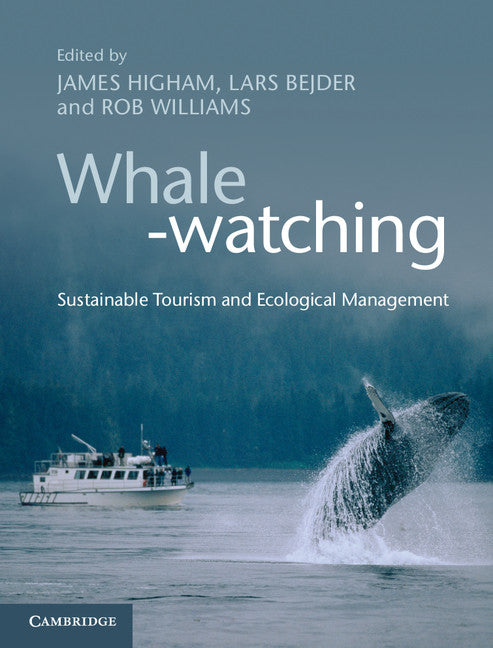
Whale-watching
Sustainable Tourism and Ecological Management
A critical insight into the diverse socio-cultural, political, economic and ecological contexts of the global whale-watching industry.
James Higham (Edited by), Lars Bejder (Edited by), Rob Williams (Edited by)
9780521195973, Cambridge University Press
Hardback, published 27 March 2014
401 pages, 64 b/w illus. 20 colour illus. 24 tables
25.2 x 19.4 x 2.4 cm, 1.06 kg
'This book is a must for a broad spectrum of readers … In 25 chapters, 48 international experts - incorporating diverse perspectives ranging from cetacean researchers to ecotourism and whale-watching captains - bring a new insight on every page … ideally suited to help meld an informed, nuanced opinion.' Michael Stachowitsch, Marine Ecology
Within little more than a generation, whale-watching has been subject to global industrial development. It has been portrayed by destinations and business operators, and advocated by environmental groups, as a sustainable activity and an alternative to whaling. However, in recent years the sustainability of these activities has increasingly been questioned, as research shows that repeated disturbance by boat traffic can severely disrupt critical behaviours of cetaceans in the wild. Bringing together contributions by international experts, this volume addresses complex issues associated with commercial whale-watching, sustainable development and conservation of the global marine environment. It highlights widely expressed concerns for the failure of policy, planning and management and pinpoints both long-standing and emerging barriers to sustainable practice. Featuring numerous case studies, the book provides critical insights into the diverse socio-cultural, political, economic and ecological contexts of this global industry, highlighting the challenges and opportunities that arise along the pathways to sustainability.
List of contributors
Acknowledgements
Introduction
1. Tourism, cetaceans and sustainable development: moving beyond simple binaries and intuitive assumptions James Higham, Lars Bejder and Rob Williams
Part I. The Historical and Contemporary Contexts: 2. Threats facing cetacean populations: the global context Rob Williams
3. From adoration to exploitation: the historical and contemporary contexts of human-cetacean interactions Simon J. Allen
4. Human attitudes and values: tradition versus transformation Peter Corkeron
5. The whale-watch industry: historical development Erich Hoyt and Chris Parsons
6. The International Whaling Commission (IWC) and whale-watching Carole Carlson, Naomi Rose, Hidehiro Kato and Rob Williams
Part II. Human Dimensions of Whale-Watching: 7. The whaling versus whale watching debate: the resumption of Icelandic whaling Marianne Helene Rasmussen
8. Iceland and the resumption of whaling: an empirical study of the attitudes of international tourists and whale-watch tour operators Tommy Andersson, Beatrice Wende and Susanna Gothall
9. Green messengers or nature's spectacle: understanding visitor experiences of wild cetacean tours Heather Zeppel and Sue Muloin
10. Whale-watching: an effective education programme is no fluke Genevieve Johnson and Cynde McInnis
11. What's in it for the whales? Exploring the potential contribution of environmental interpretation to conservation Mark Orams, Paul Forestell and Jonathon Spring
12. Integrating traditional ecological knowledge and community engagement in marine mammal protected areas Naomi McIntosh, Kepā Maly and John N. Kittinger
Part III. Ecological Dimensions of Whale-Watching: 13. Understanding the ecological effects of whale-watching on cetaceans Fredrik Christiansen and David Lusseau
14. Whale-watching and behavioural ecology Rochelle Constantine
15. Energetic linkages between short-term and long-term effects of whale-watching disturbance on cetaceans: an example drawn from northeast Pacific resident killer whales David E. Bain, Rob Williams and Andrew W. Trites
16. Ecological constraints and the propensity for population consequences of whale-watching disturbances David Lusseau
17. The use of area-time closures as a tool to manage cetacean-watch tourism Julian Tyne, Neil Loneragen and Lars Bejder
Part IV. Sustainable Management – Insights and Issues: 18. The socioeconomic, educational and legal aspects of whale-watching: a Scottish case study Chris Parsons
19. Vigilance, resilience and failures of science and management: spinner dolphins and tourism in Hawai'i David W. Johnston
20. A multi-agent model to simulate whale-watching tours: the case of the St Lawrence Estuary in Quebec, Canada Clément Chion, Jacques-André Landry, Lael Parrott, Danielle Marceau, Philippe Lamontagne, Samuel Turgeon, Robert Michaud, Cristiane C. A. Martins, Nadia Ménard, Guy Cantin and Suzan Dionne
21. Cetacean-watching in developing countries: a case study from the Mekong River Isabel Beasley, Lars Bejder and Helene Marsh
22. Whale-watching and community development: the Kaikoura (New Zealand) story David G. Simmons
23. Management of dusky dolphin tourism at Kaikoura (New Zealand) David Lundquist
24. Save the whales part 2: a new science advocacy communication framework Wiebke Finkler
25. Time to rethink: fostering the nascent 'sustainability paradigm' James Higham, Lars Bejder and Rob Williams
Index.
Subject Areas: Pollution & threats to the environment [RNP], Applied ecology [RNC], The environment [RN], Animal ecology [PSVS], Animal behaviour [PSVP], Marine biology [PSPM], Biology, life sciences [PS], Environmental economics [KCN], Anthropology [JHM]