Freshly Printed - allow 7 days lead
Couldn't load pickup availability
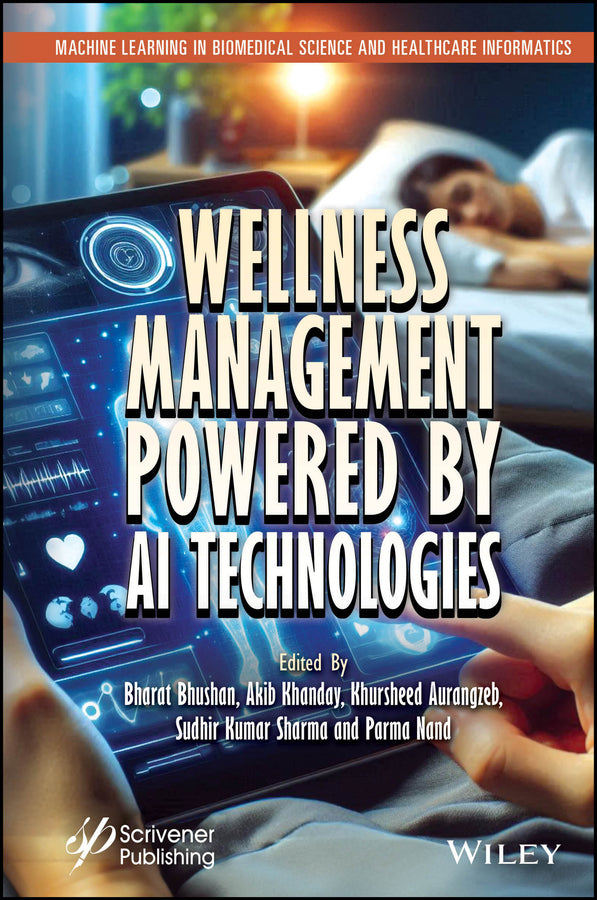
Wellness Management Powered by AI Technologies
B Bhushan (Author)
9781394286997, Wiley
Hardback, published 17 January 2025
448 pages
22.9 x 15.2 x 2.7 cm, 0.7 kg
This book is an essential resource on the impact of AI in medical systems, helping readers stay ahead in the modern era with cutting-edge solutions, knowledge, and real-world case studies. Wellness Management Powered by AI Technologies explores the intricate ways machine learning and the Internet of Things (IoT) have been woven into the fabric of healthcare solutions. From smart wearable devices tracking vital signs in real time to ML-driven diagnostic tools providing accurate predictions, readers will gain insights into how these technologies continually reshape healthcare. The book begins by examining the fundamental principles of machine learning and IoT, providing readers with a solid understanding of the underlying concepts. Through clear and concise explanations, readers will grasp the complexities of the algorithms that power predictive analytics, disease detection, and personalized treatment recommendations. In parallel, they will uncover the role of IoT devices in collecting data that fuels these intelligent systems, bridging the gap between patients and practitioners. In the following chapters, readers will delve into real-world case studies and success stories that illustrate the tangible benefits of this dynamic duo. This book is not merely a technical exposition; it serves as a roadmap for healthcare professionals and anyone invested in the future of healthcare. Readers will find the book: Audience
This book is a valuable resource for researchers, industry professionals, and engineers from diverse fields such as computer science, artificial intelligence, electronics and electrical engineering, healthcare management, and policymakers.
Preface xv 1 Exploring Functional Modules Using Co-Clustering of Protein Interaction Networks 1 1.1 Introduction 2 1.2 Related Works 4 1.3 Basic Terminologies 9 1.3.1 Scientific Terms Used 10 1.4 Existing Methods 12 1.4.1 Binary Co-Clustering Approaches 13 1.4.1.1 Binary Inclusion-Maximal Algorithm 13 1.4.1.2 xMotif Algorithm 14 1.5 About Dataset 15 1.5.1 Protein Interaction Networks 15 1.5.1.1 STRING Repository 16 1.5.2 Protein Complex Dataset 17 1.5.2.1 CORUM Database 17 1.6 Experimental Environment 18 1.6.1 MapReduce Framework 18 1.7 Validation Measures 19 1.7.1 Match Score Measure 19 1.7.2 Functional Coherence 20 1.8 Biological Significances 21 1.9 Proposed Co-Clustering Approach: MR-CoC 22 1.9.1 SCoC for Non-Symmetric Matrix 22 1.9.1.1 Toy Example: SCoCnsym 22 1.9.1.2 Synthetic Dataset Description 24 1.9.1.3 Experimental Analysis: SCoC nsym 25 1.9.2 Randomized SCoC 27 1.9.2.1 Synthetic Dataset Description 30 1.9.2.2 Experimental Analysis: SCoC rand 31 1.9.3 SCoC with MapReduce (MR-CoC) 34 1.9.3.1 Synthetic Dataset Description 36 1.9.3.2 Experimental Analysis: MR-CoC 37 1.10 Functional Module Mining Using MR-CoC 39 1.11 Conclusion 49 Appendix 50 References 51 2 Natural Language Processing in Healthcare: Enhancing Wellbeing through a COVID-19 Case Study 55 2.1 Introduction 56 2.2 NLP Approaches 57 2.3 NLP Pipeline for Smart Healthcare 59 2.3.1 Preprocessing 60 2.3.2 Feature Extraction 60 2.3.3 Classification 60 2.3.4 Model Interpretability 61 2.4 Applications of NLP in Healthcare 61 2.4.1 Clinical Records 61 2.4.2 Information Extraction 62 2.4.3 Decision Support 63 2.4.4 Health Assistance 63 2.4.5 Opinion Mining 64 2.5 COVID Detection Using NLP 65 2.5.1 Data Collection 66 2.5.2 Preprocessing 67 2.5.3 Feature Engineering 67 2.5.4 Classification 68 2.5.5 Ensemble Classification 69 2.6 Results and Discussion 70 2.6.1 Traditional Machine Learning 70 2.6.2 Ensemble Machine Learning 71 2.7 Conclusion 72 References 72 3 Artificial Intelligence Assisted Internet of Medical Things (AIoMTs) in Sustainable Healthcare Ecosystem 75 3.1 Introduction 76 3.1.1 Key Contributions of the Chapter 78 3.1.2 Chapter Organization 79 3.2 Medical Wearable Electronics 79 3.2.1 Electronic Sensor Traits 79 3.2.2 Disposable Health Sensors 80 3.2.3 Ingestible Sensors 80 3.2.4 Patch Sensors 80 3.2.5 Connected Health Sensors 80 3.2.6 Wearables 80 3.2.7 Smart Clothing 81 3.2.8 Implantable Sensors 81 3.3 Electronic Signals in Sensors 82 3.3.1 Gait Analysis 82 3.3.2 Photoplethysmography 82 3.3.3 Electromyography 83 3.3.4 Auscultation 83 3.4 Electronic Devices Challenges in the AIoMT 84 3.4.1 Data Security Threats 85 3.4.2 Data Interoperability 86 3.4.3 Regulatory Challenges 86 3.4.4 High Infrastructure Costs 86 3.4.5 Standardization Challenges 87 3.4.6 Cybersecurity 87 3.4.7 Device Mobility 87 3.4.8 Adoption Scale 88 3.4.9 Advanced Analytics 88 3.4.10 Trust Maintenance 89 3.4.11 Data Security 89 3.4.12 Licensing Challenge 89 3.5 AIoMT Benefits 89 3.5.1 Medical Diagnosis 89 3.5.2 Medical Treatment 90 3.5.3 Patient Empowerment 90 3.5.4 Reduction in Medical Costs 90 3.5.5 Reduction in Human Error 91 3.6 AIoMTs Challenges 91 3.6.1 Privacy Concerns 91 3.6.2 Missteps and Errors 91 3.6.3 Data Management and Power Issues 92 3.6.4 Bias 92 3.7 AIoMT Limitations 93 3.8 Future Research Direction 93 3.9 Conclusions and Future Scope 94 References 95 4 An Online Platform for Timely Access to Medical Care with the Help of Real-Time Data Analysis 103 4.1 Introduction 104 4.1.1 Research Questions 104 4.1.2 Inspiration Drawn 105 4.1.3 Limitations 105 4.1.4 Importance of Machine Learning in this Research Work 105 4.2 What Happened 105 4.3 Literature Review 108 4.4 Methodology 115 4.4.1 Dataset Collection 117 4.4.2 Data Preprocessing 117 4.4.3 Model Building 118 4.4.4 Clustering Algorithm 118 4.4.5 A* Algorithm 120 4.5 Hardware Component 122 4.5.1 Blockchain in Health Care 124 4.6 Conclusion 126 4.7 Future Work 127 References 127 5 A Comprehensive Review of Cardiac Image Analysis for Precise Heart Disease Diagnosis Using Deep Learning Techniques 133 5.1 Introduction and Major Contribution 134 5.2 Literature Review 135 5.3 Machine Learning Methods 137 5.4 Proposed System 138 5.4.1 Dataset 138 5.4.2 Preprocessing 139 5.4.3 Network Architecture 139 5.5 Mathematical Model 141 5.6 Data Preparation 143 5.7 Model Training and Evaluation 145 5.8 Results and Discussion 146 5.9 Conclusion and Future Work 152 References 152 6 A Hybrid Machine Learning Model for an Efficient Detection of Liver Inflammation 157 Abbreviations 158 6.1 Introduction 158 6.1.1 Novelty of Detection of NAFLD Using Conglomeration of Machine Learning Techniques 159 6.2 Machine Learning for Liver Disease Prediction 160 6.2.1 Data Collection and Pre-Processing 160 6.2.2 Feature Selection 160 6.2.3 Modeling with Algorithms 161 6.2.4 Evaluating the Models 161 6.3 Related Works 162 6.3.1 Method 162 6.3.2 Detecting Liver Inflammation with Random Forest Classifier 163 6.4 Experimental Analysis 165 6.5 Result Evaluation 169 6.6 Conclusion 170 6.7 Enhancement of PCA Over Other Dimensionality Reductions 170 References 170 7 Advancements in Parkinson’s Disease Diagnosis through Automated Speech Analysis 173 7.1 Introduction 174 7.1.1 Overview 174 7.1.2 Traditional Diagnostic Methods 176 7.1.3 Emergence of Automated Speech Analysis 176 7.1.4 Major Contributions of the Work 176 7.2 Speech Characteristics in Parkinson’s Disease 177 7.2.1 Speech-Related Difficulties 178 7.2.2 Specific Speech Features 178 7.3 Technological Advances in Speech Analysis 179 7.3.1 Digital Signal Processing 179 7.3.2 Machine Learning and Artificial Intelligence 179 7.4 Integration of Multimodal Data 180 7.4.1 Complementary Modalities 180 7.4.2 Improved Diagnostic Precision 181 7.5 Related Works 182 7.6 Building a Machine Learning (ML) Model 184 7.6.1 Dataset Description 184 7.6.2 Preprocessing 187 7.6.3 Feature Extraction 187 7.6.4 Classification 189 7.7 Experimental Analysis and Performance Measures 195 7.7.1 Evaluating Classifiers 197 7.7.2 Tuning Hyperparameters 198 7.8 Future Directions 200 7.8.1 Advancements in Technology 200 7.8.2 Personalized Medicine 200 7.9 Challenges and Limitations 201 7.9.1 Influencing Factors 201 7.9.2 Ethical Considerations 201 7.9.3 Standardization and Validation 202 7.10 Conclusion and Implications 202 7.10.1 Implications for Clinical Practice 203 References 203 8 Public Opinion Segmentation on COVID-19 Vaccination and Its Impact on Wellbeing 207 8.1 Introduction 207 8.2 Background and Related Work 208 8.3 Machine Learning Techniques 212 8.3.1 Logistic Regression 213 8.3.2 Multinomial Naïve Bayes 213 8.3.3 Support Vector Machine (SVM) 215 8.3.4 Decision Trees 216 8.4 Ensemble Machine Learning Algorithms 217 8.4.1 Bagging 217 8.4.2 AdaBoost 217 8.4.3 Random Forest Classifier 217 8.4.4 Stochastic Gradient Boosting 218 8.5 Methodology 218 8.5.1 Data Collection 218 8.5.2 Data Preprocessing 219 8.5.3 Feature Engineering 221 8.5.4 Classification 222 8.6 Results and Discussion 223 8.7 Impact on Wellbeing 226 8.8 Conclusion 227 References 227 9 Revolutionizing Healthcare with IoT in Cardiology 231 9.1 Introduction 232 9.1.1 Characteristics of IoT 233 9.1.2 Healthcare 234 9.1.3 Components of Healthcare 236 9.1.4 The Role of IoT in Healthcare 237 9.1.4.1 Remote Monitoring and Management 237 9.1.4.2 Personalized Healthcare 237 9.1.4.3 Enhancing Hospital Efficiency and Patient Experience 237 9.1.4.4 Telemedicine and Remote Consultations 238 9.1.4.5 Improving Emergency Responses 238 9.1.4.6 Drug Management and Supply Chain Optimization 238 9.2 Background 239 9.3 Motivation 240 9.3.1 Access to Healthcare 240 9.3.2 Cost and Affordability 241 9.3.3 Quality of Care 241 9.3.4 Aging Population and Chronic Diseases 241 9.3.5 Healthcare Infrastructure 241 9.3.6 Healthcare Technology and Innovation 242 9.3.7 Global Health Threats 242 9.3.8 Mental Health 242 9.4 Primary Diseases Globally 243 9.5 IoT Revolutionizes Healthcare 244 9.6 IoT Patient Monitoring Devices and Early Detection of Heart-Related Problems 248 9.7 An IoT-Based Heart Disease Monitoring System 254 9.7.1 Photoplethysmography 256 9.7.2 Software Requirements 259 9.7.3 Hardware Prerequisite 261 9.8 Conclusions 267 References 267 10 Human Biological Analysis Through Fitness Watch Using Deep Learning Algorithm 275 10.1 Introduction 276 10.2 Literature Survey 278 10.3 Methodology 282 10.4 Results and Discussion 287 10.5 Limitation of the Work 290 10.6 Validation and Comparative Analysis 291 10.7 Conclusion 292 References 293 11 Decoding Kidney Health: Effectiveness of Machine Learning Techniques in Diagnosis of Chronic Kidney Disease 297 11.1 Introduction 298 11.2 Methods 299 11.2.1 Data and Features 299 11.2.2 Preprocessing 300 11.3 Methodology 301 11.3.1 Logistic Regression 302 11.3.2 Random Forest 302 11.3.3 Knn 302 11.3.4 Support Vector Machine (SVM) 303 11.3.5 Decision Tree 304 11.3.6 Adjusting Hyperparameters 304 11.3.7 Boosting Algorithm 305 11.4 Results and Discussion 305 11.4.1 Discussion 307 11.5 Conclusion 309 References 309 12 Integrating Metaheuristics and Machine Learning for Wellbeing Management: Case of COVID-19 313 12.1 Introduction 314 12.2 Related Work 315 12.2.1 Modeling Non-Pharmaceutical COVID- 19 Responses Cross Sectors 315 12.2.2 Modeling COVID-19 Responses for Schools’ Management 316 12.2.3 Modeling the Impact of Vaccines in Curbing the Outbreak 317 12.3 Background Knowledge 317 12.3.1 Machine Learning Techniques 318 12.3.2 Deep Learning 318 12.3.3 Genetic Algorithms 319 12.4 Methodology 320 12.4.1 Data Preparation 321 12.4.2 Feature Engineering 322 12.4.3 Model Selection 322 12.5 Results and Discussions 325 12.5.1 Model Validation 325 12.6 Conclusion 337 References 337 13 Fusing Sentiment Analysis with Hybrid Collaborative Algorithms for Enhanced Recommender Systems 343 13.1 Introduction 344 13.1.1 Analysis of Sentiment 346 13.1.2 Collaboration Filtering 348 13.1.2.1 HCF-Based Recommender System 349 13.2 Literature Survey 350 13.3 Comparative Result Study 358 13.4 Conclusion and Future Scope 359 References 360 14 The Future of Well-Being: AI-Powered Health Management with Privacy at its Core 363 14.1 Introduction 364 14.1.1 Challenges in Traditional Wellness Management 365 14.1.2 AI Accelerators: A Game-Changer 366 14.1.3 The Privacy Revolution of Federated Learning 367 14.1.4 Objectives 368 14.1.5 Contributions 369 14.2 Related Works 370 14.3 Proposed Work 375 14.3.1 Secure Data Access with Federated Identity 375 14.3.2 Blockchain-Powered Data Sharing: Revolutionizing Patient Data Management 380 14.3.3 AI-Powered Analytics for Personalized Care 384 14.3.4 Privacy-Preserving AI Through Federated Learning 386 14.4 Performance Evaluation 390 14.4.1 Model Accuracy 391 14.4.2 Privacy Preservation 391 14.4.3 Metrics Comparison Across Systems 396 14.5 Conclusion and Future Work 398 References 399 15 Artificial Pancreas: Enhancing Glucose Control and Overall Well-Being 403 15.1 Introduction 404 15.1.1 Glucose Monitoring 405 15.1.2 Insulin Pumps 408 15.2 Closed-Loop Diabetes Control System 409 15.3 Testing and Regulatory Approvals 411 15.4 Safety Requirements in the Design of Artificial Pancreas 413 15.4.1 General Safety Requirements 413 15.4.2 Sensor Disturbance 413 15.4.3 Insulin Pumps 414 15.4.4 Control Algorithm 414 15.4.5 Software/Network Vulnerabilities 415 15.4.6 Profusion Site 415 15.4.7 Meal and Other Disturbances 415 15.4.8 Insulin Sensitivity 416 Conclusion 417 References 417 Index 421
R. Gowri and R. Rathipriya
Akib Mohi Ud Din Khanday, Salah Bouktif and Ali Ouni
Wasswa Shafik
Pancham Singh and Mrignainy Kansal
Anuj Gupta, Vikas Kumar and Aryan Nakhale
Hema Ramachandran and Syedakbar Syed Yusuff
P. Deepa, Rashmita Khilar and Saumendra Kumar Mohapatra
Akib Mohi Ud Din Khanday, Salah Bouktif and K. Nimmi
Aafreen Jan, K. Nimmi and Mohd Anas Wajid
Nilesh Bhaskarrao Bahadure, Ramdas Khomane, Anjali Singh, Anisha Jaiswal, Rashmi Kadu, Rohini Bharne, Bhumika Kosarkar and Sidheswar Routray
Suhail Rashid Wani, Syed Naseer Ahmad Shah, Roshni Afshan and Asif Adil
Safea Matar Al Senani and Salah Bouktif
Anindya Nag, Md. Mehedi Hassan, Mohammad Abu Tareq Rony, Biva Das, Riya Sil, Prianka Saha, Pronab Sarker and Anupam Kumar Bairagi
D. Dhinakaran, S. Edwin Raja, J. Jeno Jasmine, P. Vimal Kumar and R. Ramani
Owais Bhat, Syed Tanzeel Rabani, Syed Mohsin Saif, Zubair Jeelani and Nawaz Ali Lone
Subject Areas: Clinical & internal medicine [MJ]