Freshly Printed - allow 7 days lead
Couldn't load pickup availability
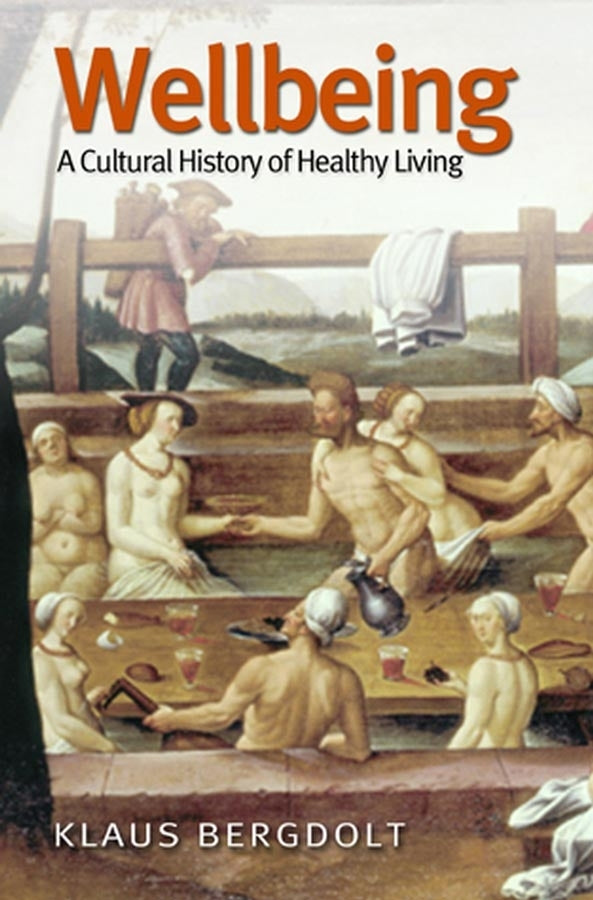
Wellbeing
A Cultural History of Healthy Living
Klaus Bergdolt (Author)
9780745629148, Polity Press
Paperback / softback, published 23 April 2008
416 pages
22.9 x 15.2 x 2.9 cm, 0.562 kg
"A fascinating and nearly exhaustive overview of the traditional concepts of hygiene and dietetics from ancient times through to the nineteenth century." "The thematic and chronological scope of Wellbeing is ambitious; yet it is surprisingly readable, a testament to both its author and translator. The arrangement of chapters, clear index and thoughtful introduction draw in the reader and the comprehensive referencing provides a wealth of additional material without interrupting the flow of the text." "In this scholarly, authoritative, and well-referenced monograph, Bergdolt presents the chronological development of many aspects related to well-being, including diet, cleanliness, exercise/sport, spirituality, and psychology, as well as healing (by useful and dubious means) ... Highly recommended for lower-level undergraduates and above and general readers." "Klaus Bergoldt's masterly contribution to the bibliography of health has been a long time coming, but is no less welcome for that ... Bergdolt has achieved a heroic internal synthesis of the health genre." "This book is ... absolutely central to what traditionally constituted the mainstream of medicine, and Bergdolt handles his subject matter with clarity, skill and erudition."
Social History of Medicine
History
Choice
Medical History
Roy Porter
This authoritative new book offers a panoramic overview on health and healthy living from classical Antiquity through to the mid-nineteenth century, when scientific medicine began to gain ascendancy. Klaus Bergdolt offers the reader a lively and well exemplified account of the numerous historical manifestations of dietetics showing that despite the diversity of notions of healthy and ill', directions on healthy living remain surprisingly constant throughout the centuries. Notwithstanding his admiration for the achievements of modern medicine, Bergdolt regrets that the simplest dietetic principles such as moderation, as well as the notion of individual responsibility for ones own health, are increasingly neglected, and that the old health precepts are frequently divorced from modern medicine. However, some circumstances, including economic constraints, speak in favour of a better balance between scientific medicine and traditional teachings on healthy living.
Introduction 1 Prologue: The Ancient Advanced Civilizations – Egypt, Mesopotamia, Persia 7 1 Greece 14 The ideal of health in ancient Greece 14 The Presocratics 19 The Hippocratic corpus 24 Diocles of Carystus, a fourth-century health pedagogue 30 ‘Knidic’ dietetics 33 Health in Plato and Aristotle 37 Dietetics in Alexandria 44 Cures and miracles, Aesculapius and Hygieia 46 Public health care and sport 53 Early Stoics and Cynics 56 2 Rome 62 People and literati: dietetics in ancient Rome 62 New doctors, new theories 73 Sport and baths 77 The sacred tales of Publius Aelius Aristides 79 The Roman Stoics: Plutarch, Seneca, Marcus Aurelius, Epictetus 82 Galen 87 3 Jewish and Early Christian Traditions 94 Jewish doctrines of health 94 Christus medicus 98 Early Christian doctrines of health 103 4 Medieval Traditions in the East and West 109 Jealing and health in early monasticism 109 The first German pharmacopoeia 113 Dietetics in Islam 116 Medieval doctrines of health in the West 124 Asceticism and mysticism – feasts and beauty care 131 Western and Eastern clerical scholars: Maimonides, Petrus, Hispanus, Roger Bacon 137 Hildegard of Bingen 146 Saints and miracle workers 149 The power of the stars 154 5 Doctrines of Health in the Renaissance 158 Petrarch’s conception of health 158 Alberti and other intellectuals around 1500 161 House books and manuals – health and literature 168 Further humanists – Platina, More, Luther 173 Philosophy of health and prophylaxis in Venice – Mercuriale, Rangone, Cornaro 179 Gabriele Zerbi and the Gerontocomia 185 Paracelsus’ teachings on health 187 Herbal books 191 Dietetics in daily life 194 6 Dietetics in the Seventeenth Century 199 Cartesianism and conservative tendencies 199 Van Helmont, Sylvius and other ‘iatrochemists’ 208 Doctrines of health in England – the dietetics of the state 210 Health through planning – the utopias 216 The dietetics of the Enlightenment – philosophers, pedagogues, charlatans 220 7 Doctrines of Health in the Eighteenth Century 226 Medical theories of health 226 The French Enlightenment and Rousseau 233 Tissot, Triller, Mai: health education at grassroots 239 Public health care 247 8 Around 1800 251 The notion of ‘Lebenskraft’ (vital force) – Hufeland and Kant 251 The recurrent topic of a dietetic regime for intellectuals 255 Alternative paths to health 258 Goethe 263 Romantic medicine – Schelling, Carus, Novalis 266 9 The Nineteenth Century 274 Trends in the nineteenth century 274 Rudolf Virchow and the dietetics of reason 276 Nietzsche, Schopenhauer and the philosophical critique of positivism 280 The revolution in nutrition and alternative paths to health 283 Afterword 287 Notes 289 References 327 Index 348
Subject Areas: History [HB]