Freshly Printed - allow 7 days lead
Couldn't load pickup availability
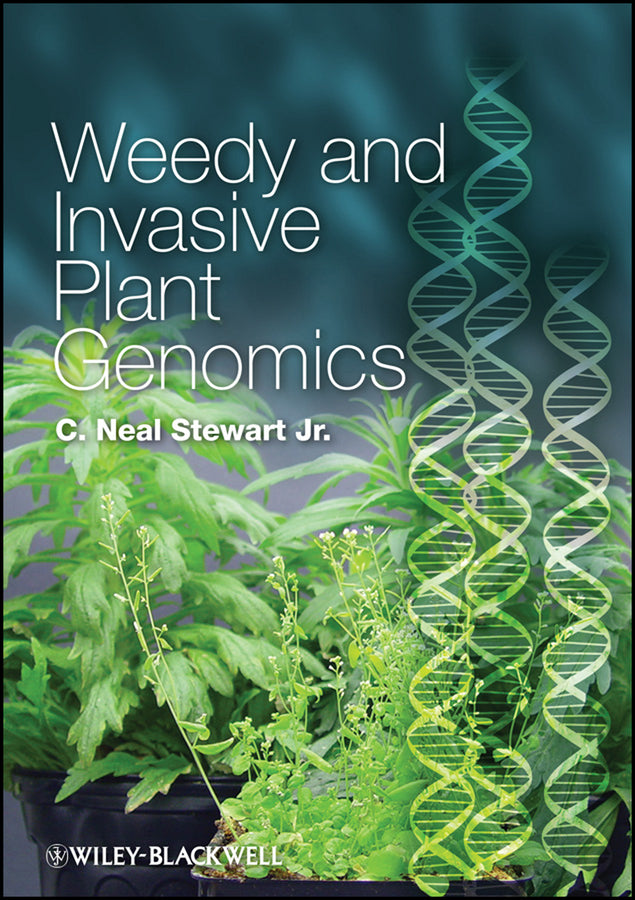
Weedy and Invasive Plant Genomics
C. Neal Stewart, Jr. (Author)
9780813822884, Wiley
Hardback, published 28 August 2009
272 pages
25.2 x 17.8 x 2.1 cm, 0.744 kg
Weedy and Invasive Plant Genomics offers a comprehensive, up-to-date reference on genetic and genomics research in weedy and invasive plants. Forward-looking in its approach, the work also assesses the areas of future research necessary to defeat these agricultural pests. This research-based, scholarly work engenders a further understanding of weeds and invasive plants, opening avenues for developing more effective methods of managing them. This volume will be a necessary reference for weed scientists, agrochemical industry researchers, conservation geneticist, and plant biologists.
Contributors xi Preface xv Chapter 1 Why Should Weed Scientists Care About Genomics? 3 Genomics To A Weed Scientist 3 Resistance 4 Better Use Of Existing Herbicides 8 Chapter 2 An Introduction To Molecular Genetic And Genomic Techniques 11 Weeds As A Source Of Genes For Crop Improvement 11 Tools And Approaches For Understanding Weediness At The Molecular Level 12 Chapter 3 Arabidopsis Is Not A Weed, And Mostly Not A Good Model For Weed Genomics; There Is No Good Model For Weed Genomics 25 Introduction: Arabidopsis And Weediness 25 Questions About Weeds—Can Arabidopsis Genomics Answer Them? 27 The Misdirected Approach In Using Arabidopsis To Elucidate New Herbicide Targets 28 Arabidopsis Genomics Can Help In Dealing With Transgene Flow—In A Limited Manner 29 Lessons To Be Learned 30 Chapter 4 Model Weeds For Genomics Research 33 What Makes A Good Model Species? 34 Leveraging From Other Models 36 Genomics Tools For Weeds That Are Under Development 44 Chapter 5 21st-Century Weed Science: A Call For Amaranthus Genomics 53 The Amaranthus Genus 53 Hybridization And Adaptive Evolution 61 Herbicide Resistance 64 Currently Available Genomic Resources 71 Needs And Opportunities 75 Chapter 6 Evolutionary Genomics Of Weedy Rice 83 Phenotypic Diversity Of Weedy Rice 84 Genomic Diversity Of Weedy Rice 85 The Origin(s) And Evolution Of Weedy Rice 89 The Genetic Basis Of Weediness And Use Of Weedy Rice In Crop Breeding 94 Chapter 7 Rhizomatousness: Genes Important For A Weediness Syndrome 99 Developmental Context 100 An Exemplary Case: Johnsongrass 101 Dissecting The Genetic Control Of Rhizomatousness 103 Early Insights Into The Sorghum Rhizo-Transcriptome 105 Future Work And Potential Applications 107 Synthesis 109 Chapter 8 Leafy Spurge: An Emerging Model To Study Traits Of Perennial Weeds 113 Regulation Of Shoot Development And Growth 113 Regulation Of Bud Dormancy 116 Case Study: Leafy Spurge 117 Future Work 122 Chapter 9 Herbicide Resistance: Target Site Mutations 127 Resistance To Photosystem II-Inhibiting Herbicides 128 Resistance To Acetohydroxyacid Synthase-Inhibiting Herbicides 131 Resistance To Acetyl Coenzyme A Carboxylase-Inhibiting Herbicides 136 Resistance To Glyphosate 138 Resistance To Microtubule Assembly Inhibitors 140 Resistance To Phytoene Desaturase Inhibitors 141 Chapter 10 Molecular and Genomic Mechanisms Of Non-Target-Site Herbicide Resistance 149 Herbicide Application And Resistance 149 Herbicide Classification And Resistance 150 Non-Target Herbicide Resistance 150 Signal Transduction 150 Detoxification and Modification 151 Chapter 11 A Herbicide Defense Trait That Is Distinct From Resistance: The Evolutionary Ecology And Genomics Of Herbicide Tolerance 163 Resistance Versus Tolerance In Weed Science 163 Tolerance In Evolutionary Ecology 166 Tolerance Traits And The Genomics Of Tolerance 171 Why Again Should We Focus On Tolerance, Tolerance Traits, And The Genomics Of Tolerance? 172 Chapter 12 The Genomics of Plant Invasion: A Case Study In Spotted Knapweed 177 Why Study Invasive Plant Genomics? 177 Spotted Knapweed Life History 178 Allelopathy And The Novel Weapons Hypothesis 180 Genomics Resources And Approaches For Studying Spotted Knapweed 185 Chapter 13 Molecular Ecology Of Plant Competition 197 Competition Signals And Their Perception By Plants 198 Molecular Basis Of Competitively Important Traits 207 Transcriptomic Insights Into Competitive Interactions Of Weedy Plants 211 Chapter 14 Genomics And Weeds: A Synthesis 221 From Fundamental Information To Practical Solutions 222 Where Do We Go From Here? 241 Index 249
WILLIAM K. VENCILL
CHHANDAK BASU AND SAM R. ZWENGER
JONATHAN GRESSEL
WUN S. CHAO AND DAVID P. HORVATH
PATRICK J. TRANEL AND FEDERICO TRUCCO
BRIANA L. GROSS AND KENNETH M. OLSEN
ANDREW H. PATERSON
DAVID P. HORVATH AND JAMES V. ANDERSON
CHRISTOPHER PRESTON
JUN HU, PATRICK J. TRANEL, C. NEAL STEWART JR., AND JOSHUA S. YUAN
REGINA S. BAUCOM
AMANDA K. BROZ AND JORGE M. VIVANCO
DOMINIK D. SCHMIDT, MERIJN R. KANT, AND IAN T. BALDWIN
STEPHEN O. DUKE, SCOTT R. BAERSON, AND JONATHAN GRESSEL
Subject Areas: Biology, life sciences [PS]