Freshly Printed - allow 6 days lead
Couldn't load pickup availability
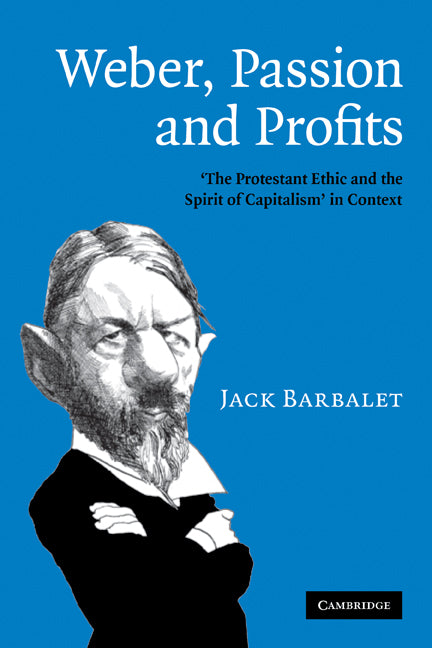
Weber, Passion and Profits
'The Protestant Ethic and the Spirit of Capitalism' in Context
A fresh vision of Max Weber's most renowned work, The Protestant Ethic and the Spirit of Capitalism.
Jack Barbalet (Author)
9780521895095, Cambridge University Press
Hardback, published 10 July 2008
264 pages
23.4 x 15.8 x 2.2 cm, 0.56 kg
Review of the hardback: 'Jack Barbalet's reading of Max Weber's sociology of religious asceticism extracts a new richness from these classical texts and restores to modern sociology a discourse – passion, virtue and calling – which we have unfortunately lost. More than simply an interpretation of Weber's work on the Protestant sects, Barbalet situates his appreciation of Weber within the broader context of theories of the market, the missing work on Roman Catholicism and anti-Semitism. Weber, Passions and Profits, building on his earlier work on emotions, is not only a work of immense scholarship but also a work of passion.' Bryan S. Turner, Editor of the Cambridge Dictionary of Sociology (2006)
Max Weber's The Protestant Ethic and the Spirit of Capitalism is one of the best-known and most enduring texts of classical sociology, continually inspirational and widely read by both scholars and students. In an insightful interpretation, Jack Barbalet discloses that Weber's work is not simply about the cultural origins of capitalism but an allegory concerning the Germany of his day. Situating The Protestant Ethic in the development of Weber's prior and subsequent writing, Barbalet traces changes in his understanding of key concepts including 'calling' and 'rationality'. In a close analysis of the ethical underpinnings of the capitalist spirit and of the institutional structure of capitalism, Barbalet identifies continuities between Weber and the eighteenth-century founder of economic science, Adam Smith, as well as Weber's contemporary, the American firebrand Thorstein Veblen. Finally, by considering Weber's investigation of Judaism and capitalism, important aspects of his account of Protestantism and capitalism are revealed.
Introduction
1. From the inaugural lecture to the Protestant ethic: political education and German futures
2. From the Protestant ethic to the vocation lectures: Beruf, rationality and emotion
3. Passions and profits: the emotional origins of capitalism in seventeenth-century England
4. Protestant virtues and deferred gratification: Max Weber and Adam Smith on the spirit of capitalism
5. Ideal type, institutional and evolutionary analyses of the origins of capitalism: Max Weber and Thorstein Veblen
6. The Jewish question: religious doctrine and sociological method
Conclusion.
Subject Areas: Economic history [KCZ], Social theory [JHBA], History of ideas [JFCX]