Freshly Printed - allow 10 days lead
Couldn't load pickup availability
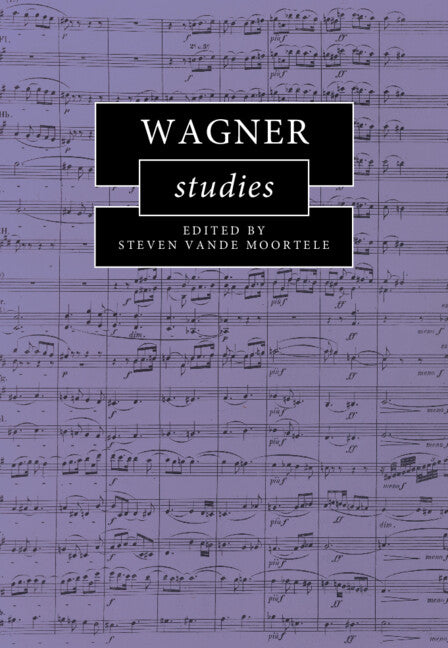
Wagner Studies
Captures the breadth of analytical Wagner research today, expanding its reach and challenging it to break new interpretative and methodological ground.
Steven Vande Moortele (Edited by)
9781108837064, Cambridge University Press
Hardback, published 24 April 2025
259 pages
25 x 17.8 x 2 cm, 0.62 kg
While the music of Richard Wagner has long served as a touchstone for music-theoretical and analytical models both old and new, music analysts have often been intimidated by the complexity of his works, their multi-layeredness, and their sheer unwieldiness. This volume brings together ten contributions from an international roster of leading Wagner scholars of our time, all of which engage in some way with analytical or theoretical questions posed by Wagner's music. Addressing the operas and music dramas from Die Feen through Parsifal, they combine analytical methods including form-functional theory, Neo-Riemannian theory, Leitmotiv analysis, and history of theory with approaches to dramaturgy, hermeneutics, reception history, and discursive analysis of sexuality and ideology. Collectively, they capture the breadth of analytical studies of Wagner in contemporary scholarship and expand the reach of the field by challenging it to break new interpretative and methodological ground.
List of figures
List of tables
List of music examples
List of contributors
Introduction: analyzing Wagner Steven Vande Moortele: Part I Orientations: 1. 'Wo sind wir?': Tristan Disorientations Arnold Whittall
2. Bottoming for Wagner: listening, analysis and (gay-male) subjectivity Matthew Bribitzer-Stull
Part II. Form, Drama and Convention: 3. Wagner and the uses of convention? La solita forma from Die Feen through Lohengrin William M. Marvin
4. Elsa, Ortrud, the grail and the forbidden question: formal functions and rotational form in Lohengrin Graham Hunt
5. Scena, form and drama in act 1 of Die Walküre Steven Vande Moortele
Part III. Time, Texture and Tonality: 6. Time, sound and regression in Tristan und Isolde Tobias Janz
7. Waltraute's plaint: Riemannian tonal function and dramatic narrative J. P. E. Harper-Scott and Oliver Chandler
8. Wagner's Late Counterpoint Ariane Jeßulat
Part IV. Reception: 9. Silence and Gesture in Mahler's Ninth Symphony and Wagner's Parsifal Anna Stoll Knecht
10. Wagner's early analysts Alexander Rehding
Bibliography
Index.
Subject Areas: Classical music [c 1750 to c 1830 AVGC4]