Freshly Printed - allow 10 days lead
Couldn't load pickup availability
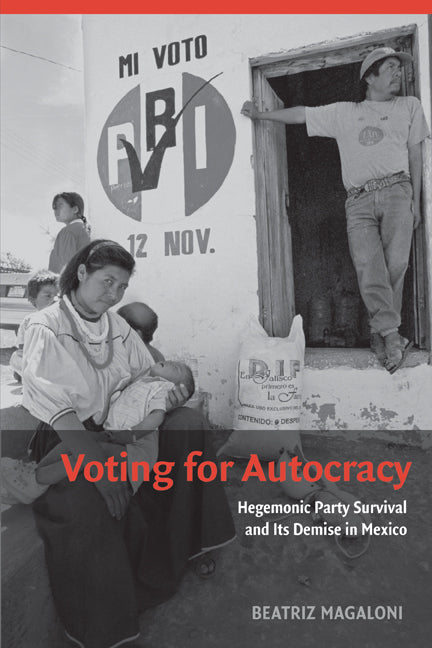
Voting for Autocracy
Hegemonic Party Survival and its Demise in Mexico
This 2006 book provides a theory of the logic of survival of the Institutional Revolutionary Party (PRI).
Beatriz Magaloni (Author)
9780521736596, Cambridge University Press
Paperback / softback, published 11 August 2008
316 pages, 27 tables
22.6 x 15.2 x 2 cm, 0.43 kg
'Magaloni's study of the dominance and collapse of a single-party dominant autocratic regime is a landmark in Mexican political economy and regime transitions. With incisive theorizing and rich empirical testing, she solves crucial puzzles, such as how an unpopular government can submit itself to elections and still retain power.' Susan Stokes, Yale University, Connecticut
This 2006 book provides a theory of the logic of survival of the Institutional Revolutionary Party (PRI), one of the most resilient autocratic regimes in the twentieth century. An autocratic regime hid behind the facade of elections that were held with clockwise precision. Although their outcome was totally predictable, elections were not hollow rituals. The PRI made millions of ordinary citizens vest their interests in the survival of the autocratic regime. Voters could not simply 'throw the rascals out of office' because their choices were constrained by a series of strategic dilemmas that compelled them to support the autocrats. The book also explores the factors that led to the demise of the PRI. The theory sheds light on the logic of 'electoral autocracies', among the most common type of autocracy, and is the only systematic treatment in the literature today dealing with this form of autocracy.
1. Equilibrium party hegemony
2. Structural determinants of mass support
3. Budget cycles under autocracy
4. The politics of vote-buying
5. Judging economic performance in hard times
6. Ideological divisions in the opposition camp
7. How voters choose and mass coordination dilemmas
8. Electoral fraud and the game of electoral transitions
9. Conclusion.
Subject Areas: Comparative politics [JPB], Regional studies [GTB]