Special Order - allow 2+ weeks lead
Couldn't load pickup availability
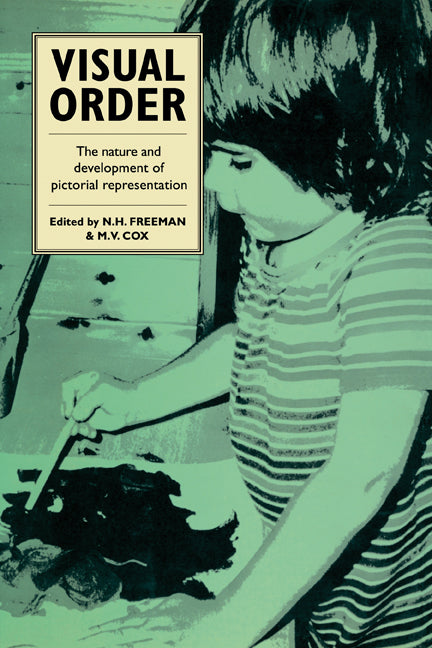
Visual Order
The Nature and Development of Pictorial Representation
This collection of essays researches the nature and development of pictorial representation.
N. H. Freeman (Edited by), M. V. Cox (Edited by)
9780521127097, Cambridge University Press
Paperback / softback, published 15 January 2010
412 pages
22.9 x 15.2 x 2.3 cm, 0.6 kg
This collection brings together and integrates topical research on the nature and development of pictorial representation by twenty investigators - psychologists, artists and educationalists from several countries. Four themes dominate the book: What is a picture, and what makes a picture successful? What mental apparatus is called into play by the person who tries to draw? What information do children typically try to capture in a range of conditions, both normal and abnormal? How accurate can we expect children to be in pursuit of their own graphic goals? In the ten years leading up to the book's publication in 1985, major advances had been made in the scientific study of line drawing and this book presents many exciting insights into this field at the point of its development.
List of contributors
Preface
Introduction N. H. Freeman and M. V. Cox
1. How meaning covers the traces Alan Costall
Commentary N. H. Freeman and M. V. Cox
2. A perspective on traditional artistic practices Francis Pratt
3. There is no development in art Margaret A. Hagen
4. Drawing systems revisited: the role of denotation systems in children's figure drawings John Willats
5. The adolescent's point of view: studies of forms in conflict R. K. Duthie
Commentary N. H. Freeman and M. V. Cox
6. On the discovery, storage and use of graphic descriptions W. A. Phillips, M. Inall and E. Lauder
7. Anomalous drawing development: some clinical studies Lorna Selfe
Commentary N. H. Freeman and M. V. Cox
8. Young children's representational drawings of solid objects: a comparison of drawing and copying May Jane Chen
9. Some children do sometimes do what they have been told to do: task demands and verbal instructions in children's drawing M. D. Barrett, A. V. Beaumont and M. S. Jennett
10. One object behind another: young children's use of array-specific or view-specific representations M. V. Cox
11. The canonical bias: young children's drawings of familiar objects Alyson M. Davies
12. The development of view-specific representation considered from a socio-cognitive standpoint Paul Light
13. Three into two won't go: symbolic and spatial coding processes in young children's drawings Nigel Ingram
14. Knowledge and appearance Charles Crook
15. The head is smaller than the body: but how does it join on? Juri Allik and Tiia Laak
Commentary N. H. Freeman and M. V. Cox
16. Geometrical foundations of children's drawing Michael C. Mitchelmore
17. Figural biases and young children's drawings J. Gavin Bremner
18. Cross-cultural analysis of drawing errors Ruvide Bayraktar
19. The perceptual-motor skill of drawing Judith I. Laszlo and Pia A. Broderick
20. The transition from construction to sketching in children's drawings Larry Fenson
Conclusions N. H. Freeman and M. V. Cox
Indexes.
Subject Areas: Psychology [JM]