Freshly Printed - allow 10 days lead
Couldn't load pickup availability
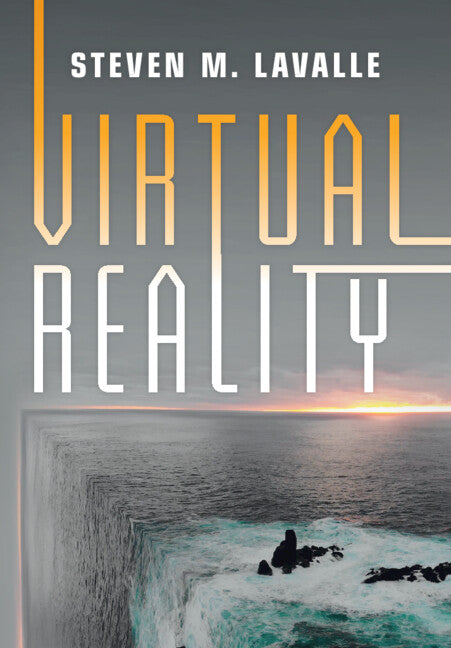
Virtual Reality
An interdisciplinary text for students, researchers, and developers that blends foundations of virtual reality with industry insights.
Steven M. LaValle (Author)
9781107198937, Cambridge University Press
Hardback, published 2 November 2023
392 pages
25.9 x 17.9 x 2.3 cm, 0.93 kg
'An excellent introductory textbook for VR, well-organized, with broad coverage, and clear prose. LaValle is a knowledgeable guide through the wide variety of topics germane to VR, from the history of the field, to visual perception, to mathematics of 3D geometry, to displays, rendering, tracking, audio, user interaction, and much more. If there is a better introductory VR textbook, I've yet to find it.' Henry Fuchs, University of North Carolina at Chapel Hill
Virtual reality (VR) is a powerful technology that promises to transform our lives. This balanced and interdisciplinary text blends the key components from computer graphics, perceptual psychology, human physiology, behavioral science, media studies, human-computer interaction, optical engineering, and sensing and filtering, showing how each contributes to engineering perceptual illusions. Steven LaValle draws on his unique experience as a teacher, researcher, and early founder of Oculus VR, to demonstrate how the best practices and insights from industry are built on fundamental computer science principles. Topics include media history, geometric modeling, optical systems, displays, eyes, ears, low-level perception, neuroscience of vision, graphical rendering, tracking systems, interaction mechanisms, audio, evaluating VR systems, and mitigating side effects. Students, researchers, and developers will gain a clear understanding of timeless foundations and new applications, enabling them to make innovative contributions to this growing field as scientists, engineers, business developers, and content makers.
Preface
1. Introduction
2. Bird's-eye view
3. The geometry of virtual worlds
4. Light and optics
5. The physiology of human vision
6. Visual perception
7. Visual rendering
8. Motion in real and virtual worlds
9. Tracking
10. Interaction
11. Audio
12. Evaluating VR systems and experiences
13. Frontiers
References
Index.
Subject Areas: Image processing [UYT]