Freshly Printed - allow 10 days lead
Couldn't load pickup availability
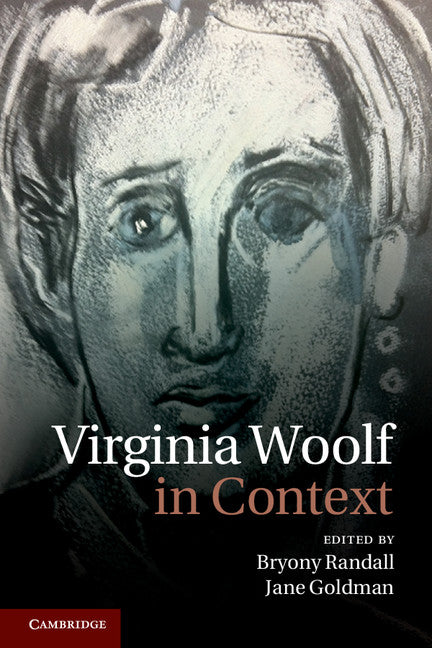
Virginia Woolf in Context
Covering a wide range of historical, theoretical, critical and cultural contexts, this collection studies key issues in contemporary Woolf studies.
Bryony Randall (Edited by), Jane Goldman (Edited by)
9781107003613, Cambridge University Press
Hardback, published 17 December 2012
522 pages
22.9 x 15.2 x 3.3 cm, 0.93 kg
'Similar to other books in Cambridge University Press's Literature in Context series, this collection places a particular writer within the various contexts that inform his or her work … this collection provides the contexts necessary to understand Woolf's more difficult works without prescribing the view one should take of these works - and Woolf herself.' Molly Youngkin, English Literature in Transition, 1880–1920
As a paradigmatic modernist author, Virginia Woolf is celebrated for the ways her fiction illuminates modern and contemporary life. Woolf scholars have long debated how context - whether historical, cultural, or theoretical - is to be understood in relation to her work and how her work produces new insights into context. Drawing on an international field of leading and emergent specialists, this collection provides an authoritative resource for contemporary Woolf scholarship that explores the distinct and overlapping dimensions of her writings. Rather than survey existing scholarship, these essays extend Woolf studies in new directions by examining how the author is contextualised today. The collection also highlights connections between Woolf and key cultural, political and historical issues of the twentieth century such as avant-gardism in music and art, developments in journalism and the publishing industry, political struggles over race, gender and class and the bearings of colonialism, empire and war.
Preface Jane Goldman and Bryony Randall
Part I. Theory and Critical Reception: 1. Historicising Woolf: context studies Michael Whitworth
2. Virginia Woolf: after lives Mark Hussey
3. Woolf and modernist studies Bryony Randall
4. Woolf and realism Pam Morris
5. Woolf and intertextuality Anne Fernald
6. Woolf and 'theory' Claire Colebrook
7. Woolf and feminist theory Lisa Coleman
8. Woolf and psychoanalytic theory Sanja Bahun
9. Woolf and theories of postcolonialism Sonita Sarker
10. Woolf and theories of sexuality Morgne (Patricia) Cramer
Part II. Historical and Cultural Context: 11. Virginia Woolf and modernity: crisis and catoptrics Randall Stevenson
12. Virginia Woolf: war and peace Jane Lilienfeld
13. Woolf's Bloomsbury Kathryn Simpson
14. Politics and class Elena Gualtieri
15. Feminist politics Judith Allen
16. Race, empire and Ireland Anna Snaith
17. Jewishness and anti-Semitism Heidi Stalla
18. Woolf's London: London's Woolf David Bradshaw
19. Regionalism, nature and the environment Bonnie Kime Scott
20. Science and technology Holly Henry
21. Art Suzanne Bellamy
22. Music Emma Sutton
23. Cinema and photography Maggie Humm
24. Woolf and theatre Beth Wright
25. Woolf and publishing Drew Shannon
26. Woolf, journalism and reviewing James Stewart
27. Woolf and Freud Perry Meisel
28. Woolf and lesbian culture Madelyn Detloff
29. Woolf and the culture of letter-writing and diary-keeping Ian Blyth
30. Contemporary philosophy Derek Ryan
31. Continental Woolf Carole Bourne-Taylor
32. Woolf and the Russians Darya Protopopova
33. American Woolf Thaine Stearns
34. Woolf and the Victorians Margaret Homans
35. Classical Woolf Vassiliki Kolocotroni
36. Woolf and eugenics Linden Peach
37. Woolf and commodities Ruth Hoberman
38. Woolf and the private sphere Jessica Berman
Key critical works cited
Index.
Subject Areas: Literary studies: fiction, novelists & prose writers [DSK], Literary studies: from c 1900 - [DSBH]