Special Order - allow 2+ weeks lead
Couldn't load pickup availability
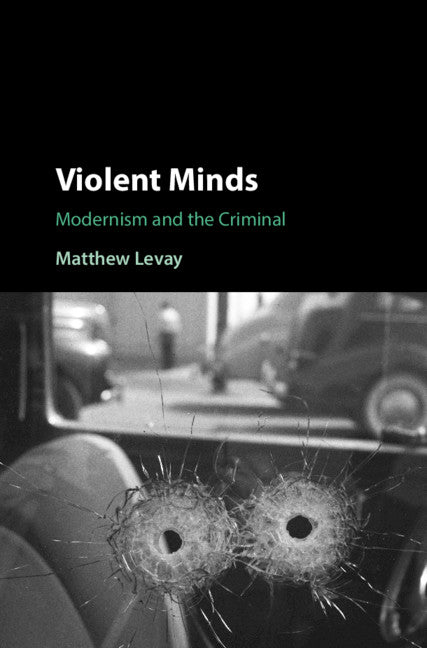
Violent Minds
Modernism and the Criminal
Levay analyzes representations of the criminal in British and American modernism from the late nineteenth century to the 1950s.
Matthew Levay (Author)
9781108428866, Cambridge University Press
Hardback, published 3 January 2019
248 pages
23.5 x 15.7 x 1.7 cm, 0.48 kg
'Excitingly, Levay works not only on canonical modernism, whose analysis allows Levay to uncover 'criminality's pivotal role in establishing quintessentially modernist forms of psychological representation', but also on crime fiction itself, analysing figures like Graham Greene, Patricia Highsmith, Dorothy L. Sayers, and Dashiell Hammett as writers of a 'popular modernism' …' Year's Work in English Studies
Just as cultural attitudes toward criminality were undergoing profound shifts in the late nineteenth and early twentieth centuries, modernist authors became fascinated by crime and its perpetrators, as well as the burgeoning genre of crime fiction. Throughout the period, a diverse range of British and American novelists took the criminal as a case study for experimenting with forms of psychological representation while also drawing on the conventions of crime fiction in order to imagine new ways of conceptualizing the criminal mind. Matthew Levay traces the history of that attention to criminal psychology in modernist fiction, placing understudied authors like Wyndham Lewis, Dorothy Sayers, Graham Greene, and Patricia Highsmith in dialogue with more canonical contemporaries like Joseph Conrad, Henry James, Dashiell Hammett, and Gertrude Stein. Levay demonstrates criminality's pivotal role in establishing quintessentially modernist forms of psychological representation and brings to light modernism's deep but understudied connections to popular literature, especially crime fiction.
Introduction
1. Modernist detection: minds, mindlessness, and the logic of criminal pursuit
2. Criminal types: anarchism, terrorism, and the violence of chance
3. The modernist crime novel: popular literature and the forms of experiment
4. Cases of identity: late modernism and the life of crime
Conclusion
Bibliography
Index.
Subject Areas: Literature & literary studies [D]