Freshly Printed - allow 10 days lead
Couldn't load pickup availability
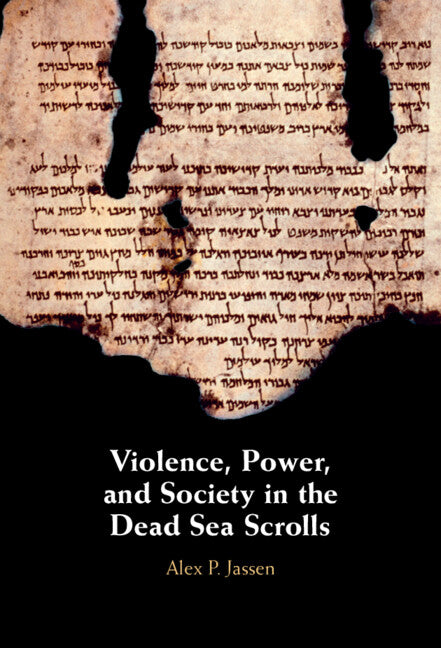
Violence, Power, and Society in the Dead Sea Scrolls
This book explores the intersection of violence and power in the ancient social group behind the Dead Sea Scrolls.
Alex P. Jassen (Author)
9781009609081, Cambridge University Press
Hardback, published 16 October 2025
296 pages
22.9 x 15.2 x 2.1 cm, 0.541 kg
'In this incisive study, Alex P. Jassen guides readers through the complex and often contradictory portrayals of violence in the Dead Sea Scrolls. By combining close textual analysis with insights from social scientific research – including the study of New Religious Movements – he elucidates how the sectarian imagination of violence evolved in response to shifting social contexts. Jassen shows how arhetoric of violence served as a means of coping with disempowerment and perceived persecution, providing a literary space to imagine the reversal of a world gone wrong. This nuanced approach enriches our understanding of the texts and the people who produced them.' Cecilia Wassen, Professor of New Testament, Uppsala University
Violence is one of the key themes in the Dead Sea Scrolls. It captured the imagination of the Sectarians who wrote these scrolls, and who saw themselves as victims of persecution. Their vision for the end of days included fantasies of revenge against their enemies. In this volume, Alex P. Jassen explores the intersection of violence and power in the Dead Sea Scrolls and the ancient sectarian movement which generated and preserved these texts. Bringing a multidisciplinary approach to this topic, he offers insights into the origins and function of violence for the people behind the Dead Sea Scrolls. He demonstrates how they positioned themselves in a world dominated by more powerful Jews and the overwhelming might of foreign empires. Jassen addresses the complex relationship between violence, power, and social groups by drawing on cross-cultural examples of sectarianism, millennial movements, and disempowered groups, with particular emphasis on New Religious movements such as the Branch Davidians.
1. Introduction
2. From contextless accounts to holistic portraits of violence
3. The beginnings of violent conflict
4. Sectarian identity, intensified conflict, and the turn to violence
5. Persecution, victimhood, and storytelling in sectarian portraits of present-time violence
6. Reversal, reciprocity, and revenge in sectarian fantasies of eschatological violence
7. Violent imaginaries and practical violence in the war scroll
8. Conclusion
Bibliography.
Subject Areas: Judaism [HRJ]