Freshly Printed - allow 10 days lead
Couldn't load pickup availability
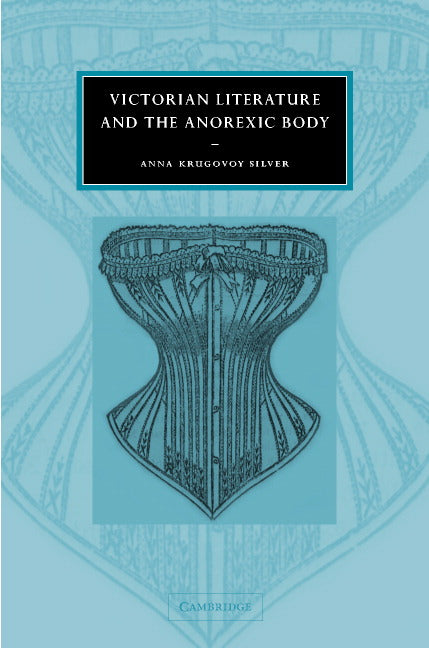
Victorian Literature and the Anorexic Body
A study of women's bodies and eating disorders as depicted in Victorian literature.
Anna Krugovoy Silver (Author)
9780521816021, Cambridge University Press
Hardback, published 8 August 2002
236 pages, 2 b/w illus.
23.7 x 15.9 x 2 cm, 0.469 kg
'Silver's rigorous investigation of the relationship between anorexia and Victorian literature and culture has the revelatory effect of crystallizing latent knowledge.' The Times Literary Supplement
Anna Krugovoy Silver examines the ways nineteenth-century British writers used physical states of the female body - hunger, appetite, fat and slenderness - in the creation of female characters. Silver argues that anorexia nervosa, first diagnosed in 1873, serves as a paradigm for the cultural ideal of middle-class womanhood in Victorian Britain. In addition, Silver relates these literary expressions to the representation of women's bodies in the conduct books, beauty manuals and other non-fiction prose of the period, contending that women 'performed' their gender and class alliances through the slender body. Silver discusses a wide range of writers including Charlotte Brontë, Christina Rossetti, Charles Dickens, Alfred Lord Tennyson, Bram Stoker and Lewis Carroll to show that mainstream models of middle-class Victorian womanhood share important qualities with the beliefs or behaviours of the anorexic girl or woman.
Acknowledgments
Introduction
1. Waisted women: reading Victorian slenderness
2. Appetite in Victorian children's literature
3. Hunger and repression in Shirley and Villette
4. Vampirism and the anorexic paradigm
5. Christina Rossetti's sacred hunger
Conclusion: the politics of thinness
Notes
Bibliography
Index.
Subject Areas: Gender studies, gender groups [JFSJ], Literary studies: c 1800 to c 1900 [DSBF]