Freshly Printed - allow 6 days lead
Couldn't load pickup availability
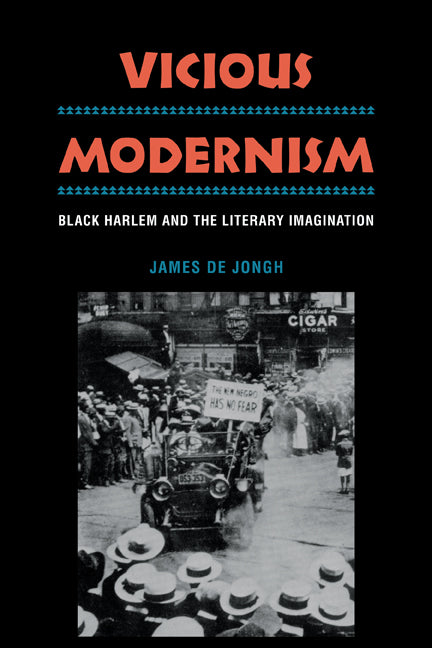
Vicious Modernism
Black Harlem and the Literary Imagination
This book concentrates on the aesthetic and cultural force of Harlem, which inspired writers from Sherwood Anderson to Tom Wolfe.
James de Jongh (Author)
9780521123303, Cambridge University Press
Paperback, published 19 November 2009
292 pages
22.9 x 15.2 x 1.7 cm, 0.43 kg
Harlem, a quintessentially black city in the midst of a great modern metropolis, has piqued the imagination of writers and artists since the turn of the century. Its subsequent history as a legendary cultural centre and a notorious ghetto only intensified its mystique and inspired large numbers of writers, among them Sherwood Anderson, Federico Garcia Lorca, Fannie Hurst, James Baldwin, Ralph Ellison, Ishmael Reed, and Tom Wolfe. In Vicious Modernism, James de Jongh traces the evolution of the imaginative usage of Harlem by literary artists over the past seventy years. The book concentrates on the aesthetic and cultural force of the idea of Harlem, and de Jongh identifies three distinct phases in its evolution within the literary imagination: its promise as a cultural capital in the 1920s; the failure of that promise and the emergence of a ghetto in the 40s; and finally, following the race riots of the early 1960s, a shared vision of Harlem as cultural capital and contemporary slum.
Introduction
Vicious Modernism
Part I. the Legendary Capital: the 1920s and 1930s
1.The legendary capital
2. City of refuge
3. Crossing the color line
4. Me revoici, Harlem
Part II. The Emerging Ghetto: The 1940s and 1950s
5. The emerging ghetto
6. Go tell it on the mountain
7. Montage of a dream deferred
8. Megro de todo o mundo
Part III. the Inner City: the 1960s and 1970s
9. The inner city
10. Jitterbugging in the streets
11. Echoes in a burnt building
12. Mumbo jumbo
Epilogue: black Harlem and the literary imagination
Appendices.
Subject Areas: Literary studies: general [DSB]