Freshly Printed - allow 7 days lead
Couldn't load pickup availability
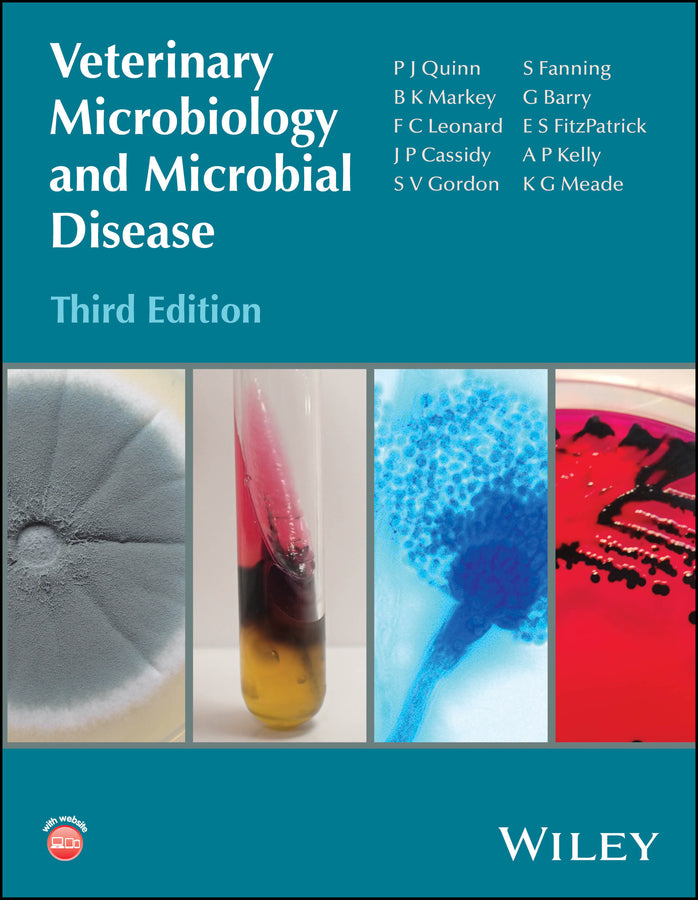
Veterinary Microbiology and Microbial Disease
P. J. Quinn (Author), B. K. Markey (Author), F. C. Leonard (Author), J. P. Cassidy (Author), S. V. Gordon (Author), S. Fanning (Author), G. Barry (Author), E. S. Fitzpatrick (Author), A. P. Kelly (Author), Kieran G. Meade (Author)
9781119716785, Wiley
Hardback, published 7 May 2026
1008 pages
27.9 x 21.8 x 4.8 cm, 2.994 kg
The definitive resource for understanding infectious disease in veterinary medicine The revised third edition of Veterinary Microbiology and Microbial Disease equips veterinary professionals with essential knowledge of bacteriology, mycology and virology. Serving as both an authoritative reference and practical clinical guide to infectious disease, the authors provide up-to-date information relevant to animal and public health, along with the latest diagnostic tools and the information required to treat and control them. This new edition incorporates substantial advances in molecular biology and genome sequencing that have transformed veterinary microbiology. New material also addresses contemporary challenges in infectious disease management, such as drug-resistant microorganisms, zoonotic pathogens, and other emerging threats. Readers will find: Veterinary Microbiology and Microbial Disease provides undergraduate and postgraduate veterinary students, practicing veterinary surgeons, researchers, and graduates specializing in diagnostic microbiology or regulatory activities with up-to-date information on bacterial, fungal, and viral pathogens.
Preface ix Acknowledgements x Author biographies xi About the Companion Website xiv Section I Introduction to Microbiology, Infection, Immunity and Molecular Diagnostic Methods 1 Microbiology, microbial pathogens and infectious disease 3 2 Subdivisions, classification and morphological characterization of infectious agents 8 3 Immunity and infection 14 4 Immune system disorders 78 5 Vaccines and vaccination 96 6 Molecular diagnostic methods 114 Section II Introductory Bacteriology 7 The structure of bacterial cells and bacterial taxonomy 143 8 Cultivation, preservation and inactivation of bacteria 151 9 Bacterial genetics, mechanisms of genetic variation and gene databases 158 10 Laboratory diagnosis of bacterial disease 177 11 Antibacterial agents 183 12 Antibacterial resistance 192 13 Bacterial colonization, tissue invasion and clinical disease 202 Section III Pathogenic Bacteria 14 Overview of bacteria of veterinary importance 217 15 Staphylococcus species 225 16 Streptococcus species and Enterococcus species 233 17 Actinomycetes 242 18 Corynebacterium species 253 19 Rhodococcus equi 260 20 Listeria species 264 21 Erysipelothrix rhusiopathiae 269 22 Bacillus species 273 23 Clostridium and Clostridioides species 280 24 Mycobacterium species 296 25 Enterobacterales 309 26 Pseudomonas aeruginosa and Burkholderia species 335 27 Actinobacillus species 342 28 Pasteurella species, Mannheimia haemolytica and Bibersteinia trehalosi 349 29 Francisella tularensis 358 30 Histophilus somni, Glaesserella parasuis, Avibacterium paragallinarum and Gallibacterium anatis 362 31 Taylorella species 369 32 Bordetella species 372 33 Moraxella species 378 34 Brucella species 382 35 Campylobacter and Helicobacter species 390 36 Lawsonia intracellularis 397 37 Spirochaetes 400 38 Pathogenic anaerobic non-spore-forming Gram-negative bacteria 415 39 Mycoplasmas 421 40 Chlamydia species 432 41 Rickettsiales and Coxiella burnetii 442 42 Bacterial species of limited pathogenic significance in animals 453 Section IV Mycology 43 General features of fungi and an overview of their veterinary importance 461 44 Dermatophytes 471 45 Aspergillus species 478 46 Yeasts and disease production 484 47 Dimorphic fungi 494 48 Zygomycetes of veterinary importance 502 49 Fungus-like organisms of veterinary importance 508 50 Pneumocystis species 513 51 Opportunistic infections caused predominantly by phaeoid fungi 516 52 Mycotoxins and mycotoxicoses 520 53 Pathogenic algae and cyanobacteria 535 54 Antifungal chemotherapy 541 Section V Introductory Virology 55 Nature, structure and taxonomy of viruses 561 56 Replication of viruses 572 57 Virus evolution 580 58 Propagation of viruses and virus–cell interactions 585 59 Pathogenesis of viral diseases 590 60 Laboratory diagnosis of viral infections 597 61 Antiviral chemotherapy 603 Section VI Viruses and Prions 62 Overview of viruses of veterinary importance 623 63 Orthoherpesviridae 628 64 Papillomaviridae 645 65 Adenoviridae 651 66 Poxviridae 657 67 Asfarviridae 668 68 Parvoviridae 672 69 Circoviridae and Anelloviridae 681 70 Retroviridae 685 71 Sedoreoviridae and Spinareoviridae 701 72 Birnaviridae 710 73 Orthomyxoviridae 714 74 Paramyxoviridae and Pneumoviridae 723 75 Rhabdoviridae 736 76 Bornaviridae 743 77 Peribunyaviridae, Nairoviridae, Phenuiviridae and Hantaviridae 746 78 Picornaviridae 752 79 Caliciviridae 762 80 Astroviridae 768 81 Coronaviridae 771 82 Arteriviridae 784 83 Flaviviridae 790 84 Togaviridae 801 85 Prions: unconventional infectious agents 806 Section VII Microbial Agents and Disease 86 Lesions resulting from interaction of bacterial, fungal and viral pathogens with host organ systems 817 87 Interactions of microbial pathogens with the nervous system 819 88 Interactions of microbial pathogens with the male and female reproductive systems 828 89 The role of microbial pathogens in intestinal and liver disease 837 90 The role of microbial pathogens in respiratory disease 849 91 Interactions of microbial pathogens with the urinary system 859 92 Microbial diseases of the cardiovascular system 870 93 Interactions of microbial pathogens with the musculoskeletal system 880 94 The role of microbial pathogens in diseases of the integumentary system 895 95 Bacterial causes of bovine mastitis 908 96 Disinfection, biosecurity and other aspects of disease control 922 Appendix: Relevant websites 966 Index 969
Subject Areas: Veterinary medicine [MZ]