Freshly Printed - allow 10 days lead
Couldn't load pickup availability
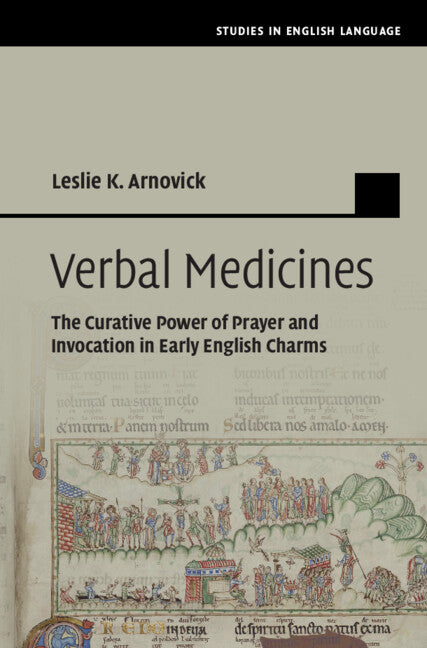
Verbal Medicines
The Curative Power of Prayer and Invocation in Early English Charms
Explores the function of charms in Early English by situating them in the historical and cultural environment of the period.
Leslie K. Arnovick (Author)
9781009423144, Cambridge University Press
Hardback, published 7 November 2024
318 pages
23.5 x 15.9 x 2.2 cm, 0.59 kg
'This is a superbly ordered book that persuasively argues that English healing charms purposefully embedded verbal and performative elements from sacramental and liturgical conventions while retaining their folk-traditional integrity. Arnovick's respectful approach to late-Saxon charms and her meticulous analysis of their hybridity are masterful.' Martha Rampton, Professor of History, Pacific University Oregon
Religious texts played a central role in Early English, and this innovative book looks in particular at how medieval Christians used prayers and psalms in healing the sick. At first glance, the variety and multiplicity of utterances, prayers, exorcistic formulas, and other incantations found in a single charm may seem to be random and eclectic. However, this book shows that charms had distinct, logical linguistic characteristics, as well performative aspects that were shaped by their usage and cultural significance. Together, these qualities gave the texts a unique role in the early development of English, in particular its use in ritual and folklore. Arnovick identifies four forms of incantations and a full chapter is devoted to each form, arranged to reflect the lived experiences of medieval Christians, from their baptism in infancy, to daily prayer and attendance at Church celebrations, and to their Confession and anointing during grave illness.
Preface
1. Invoking baptism
2. Psalm charms as aids against illness
3. Invoking the name of Mary
4. Invoking the visitation of the sick
5. The multiplier effect
Theoretical implications.
Subject Areas: Language: history & general works [CBX]