Freshly Printed - allow 7 days lead
Couldn't load pickup availability
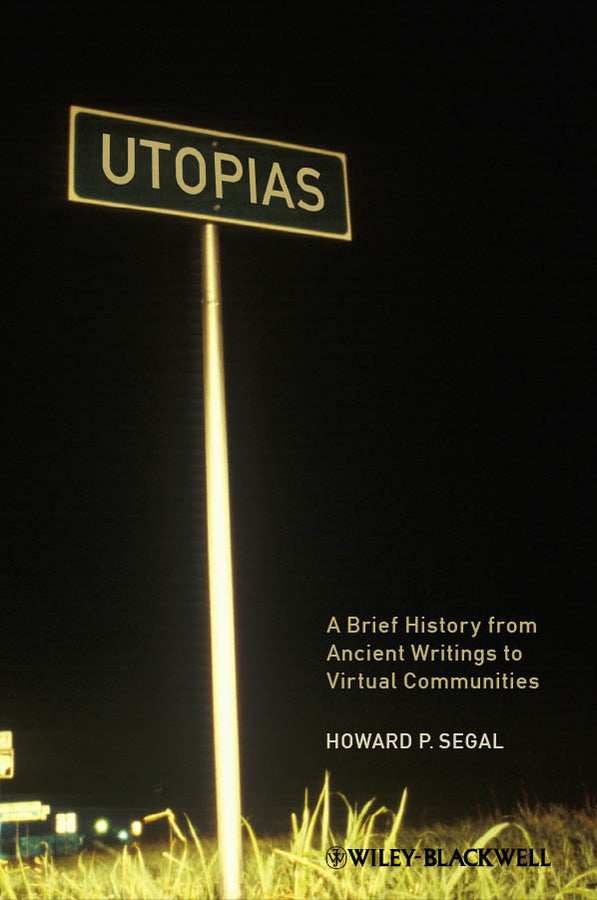
Utopias
A Brief History from Ancient Writings to Virtual Communities
"A 'near perfect' account of utopias and utopian thinking of the past, present, and future. Historian Howard Segal revisits utopian ideologies revealing their perennial appeal, their use and misuse of technology, and their considerable power to reshape society, then and now." "An expansive, entertaining and provocative introduction to utopianism and its practitioners ... Utopias captures both the whimsical extravagance as well as the earnestness of attempts (western as well as non-western) to imagine better futures and then actually create better societies across the ages ... [It] is bound to stimulate thought on the subject, and will appeal to a wide readership." "Segal offers a focus on 'western' expressions of utopianism while devoting substantial space to diversity. Hence we find the expected discussions of literature from More to Bellamy and Wells and beyond ... but there are also interesting examinations of utopias from China, Japan, India, and Latin America; and subsections on World's Fairs, professional forecasters, cyberspace, Megaprojects, social media, E-books, and George Lucas's Edutopia." "The potential for good of science and technology, and their manifest dangers and pitfalls, are vividly evoked by Segal in his accessible account of utopias past and present. This is a work of insight and reflection."
—James Rodger Fleming, Colby College
—Greg Claeys, University of London
—Kenneth M. Roemer, University of Texas at Arlington
—Barbara Goodwin, University of East Anglia
Howard P. Segal (Author)
9781405183291, Wiley
Hardback, published 19 April 2012
304 pages
22.4 x 14.7 x 2.1 cm, 0.454 kg
"Segal does not shy away from bold definitions and delineations to separate utopias from millenarianism and science fiction, from abstract utopias and daydreams. ...Utopias is an accessible and thought-provoking introduction to utopias and utopianism and will appeal to scholars, students, and the general reader alike." (Utopian Studies, 1 October 2015) "In the capable hands of Howard P. Segal, professor of history at the University of Maine, technology rightfully has an important role in the imagination of alternative societies. His concise, well-written book covers utopias ancient and modern, Western and non-Western, and it is not limited to fiction conventionally labeled utopian but includes world’s fairs, social science, digital media, prophecies, millennial movements, and science fiction." (Technology and Culture, 1 October 2015) “To conclude: Segal’s book on utopias is a well-made treatise on an important aspect of European and American history. He convincingly shows that utopias had a political, as well as an economic, relevance. The view on the interaction between different cultural systems, such as art, politics, religion, technology, and economics, is a great strength of the book. It shows how complex processes around utopian visions have been, and how relevant they are for the implementation and change of different cultural spheres.” (Religion, 30 May 2015) “This text provides a unique approach for teaching history and the history of science. Highly recommended. General readers; lower-division undergraduates and above. (Choice, 1 February 2013) “Segal brings considerable scholarship and experience to bear, particularly on the historical intersections between technology and utopia ... [He] covers several continents and many centuries, addressing key texts and thinkers ... [and] supplies impressive coverage and thoughtful interpretations.” (Times Higher Education, 12 July 2012)
This brief history connects the past and present of utopian thought, from the first utopias in ancient Greece, right up to present day visions of cyberspace communities and paradise.
Preface xi Introduction 1 1 The Nature of Utopias 5 Utopias Defined 5 Utopias Differ from both Millenarian Movements and Science Fiction 8 Utopias' Spiritual Qualities are Akin to those of Formal Religions 9 Utopias'Real Goal: Not Prediction of the Future but Improvement of the Present 12 How and When Utopias are Expected to be Established 13 2 The Variety of Utopias 16 The Global Nature of Utopias: Utopias are Predominantly but not Exclusively Western 16 The Several Genres of Utopianism: Prophecies and Oratory, Political Movements, Communities, Writings, World's Fairs, Cyberspace 24 3 The European Utopias and Utopians and Their Critics 47 The Pioneering European Visionaries and Their Basic Beliefs: Plato's Republic and More's Utopia 47 Forging the Connections Between Science, Technology, and Utopia 50 The Pansophists 53 The Prophets of Progress: Condorcet, Saint-Simon, and Comte 55 Dissenters from the Ideology of Unadulterated Scientific and Technological Progress: Thomas Carlyle, John Ruskin, and William Morris 58 The Expansive Visions of Robert Owen and Charles Fourier 60 The "Scientific"Socialism of Karl Marx and Friedrich Engels 66 4 The American Utopias and Utopians and Their Critics 74 America as Utopia: Potential and Fulfillment 74 The Pioneering American Visionaries and their Basic Beliefs in America as Land of Opportunity: John Adolphus Etzler, Thomas Ewbank, and Mary Griffith 78 America as "Second Creation": Enthusiasm and Disillusionment 81 5 Growing Expectations of Realizing Utopia in the United States and Europe 89 Later American Technological Utopians: John Macnie Through Harold Loeb 89 Utopia Within Sight: The American Technocracy Crusade 96 Utopia Within Reach: "The Best and the Brightest"—Post-World War II Science and Technology Policy in the United States and Western Europe and the Triumph of the Social Sciences 99 On Misreading Frankenstein: How Scientific and Technological Advances have Changed Traditional Criticisms of Utopianism in the Twentieth and Twenty-First Centuries 123 6 Utopia Reconsidered 139 The Growing Retreat from Space Exploration and Other Megaprojects 139 Nuclear Power: Its Rise, Fall, and Possible Revival—Maine Yankee as a Case Study 142 The Declining Belief in Inventors, Engineers, and Scientists as Heroes; in Experts as Unbiased; and in Science and Technology as Social Panaceas 157 Contemporary Prophets for Profit: The Rise and Partial Fall of Professional Forecasters 160 Post-colonial Critiques of Western Science and Technology as Measures of "Progress"169 7 The Resurgence of Utopianism 186 The Major Contemporary Utopians and Their Basic Beliefs 186 Social Media: Utopia at One's Fingertips 193 Recent and Contemporary Utopian Communities 194 The Star Trek Empire: Science Fiction Becomes Less Escapist 199 Edutopia: George Lucas and Others 203 The Fate of Books and Newspapers: Utopian and Dystopian Aspirations 217 8 The Future of Utopias and Utopianism 234 The "Scientific and Technological Plateau"and the Redefinition of Progress 234 Conclusion: Why Utopia Still Matters Today and Tomorrow 241 Further Reading 261 Index 269
Subject Areas: Religion & beliefs [HR]