Freshly Printed - allow 7 days lead
Couldn't load pickup availability
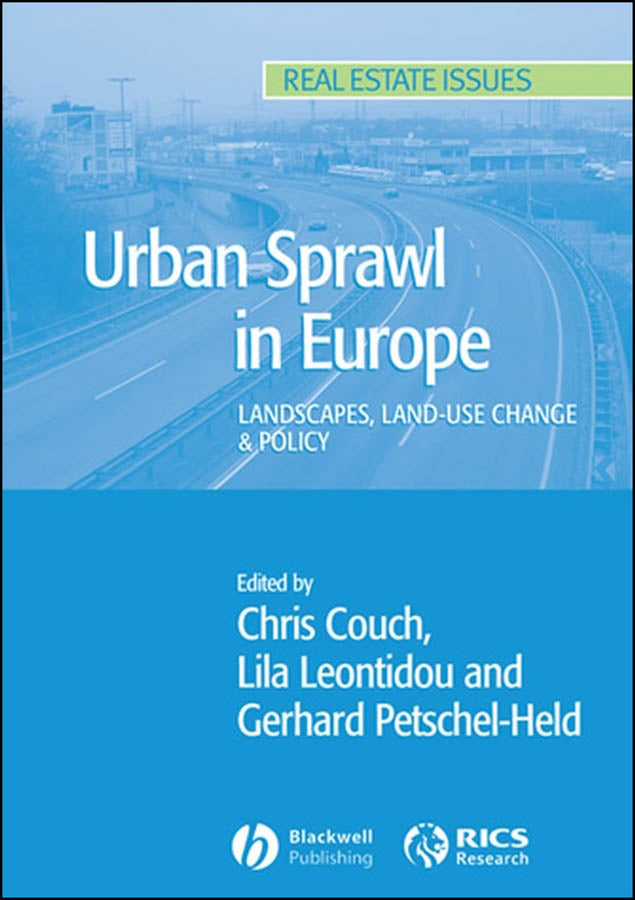
Urban Sprawl in Europe
Landscape, Land-Use Change and Policy
Chris Couch (Edited by), Gerhard Petschel-Held (Edited by), Lila Leontidou (Edited by)
9781405139175, Wiley
Paperback / softback, published 30 October 2007
304 pages
24.4 x 17.3 x 1.6 cm, 0.635 kg
Urban sprawl is one of the most important types of land-use changes currently affecting Europe. It increasingly creates major impacts on the environment (via surface sealing, emissions by transport and ecosystem fragmentation); on the social structure of an area (by segregation, lifestyle changes and neglecting urban centres); and on the economy (via distributed production, land prices, and issues of scale). Urban Sprawl in Europe: landscapes, land-use change & policy explains the nature and dynamics of urban sprawl. The book is written in three parts. Part I considers contemporary definitions, theories and trends in European urban sprawl. In part II authors draw upon experiences from across Europe to consider urban sprawl from a number of perspectives: In part III a formal qualitative model of sprawl is developed. Policies for the control of urban sprawl and the roles of different stakeholders are considered. Finally, a concluding chapter raises questions about the nature and dynamics of these new urban landscapes and their sustainability.
Contributors xiii Part I Theory and Method 1 1 Introduction: Definitions, Theories and Methods of Comparative Analysis 3 Background 3 2 Sprawl in European Cities: The Comparative Background 39 Urban trends in Europe 39 Part II Types of Urban Sprawl in Europe 69 3 Infrastructure-related Urban Sprawl: Mega-events and Hybrid Peri-urban Landscapes in Southern Europe 71 Introduction: theory and method 71 4 Sprawl in the Post-Socialist City: The Changing Economic and Institutional Context of Central and Eastern European Cities 102 Socialist cities in Central and Eastern Europe 102 5 Decline and Sprawl: Urban Sprawl is not Confined to Expanding City Regions 136 Sprawl in the context of urban decline 136 6 No Place Like Second Home: Weekends, Holidays, Retirement and Urban Sprawl 163 The largest industry in the world 163 Part III Models, Urban Policy and Sustainability 181 7 Modelling Urban Sprawl: Actors and Mathematics 183 Actors, actor classes and sprawl 184 8 Lines of Defence: Policies for the Control of Urban Sprawl 217 The aims of policy 217 9 Urban Sprawl and Hybrid Cityscapes in Europe: Comparisons, Theory Construction and Conclusions 242 'Urban', 'suburban', 'post-suburban', and their in-between spaces 243 Note 265
Preface xvii
Acknowledgments xx
Chris Couch, Lila Leontidou and Karl-Olov Arnstberg
The origins of suburbia and urban sprawl in Europe and the USA 6
Some differences between Europe and the USA 15
The development of theory and policy in Europe 20
Methodology 28
The structure of the book 32
Note 34
References 34
Diana Reckien and Jay Karecha
Urban trends in the case study cities 45
Conclusions 64
Appendix: Patterns of growth and sprawl across European cities 65
References 67
Lila Leontidou, Alex Afouxenidis, Elias Kourliouros and Emmanuel Marmaras
'Astyphilia' and popular spontaneous suburbanisation until the 1970s 73
Modernism and urban land policy after EU accession 80
Toward the entrepreneurial city and post-Olympic landscapes 87
Mega-events and Mediterranean urban futures 94
Notes 96
References 98
Natasa Pichler-Milanovic, Malgorzata Gutry-Korycka and Dieter Rink
Transition reforms in Central and Eastern Europe 104
The patterns of urban sprawl in post-socialist cities 108
The causes of urban sprawl in the post-socialist cities 114
The consequences of urban sprawl in post-socialist cities 121
Policy responses 127
Conclusions: what is needed for 'sustainable' sprawl in post-socialist cities? 130
Notes 133
References 133
Henning Nuissl, Dieter Rink, Chris Couch and Jay Karecha
Trends in urban sprawl in Britain and Germany 138
The two cases 141
Comparisons between Liverpool and Leipzig 150
Conclusions 156
Notes 160
References 160
Karl-Olov Arnstberg and Inger Bergstrom
A short history of the summerhouse 165
The summers of my childhood 165
Two homes 167
Making and maintaining roots 169
Recreation, retirement ... and investment 170
Retreat to a loved place 171
Varmdo, a sprawled community in the Stockholm region 173
References 180
Matthias Ludeke, Diana Reckien and Gerhard Petschel-Held
The actor versus the structural perspective on sprawl 187
Identifying the feedbacks 190
Operationalising the qualitative attractivity migration model 195
Validation and future scenarios 196
Using a QUAM model for policy analysis 198
From general targets to specific policy mechanisms: a model analysis 199
Discussion of case specific strategy – suggestions from a QUAM perspective 206
Conclusions 211
Appendix 213
References 214
Henning Nuissl and Chris Couch
The mechanisms of policy 218
Regulation 220
Economic intervention: direct investment, taxation or subsidy 227
Institutional change, management and advocacy 229
Conclusions 233
Notes 238
References 239
Lila Leontidou and Chris Couch
Deconstructing the dualism of causes/consequences of urban sprawl 244
A systematic comparison of city case studies 256
Cultures of urbanism and sprawl in Europe 260
Hybrid landscapes and questions of sustainability 264
References 265
Index 269
Subject Areas: Finance & accounting [KF]