Freshly Printed - allow 10 days lead
Couldn't load pickup availability
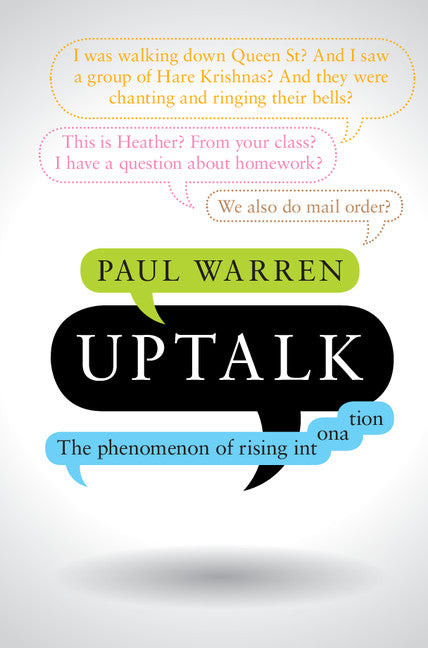
Uptalk
The Phenomenon of Rising Intonation
In this first comprehensive analysis of 'uptalk', Paul Warren examines the phenomenon's historical origins, geographical spread and social influences.
Paul Warren (Author)
9781107123854, Cambridge University Press
Hardback, published 7 January 2016
240 pages, 28 b/w illus. 2 tables
22.9 x 15.2 x 1.4 cm, 0.49 kg
'… it is certain to become the standard reference on the topic … there is no point in going anywhere else to find out what has been said about uptalk - either by researchers or by journalists and lay commentators …' D. Robert Ladd, Journal of the International Phonetic Association
'Uptalk' is commonly used to refer to rising intonation at the end of declarative sentences, or (to put it more simply) the tendency for people to make statements that sound like questions, a phenomenon that has received wide exposure and commentary in the media. How and where did it originate? Who are the most frequent 'uptalkers'? How much does it vary according to the speaker's age, gender and regional dialect? Is it found in other languages as well as English? These and other questions are the subject of this fascinating book. The first comprehensive analysis of 'uptalk', it examines its historical origins, geographical spread and social influences. Paul Warren also looks at the media's coverage of the phenomenon, including the tension between the public's perception and the views of experts. Uptalk will be welcomed by those working in linguistics, as well as anyone interested in the way we talk today.
1. Introduction – why 'uptalk'?
2. The forms of uptalk
3. The meanings and functions of uptalk
4. Uptalk in English varieties
5. Origins and spread of uptalk
6. Social and stylistic variation in uptalk use
7. Credibility killer and conversational anthrax: uptalk in the media
8. Perception studies of uptalk
9. Uptalk in other languages
10. Methodology in uptalk research
11. Summary and prospect.
Subject Areas: Phonetics, phonology [CFH], Sociolinguistics [CFB], Linguistics [CF]