Freshly Printed - allow 10 days lead
Couldn't load pickup availability
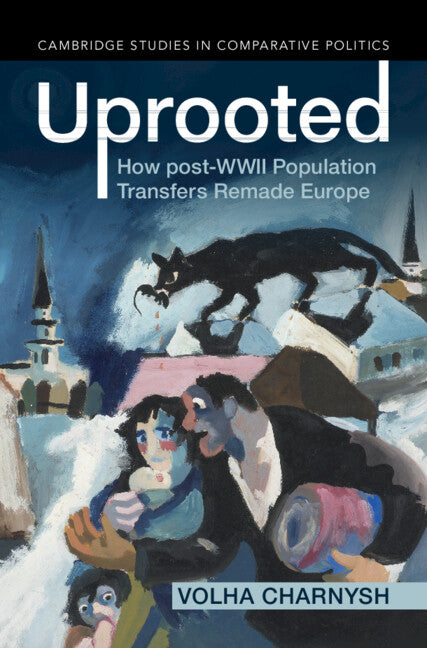
Uprooted
How post-WWII Population Transfers Remade Europe
Explores how mass displacement, notwithstanding its human costs, can strengthen receiving states and economies by diversifying populations and promoting capacity-building.
Volha Charnysh (Author)
9781009442008, Cambridge University Press
Hardback, published 21 November 2024
342 pages
23.5 x 15.9 x 2.3 cm, 0.62 kg
'Are migrants and local diversity a net economic gain for the receiving country? In this theoretically rich and historically nuanced study of post-World War II population transfers, Charnysh offers evidence that will make liberals swoon: where the receiving state is willing to supply public goods, diversity outperforms homogeneity.' Jason Wittenberg, Professor of Political Science, University of California, Berkeley
Each year, millions of people are uprooted from their homes by wars, repression, natural disasters, and climate change. In Uprooted, Volha Charnysh presents a fresh perspective on the developmental consequences of mass displacement, arguing that accommodating the displaced population can strengthen receiving states and benefit local economies. Drawing on extensive research on post-WWII Poland and West Germany, Charnysh shows that the rupture of social ties and increased cultural diversity in affected communities not only decreased social cohesion, but also shored up the demand for state-provided resources, which facilitated the accumulation of state capacity. Over time, areas that received a larger and more diverse influx of migrants achieved higher levels of entrepreneurship, education, and income. With its rich insights and compelling evidence, Uprooted challenges common assumptions about the costs of forced displacement and cultural diversity and proposes a novel mechanism linking wars to state-building.
Part I. Introduction: 1. Understanding forced migration
2. Europe's zero hour: population transfers in the aftermath of WWII
Part II. Social Cohesion and Contributions to Public Goods: 3. Cooperation in homogeneous and heterogeneous polish villages
4. Forced migration and public goods contributions in west Germany
Part III. State Building in the Wake of Mass Displacement: 5. State-building in the polish wild west
6. Expellees and the State in West Germany
Part IV. Long-run Economic Consequences of Uprooting: 7. Economic implications of cultural diversity in western Poland
8. Economic legacies of forced migration in west Germany
9. Conclusion.
Subject Areas: Comparative politics [JPB]