Freshly Printed - allow 7 days lead
Couldn't load pickup availability
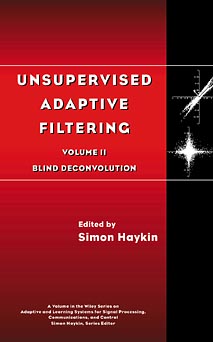
Unsupervised Adaptive Filtering, Blind Deconvolution
Simon Haykin (Edited by), SS Haykin (Author)
9780471379416, Wiley
Hardback, published 22 April 2000
200 pages
24.2 x 16 x 1.9 cm, 0.465 kg
Unüberwachte adaptive Filterung bedeutet, daß das System automatisch auf Veränderungen der Bedingungen reagiert: Die Filter können sich verschiedenen Situationen anpassen, ohne daß ein Mensch eingreifen müßte. Hunderte von Beiträgen zu diesem äußerst aktuellen Forschungsfeld sind in der Fachpresse erschienen. Dieser Band faßt den derzeitigen Erkenntnisstand zusammen und erspart Ihnen damit eine zeitraubende Recherche. (04/00)
Contributors vii Preface xi 1 Introduction 1 1.1 Why Adaptive Filtering? 1 1.2 Supervised and Unsupervised Forms of Adaptive Filtering 2 1.3 Two Important Unsupervised Signal-Processing Tasks 3 1.4 Three Fundamental Approaches to Unsupervised Adaptive Filtering 6 1.5 Organization of Volume II 10 References 11 2 The Core of FSE-CMA Behavior Theory 13 2.1 Introduction 14 2.2 MMSE Equalization and LMS 22 2.3 The CM Criterion and CMA 41 2.4 CMA-Adapted-Equalizer Design Issues with Illustrative Examples 75 2.5 Case Studies 89 2.6 Conclusions 106 References 108 3 Relationships between Blind Deconvolution and Blind Source Separation 113 3.1 Introduction 113 3.2 Problem Descriptions 117 3.3 Algorithmic Relationships 122 3.4 Structural Relationships 129 3.5 Extensions 140 3.6 Conclusions 142 References 142 4 Blind Separation of Independent Sources Based on Multiuser Kurtosis Optimization Criteria 147 4.1 Introduction 148 4.2 Problem Formulation and Assumptions 150 4.3 Review: The Single-User Equalization Problem 154 4.4 Necessary and Su½cient Conditions for BSS 160 4.5 Unconstrained Criteria: The MU-CM Approach 162 4.6 Constrained Criteria: The MUK Approach 165 4.7 Numerical Examples 171 4.8 Conclusions 175 References 176 Index 181
Simon Haykin
C. R. Johnson, Jr., P. Schniter, I. Fijalkow, L. Tong, J. D. Behm, M. G. Larimore, D. R. Brown, R. A. Casas, T. J. Endres, S. Lambotharan, A. Touzni, H. H. Zeng, M. Green, and J. R. Treichler
Scott C. Douglas and Simon Haykin
Constantinos B. Papadias
Subject Areas: Electronics & communications engineering [TJ]