Special Order - allow 2+ weeks lead
Couldn't load pickup availability
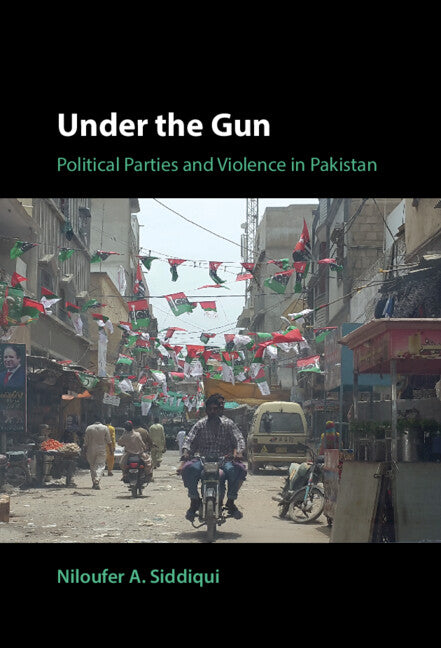
Under the Gun
Political Parties and Violence in Pakistan
The book draws on Pakistan's experience to explore why and when political parties engage in violence or ally with militant actors.
Niloufer A. Siddiqui (Author)
9781009242523, Cambridge University Press
Hardback, published 17 November 2022
292 pages
23.5 x 15.9 x 2.1 cm, 0.58 kg
'In this impressive academic endeavour, Siddiqui studies the intersections of violence and democracy, making a critical contribution across disciplines, especially political science, but her book should also appeal to criminologists and sociologists … her scholarship makes an exciting and timely contribution to our understanding of contemporary Pakistani politics …' Zoha Waseem, Bloomsbury Pakistan
Political parties are integral to democracy and yet they frequently engage in anti-democratic, violent behaviour. Parties can employ violence directly, outsource violence to gangs and militias, or form electoral alliances with non-state armed actors. When do parties engage in, or facilitate, violence? What determines the strategies of violence that they employ? Drawing on data from Pakistan, Under the Gun argues that party violence is not a simple manifestation of weak state capacity but instead the intentional product of political incentives, further complicating the process of democratization. Using a rigorous multi-method approach based on over a hundred interviews and numerous surveys, the book demonstrates that a party's violence strategy depends on the incentives it faces in the subnational political landscape in which it operates, the cost it incurs from its voters for violent acts, and its organizational capacity for violence.
1. Introduction: violence amid democracy
2. The logic of party violence
3. Setting the stage: violence, state capacity, and political representation in Pakistan
4. Who owns the guns? The Muttahida Qaumi Movement and violence in Karachi
5. The Pakistan People's Party and the gangs of Lyari, Karachi
6. Allying with militants: the Pakistan Muslim League-Nawaz and sectarian groups in Punjab
7. An ideology of non-violence? The Awami National Party in Khyber Pakhtunkhwa
8. Party violence in comparative perspective
9. Conclusion: democracy amid violence.
Subject Areas: Political parties [JPL], Political structures: democracy [JPHV], Political ideologies [JPF], Comparative politics [JPB], Politics & government [JP]