
Freshly Printed - allow 7 days lead
Couldn't load pickup availability
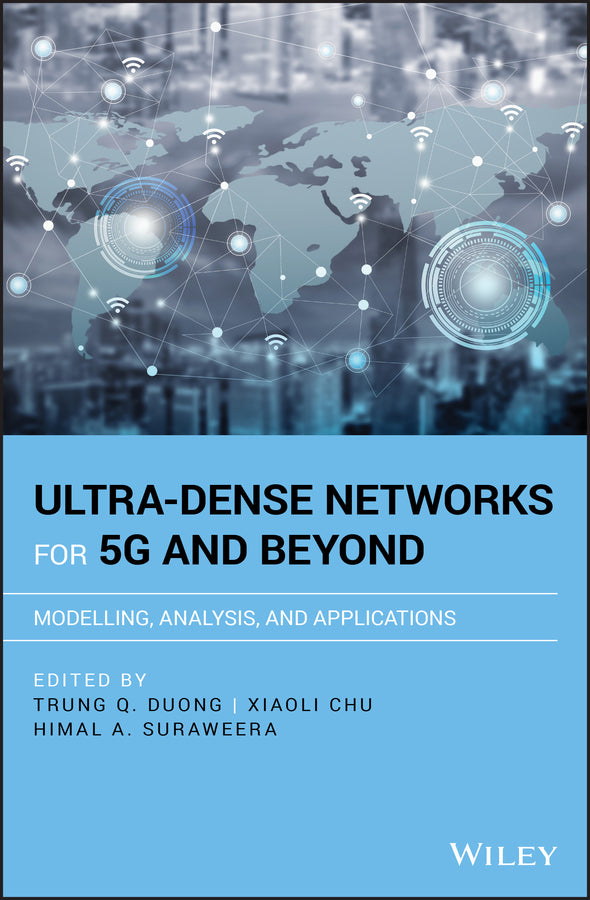
Ultra-Dense Networks for 5G and Beyond
Modelling, Analysis, and Applications
Trung Q. Duong (Edited by), Xiaoli Chu (Edited by), Himal A. Suraweera (Edited by)
9781119473695, Wiley
Hardback, published 12 April 2019
312 pages
24.1 x 17 x 2.3 cm, 0.612 kg
Offers comprehensive insight into the theory, models, and techniques of ultra-dense networks and applications in 5G and other emerging wireless networks The need for speed—and power—in wireless communications is growing exponentially. Data rates are projected to increase by a factor of ten every five years—and with the emerging Internet of Things (IoT) predicted to wirelessly connect trillions of devices across the globe, future mobile networks (5G) will grind to a halt unless more capacity is created. This book presents new research related to the theory and practice of all aspects of ultra-dense networks, covering recent advances in ultra-dense networks for 5G networks and beyond, including cognitive radio networks, massive multiple-input multiple-output (MIMO), device-to-device (D2D) communications, millimeter-wave communications, and energy harvesting communications. Clear and concise throughout, Ultra-Dense Networks for 5G and Beyond - Modelling, Analysis, and Applications offers a comprehensive coverage on such topics as network optimization; mobility, handoff control, and interference management; and load balancing schemes and energy saving techniques. It delves into the backhaul traffic aspects in ultra-dense networks and studies transceiver hardware impairments and power consumption models in ultra-dense networks. The book also examines new IoT, smart-grid, and smart-city applications, as well as novel modulation, coding, and waveform designs. Ultra-Dense Networks for 5G and Beyond - Modelling, Analysis, and Applications is an ideal reference for those who want to design high-speed, high-capacity communications in advanced networks, and will appeal to postgraduate students, researchers, and engineers in the field.
List of Contributors xi Preface xv Part I Fundamentals of Ultra-dense Networks 1 1 Fundamental Limits of Ultra-dense Networks 3 1.1 Introduction 3 1.2 System Model 6 1.3 The Quest for Exact Analytical Expressions 9 1.4 The Quest for Scaling Laws 25 1.5 Conclusions and Future Challenges 36 Bibliography 37 2 Performance Analysis of Dense Small Cell Networks with Line of Sight and Non-Line of Sight Transmissions under Rician Fading 41 2.1 Introduction 41 2.2 System Model 42 2.3 Coverage Probability Analysis Based on the Piecewise Path Loss Model 44 2.4 Study of a 3GPP Special Case 46 2.5 Simulation and Discussion 52 2.6 Conclusion 55 Appendix A: Proof ofTheorem 1.1 55 Appendix B: Proof of Lemma 2.2 60 Appendix C: Proof of Lemma 2.3 61 Appendix D: Proof of Lemma 2.4 62 Bibliography 62 3 Mean Field Games for 5G Ultra-dense Networks: A Resource Management Perspective 65 3.1 Introduction 65 3.2 Literature Review 67 3.3 Basics of Mean field game 71 3.4 MFGs for D2D Communications in 5G 76 3.5 MFGs for Radio Access Network in 5G 78 3.6 MFGs in 5G Edge Computing 84 3.7 Conclusion 85 Bibliography 85 Part II Ultra-dense Networks with Emerging 5G Technologies 91 4 Inband Full-duplex Self-backhauling in Ultra-dense Networks 93 4.1 Introduction 93 4.2 Self-backhauling in Existing Literature 94 4.3 Self-backhauling Strategies 95 4.4 Transmit Power Optimization under QoS Requirements 99 4.5 Performance Analysis 101 4.6 Summary 109 Bibliography 110 5 The Role of Massive MIMO and Small Cells in Ultra-dense Networks 113 5.1 Introduction 113 5.2 System Model 115 5.3 Average Downlink Rate 117 5.4 Numerical Results 123 5.5 Conclusion 127 Appendix 128 A.1 Proof of Theorem 5.1 128 A.2 Proof of Corollary 5.1 129 A.3 Proof of Theorem 5.2 129 A.4 Proof of Theorem 5.3 130 A.5 Proof of Proposition 5.1 130 A.6 Proof of Proposition 5.2 130 Bibliography 131 6 Security for Cell-free Massive MIMO Networks 135 6.1 Introduction 135 6.2 Cell-free Massive MIMO System Model 136 6.3 Cell-free System Model in the presence of an active eavesdropper 139 6.4 On Dealing with Eavesdropper 143 6.6 Conclusion 148 Appendix 149 Bibliography 150 7 Massive MIMO for High-performance Ultra-dense Networks in the Unlicensed Spectrum 151 7.1 Introduction 151 7.2 System Model 152 7.3 Fundamentals of Massive MIMO Unlicensed (mMIMO-U) 154 7.5 Challenges 170 7.6 Conclusion 172 Bibliography 172 8 Energy Efficiency Optimization for Dense Networks 175 8.1 Introduction 175 8.2 Energy Efficiency Optimization Tools 176 8.3 Energy Efficiency Optimization for Dense Networks: Case Studies 181 8.4 Conclusion 200 Bibliography 200 Part III Applications of Ultra-dense Networks 203 9 Big Data Methods for Ultra-dense Network Deployment 205 9.1 Introduction 205 9.2 Structured Data Analytics for Traffic Hotspot Characterization 207 9.3 Unstructured Data Analytics for Quality-of-Experience Mapping 219 9.4 Conclusion 226 Bibliography 227 10 Physical Layer Security for Ultra-dense Networks under Unreliable Backhaul Connection 231 10.1 Backhaul Reliability Level and Performance Limitation 232 10.2 Unreliable Backhaul Impacts with Physical Layer Security 235 Appendix A 242 Appendix B 243 Appendix C 244 Bibliography 245 11 SimultaneousWireless Information and Power Transfer in UDNs with Caching Architecture 247 11.1 Introduction 247 11.2 System Model 249 11.3 Maximization of the serving information rate 252 11.4 Maximization of the Energy Stored at the Relay 255 11.5 Numerical Results 260 11.6 Conclusion 263 Acknowledgment 265 Bibliography 265 12 Cooperative Video Streaming in Ultra-dense Networks with D2D Caching 267 12.1 Introduction 267 12.2 5G Network with Dense D2D Caching for Video Streaming 268 12.3 Problem Formulation and Solution 273 12.4 Performance Evaluation 276 12.5 Conclusion 285 Bibliography 285 Index 289
Marios Kountouris and Van Minh Nguyen
Amir Hossein Jafari,Ming Ding and David López-Pérez
Mbazingwa E.Mkiramweni, Chungang Yang and Zhu Han
Dani Korpi, Taneli Riihonen and Mikko Valkama
Qi Zhang, Howard H. Yang and Tony Q. S. Quek
Tiep M. Hoang, Hien Quoc Ngo, Trung Q. Duong and Hoang D. Tuan
6.5 Numerical Results 146
Adrian Garcia-Rodriguez, Giovanni Geraci, Lorenzo Galati-Giordano and David López-Pérez
7.4 Performance Evaluation 160
Quang-Doanh Vu, Markku Juntti, Een-Kee Hong and Le-Nam Tran
Weisi Guo,Maria Liakata, GuillemMosquera,Weijie Qi, Jie Deng and Jie Zhang
Huy T. Nguyen, Nam-Phong Nguyen, Trung Q. Duong andWon-Joo Hwang
Sumit Gautam, Thang X. Vu, Symeon Chatzinotas and Björn Ottersten
Nguyen-Son Vo and Trung Q. Duong
Subject Areas: Electronics & communications engineering [TJ]