Freshly Printed - allow 7 days lead
Couldn't load pickup availability
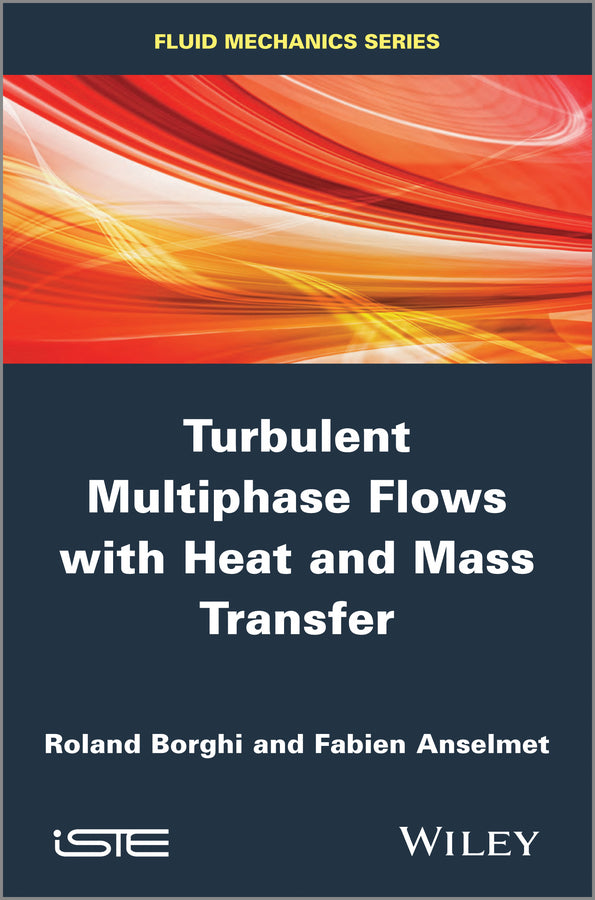
Turbulent Multiphase Flows with Heat and Mass Transfer
R Borghi (Author)
9781848216174, Wiley
Hardback, published 29 November 2013
468 pages
23.4 x 15.6 x 2.8 cm, 0.761 kg
Numerous industrial systems or natural environments involve multiphase flows with heat and mass transfer. The authors of this book present the physical modeling of these flows, in a unified way, which can include various physical aspects and several levels of complexity. Thermal engineering and nuclear reactors; the extraction and transport of petroleum products; diesel and rocket engines; chemical engineering reactors and fluidized beds; smoke or aerosol dispersion; landslides and avalanches − the modeling of multiphase flows with heat and mass transfer for all these situations can be developed following a common methodology. This book is devoted to the description of the mathematical bases of how to incorporate adequate physical ingredients in agreement with known experimental facts and how to make the model evolve according to the required complexity.
Acknowledgments xi Introduction xiii Part 1. Approach and General Equations 1 Chapter 1. Towards a Unified Description of Multiphase Flows 3 1.1. Continuous approach and kinetic approach 3 1.2. Eulerian–Lagrangian and Eulerian formulations 7 Chapter 2. Instant Equations for a Piecewise Continuous Medium 9 2.1. Integral and differential forms of balance equations 10 2.2. Phase mass balance equations in a piecewise continuous medium 13 2.3. Momentum balances 17 2.4. Energy balances 21 2.5. Position and interface area balance equations 23 2.6. Extension for a fluid phase that is a mixture 25 2.7. Completing the description of the medium 27 Chapter 3. Description of a “Mean Multiphase Medium” 29 3.1. The need for a mean description 29 3.2. How are mean values defined? 31 3.2.1. Temporal average 31 3.2.2. Volumetric average 32 3.2.3. Statistical average 34 3.2.4. Filtered average 35 3.3. Which average to choose, according to their advantages and disadvantages? 37 Chapter 4. Equations for the Mean Continuous Medium 39 4.1. Global balance equations for the mean medium 39 4.1.1. Total mass 39 4.1.2. Total momentum 40 4.1.3. Total energy 41 4.2. Balance equations for the phases of a mean medium 42 4.2.1. Phase mass 43 4.2.2. Phase momentum 44 4.2.3. Energies of each phase 47 4.2.4. Phase volume 49 4.3. Complete representation of the mean medium 49 4.3.1. Global representation 50 4.3.2. Multifluid representation 51 4.4. Mean equations of state 55 4.5. Extensions 58 4.5.1. Extension when a fluid phase is a mixture 58 4.5.2. Extension for dispersed media 59 4.6. Boundary conditions 61 Part 2. Modeling: A Single Approach Adaptable To Multiple Applications 67 Chapter 5. The Modeling of Interphase Exchanges 69 5.1. General methodology 69 5.2. Interface between phases and its mean area per unit of volume 71 5.2.1. Case of a suspension of liquid or solid particles 71 5.2.2. Case of a medium containing parcels of variable shapes and sizes 72 5.2.3. Case of a suspension of particles of constant and known sizes 74 5.3. Forces of contact and friction between phases 75 5.3.1. Pressure forces on spherical particles in a non-viscous flow 76 5.3.2. Friction on solid particles in steady flow 80 5.3.3. Slightly curved liquid–gas interfaces 87 5.3.4. Drops or bubbles 93 5.4. Heat transfers at the surface of a particle, without mass exchange 96 5.5. Heat and mass transfers during boiling 99 5.5.1. Slightly curved liquid–gas interfaces 99 5.5.2. Bubbles 105 5.6. Mass and heat exchanges by vaporization 107 5.6.1. Mass transfer by evaporation at a flat interface 107 5.6.2. Evaporation of a drop 113 5.6.3. Combustion of a drop 117 Chapter 6. Modeling Turbulent Dispersion Fluxes 119 6.1. Global modeling 119 6.1.1. General information 119 6.1.2. Kinetic energy of the “global fluctuations” 123 6.1.3. Modeling the kinetic energy of the fluctuations 128 6.1.4. Length scales for fluctuations and time scale for the dissipation of kinetic energy of fluctuations 132 6.1.5. Further studies on the dispersion flux of a phase 137 6.2. “Multifluid” modeling 147 6.2.1. The kinetic energy of the fluctuations in each phase 149 6.2.2. Modeling the balance equations of the kinetic energies of turbulence 152 6.2.3. The modeling of time or spatial scales 158 6.2.4. Modeling of the Reynolds tensor for every phase 162 Chapter 7. Modeling the Mean Gas–Liquid Interface Area per Unit Volume 165 7.1. Introduction 165 7.2. Initial equation for the mean interface area per unit volume 166 7.3. Model of the mean interface area during the “atomization” of a liquid jet 168 7.4. Effects of vaporization on the interface area 172 Chapter 8. “Large Eddy Simulation” Style Models 175 8.1. Introduction 175 8.2. Filtered equations and the nature of the models to be provided 177 8.3. Classic LES modeling for SGS additional fluxes 181 8.3.1. Reminder of LES in single-phase, constant density turbulent flows 181 8.3.2. Toward an extension for multiphase flows 183 8.4. Subgrid modeling of the interface area per unit volume 185 8.5. Partially Integrated Turbulence Modeling 188 Chapter 9. Contribution of Thermodynamics of Irreversible Processes 191 9.1. Global two-phase medium models 192 9.1.1. Entropy of a mean two-phase medium using the Prandtl model 194 9.1.2. Entropy for the k–ε model, in a medium with a variable density 200 9.2. Contribution of thermodynamics to multifluid models 206 Chapter 10. Experimental Methods 213 10.1. Introduction 213 10.2. Intrusive methods 214 10.2.1. Pitot tubes 215 10.2.2. Hot films 216 10.2.3. Optical needle probes (single probes, bi-probes and quadri-probes) 219 10.2.4. Wire networks 223 10.3. Non-intrusive methods 224 10.3.1. Particle image velocimetry (PIV) 225 10.3.2. Droplet tracking velocimetry 230 10.3.3. Laser Doppler anemometry (LDA) 234 10.3.4. Phase Doppler anemometry (PDA) 237 10.3.5. Ultrasonic Doppler Anemometry 241 10.3.6. Densimetry by attenuation of gamma, X-ray or neutron radiation 243 10.4. Advanced optical methods 245 10.4.1. Laser induced fluorescence 245 10.4.2. Interferometric methods (digital inline holography, Fourier interferometric imaging, ILIDS/IPI, rainbow) 252 Chapter 11. Some Experimental Results Pertaining to Multiphase Flow Properties that Are Still Little Understood 265 11.1. Atomization/fragmentation of liquid jets 265 11.2. Isolated bubbles, bubbles in swarm and their effects on carrier fluid 274 11.3. Boiling crisis 285 Part 3. From Fluidized Beds To Granular Media 297 Chapter 12. Fluidized Beds 299 12.1. Introduction 299 12.1.1. Classification of different fluidization regimes 299 12.1.2. Minimum fluidization and bubbling velocities 304 12.2. Complete models for the dynamics of fluidized beds 306 12.2.1. Bubbling fluidization regime 307 12.2.2. Turbulent fluidization regime 315 12.3. Global models for chemical conversion in fluidized beds 321 12.3.1. Bubbling regime fluidizations 321 12.3.2. Fast fluidization regime 324 12.3.3. Turbulent fluidization regime 325 12.4. Global models for heat transfers in fluidized beds 328 12.4.1. Bubbling fluidization regime 328 12.4.2. Fast fluidization regimes – circulating beds 331 12.5. Conclusion 334 Chapter 13. Generalizations for Granular Media 335 13.1. Introduction 335 13.2. Balance equations for mean granular media 336 13.3. Necessary closure approximations 342 13.4. Some already proposed methods 345 Chapter 14. Modeling of Cauchy Tensor of Sliding Contacts 349 14.1. Hypotheses and basic equations 349 14.2. Unclosed balance equation for Cauchy tensor of sliding contact 351 14.3. Closure approximations for irreversible terms 358 Chapter 15. Modeling the Kinetic Cauchy Stress Tensor 363 15.1. Prandtl–Bagnold modeling 364 15.2. K-lt or “turbulent granular gas” modeling 366 15.3. Toward a general model for all regimes 371 15.4. Boundary conditions at walls 373 Part 4. Studying Fluctuations and Probability Densities 377 Chapter 16. Fluctuations of the Gas Phase in Reactive Two-Phase Media 379 16.1. Specificities of reactive two-phase media 379 16.2. Probability density of composition fluctuations of the gas phase 380 16.2.1. Instant basic equations of the gas medium 382 16.2.2. PDF equation 385 16.3. Modeling the terms due to exchanges between phases 390 16.3.1. Total mass exchange 390 16.3.2. Mass exchange for species 392 16.3.3. Heat exchange 393 16.4. Modeling micromixing and turbulent dispersion 395 16.4.1. The “micromixing” term in PDF equations 395 16.4.2. Turbulent diffusion terms in PDF equations 396 16.5. Practical use of PDF equations 397 Chapter 17. Temperature Fluctuations in Condensed Phases 399 17.1. Problems 399 17.2. Instantaneous equation for the temperature of the liquid phase 401 17.3. Equation for the PDF of the temperature of the liquid 403 17.4. Closure of the equation of the temperature PDF 405 Chapter 18. Study of the PDF for Velocity Fluctuations and Sizes of Parcels 409 18.1. Phase velocity PDF equation 410 18.2. Modeling the exchanges between phases and the internal interactions 415 18.2.1. Terms of exchanges between phases 415 18.2.2. Internal dissipation and production of fluctuations 418 18.3. Practical calculation of PDF 419 18.4. The study of the sizes of the dispersed phase parcels 420 18.5. Eulerian–Lagrangian simulation of dispersed media 423 18.5.1. Lagrangian equations of the parcels 423 18.5.2. Stochastic simulations 426 Bibliography 431 Index 443
Subject Areas: Mechanical engineering & materials [TG]