Freshly Printed - allow 7 days lead
Couldn't load pickup availability
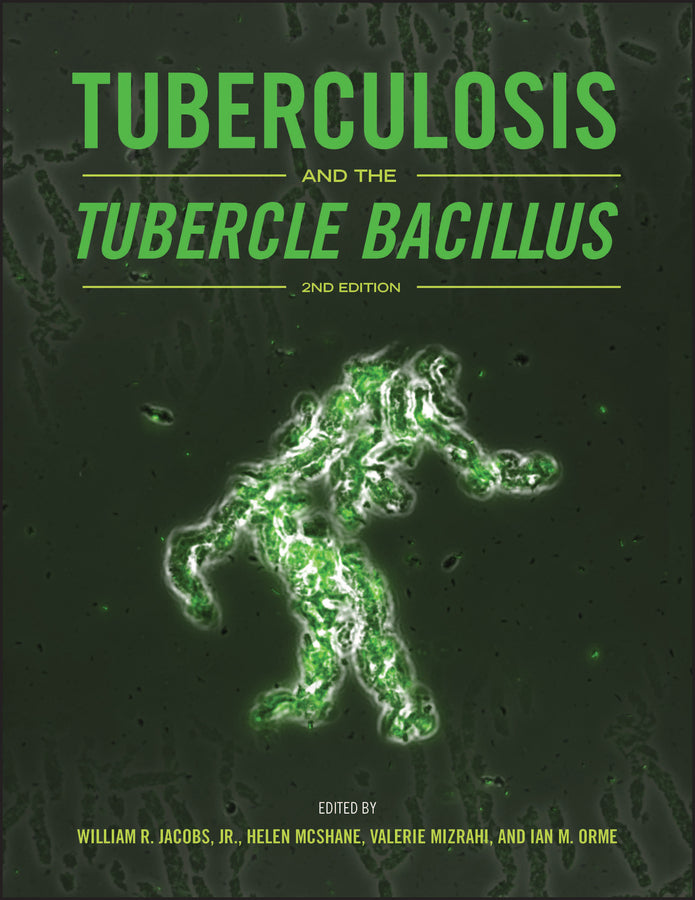
Tuberculosis and the Tubercle Bacillus
William R. Jacobs, Jr. (Edited by), Helen McShane (Edited by), Valerie Mizrahi (Edited by), Ian M. Orme (Edited by)
9781555819552, Wiley
Hardback, published 1 September 2017
730 pages
28.2 x 21.6 x 4.1 cm, 2.336 kg
Can today's innovative practices and molecular tools tame this ancient disease? One third of the world's population is infected with tuberculosis (TB), with about 10 million new cases annually. To combat TB and its agent, Mycobacterium tuberculosis, the World Health Organization launched The End TB Strategy, which aims to slash the suffering and cost of TB by 2035. This makes the second edition of Tuberculosis and the Tubercle Bacillus, edited by Jacobs, McShane, Mizrahi, and Orme, an extremely valuable resource for scientists and clinicians. The editors have gathered their colleagues from around the world to present the latest on the molecular biology of M. tuberculosis and related species, the host-pathogen interactions that enable invasion, and the host's immune response to M. tuberculosis infection. The basic, clinical, and translational research presented in this book supports the goals of WHO's End TB Strategy by driving toward the development of effective vaccines, rapid molecular diagnostics, and anti-TB drugs. The second edition of Tuberculosis and the Tubercle Bacillus presents the latest research on a microorganism that is exquisitely well adapted to its human host. This pathogen continues to confound scientists, clinicians, and public health specialists, who will all find much valuable information in this comprehensive set of reviews.
Contributors Preface Section I: Towards Edward Jenner’s Revenge: Developing an Effective Tuberculosis Vaccine A. Basic Immunology 1 Innate Immune Responses to Tuberculosis 2 Cytokines and Chemokines in Mycobacterium tuberculosis Infection 3 Regulation of Immunity to Tuberculosis 4 The Memory Immune Response to Tuberculosis 5 Pathology of Tuberculosis: How the Pathology of Human Tuberculosis Informs and Directs Animal Models B. Animal Models 6 Animal Models of Tuberculosis: An Overview 7 Mouse and Guinea Pig Models of Tuberculosis 8 Non-Human Primate Models of Tuberculosis 9 Experimental Infection Models of Tuberculosis in Domestic Livestock C. Vaccines 10 Clinical Testing of Tuberculosis Vaccine Candidates D. Human Immunology 11 Human Immunology of Tuberculosis 12 The Immune Interaction between HIV-1 Infection and Mycobacterium tuberculosis Section II: Drug Discovery and Development: State of the Art and Future Directions 13 Preclinical Efficacy Testing of New Drug Candidates 14 Oxidative Phosphorylation as a Target Space for Tuberculosis: Success, Caution, and Future Directions 15 Targeting Phenotypically Tolerant Mycobacterium tuberculosis Section III: Biomarkers and Diagnostics 16 Tuberculosis Diagnostics: State of the Art and Future Directions 17 Latent Mycobacterium tuberculosis Infection and Interferon-Gamma Release Assays 18 Impact of the GeneXpert MTB/RIF Technology on Tuberculosis Control Section IV: Host and Strain Diversity 19 The Role of Host Genetics (and Genomics) in Tuberculosis 20 The Evolutionary History, Demography, and Spread of the Mycobacterium tuberculosis Complex 21 Impact of Genetic Diversity on the Biology of Mycobacerium tuberculosis Complex Strains 22 Evolution of Mycobacterium tuberculosis: New Insights into Pathogenicity and Drug Resistance Section V: The Signature Problem of Tuberculosis Persistence 23 Acid-Fast Positive and Acid-Fast Negative Mycobacterium tuberculosis: The Koch Paradox 24 Mycobacterial Biofilms: Revisiting Tuberculosis Bacilli in Extracellular Necrotizing Lesions 25 Killing Mycobacterium tuberculosis In Vitro: What Model Systems Can Teach Us 26 Epigenetic Phosphorylation Control of Mycobacterium tuberculosis Infection and Persistence 27 DNA Replication in Mycobacterium tuberculosis 28 The Sec Pathways and Exportomes of Mycobacterium tuberculosis 29 The Role of ESX-1 in Mycobacterium tuberculosis Pathogenesis 30 The Minimal Unit of Infection: Mycobacterium tuberculosis in the Macrophage 31 Metabolic Perspectives on Persistence 32 Phenotypic Heterogeneity in Mycobacterium tuberculosis 33 Mycobacterium tuberculosis in the Face of Host-Imposed Nutrient Limitation Index
Jeffrey S. Schorey and Larry S. Schlesinger
Racquel Domingo-Gonzalez, Oliver Prince, Andrea Cooper, and Shabaana Khader
Susanna Brighenti and Diane J. Ordway
Joanna R. Kirman, Marcela I. Henao-Tamayo, and Else Marie Agger
Randall J. Basaraba and Robert L. Hunter
Ann Williams and Ian M. Orme
Ian M. Orme and Diane J. Ordway
Juliet C. Peña and Wen-Zhe Ho
Bryce M. Buddle, H. Martin Vordermeier, and R. Glyn Hewinson
Mark Hatherill, Dereck Tait, and Helen McShane
Thomas J. Scriba, Anna K. Coussens, and Helen A. Fletcher
Elsa du Bruyn and Robert John Wilkinson
Eric L. Nuermberger
Gregory M. Cook, Kiel Hards, Elyse Dunn, Adam Heikal, Yoshio Nakatani, Chris Greening, Dean C. Crick, Fabio L. Fontes, Kevin Pethe, Erik Hasenoehrl, and Michael Berney
Ben Gold and Carl Nathan
Madhukar Pai, Mark P. Nicol, and Catharina C. Boehme
Madhukar Pai and Marcel Behr
Wendy Susan Stevens, Lesley Scott, Lara Noble, Natasha Gous, and Keertan Dheda
Vivek Naranbhai
Maxime Barbier and Thierry Wirth
Stefan Niemann, Matthias Merker, Thomas Kohl, and Philip Supply
Eva C. Boritsch and Roland Brosch
Catherine Vilchèze and Laurent Kremer
Randall J. Basaraba and Anil K. Ojha
Tracy L. Keiser and Georgiana E. Purdy
Melissa Richard-Greenblatt and Yossef Av-Gay
Zanele Ditse, Meindert H. Lamers, and Digby F. Warner
Brittany K. Miller, Katelyn E. Zulauf, and Miriam Braunstein
Ka-Wing Wong
Brian C. VanderVen, Lu Huang, Kyle H. Rohde, and David G. Russell
Travis E. Hartman, Zhe Wang, Robert S. Jansen, Susana Gardete, and Kyu Y. Rhee
Neeraj Dhar, John McKinney, and Giulia Manina
Michael Berney and Linda Berney-Meyer
Subject Areas: Clinical & internal medicine [MJ]