Freshly Printed - allow 7 days lead
Couldn't load pickup availability
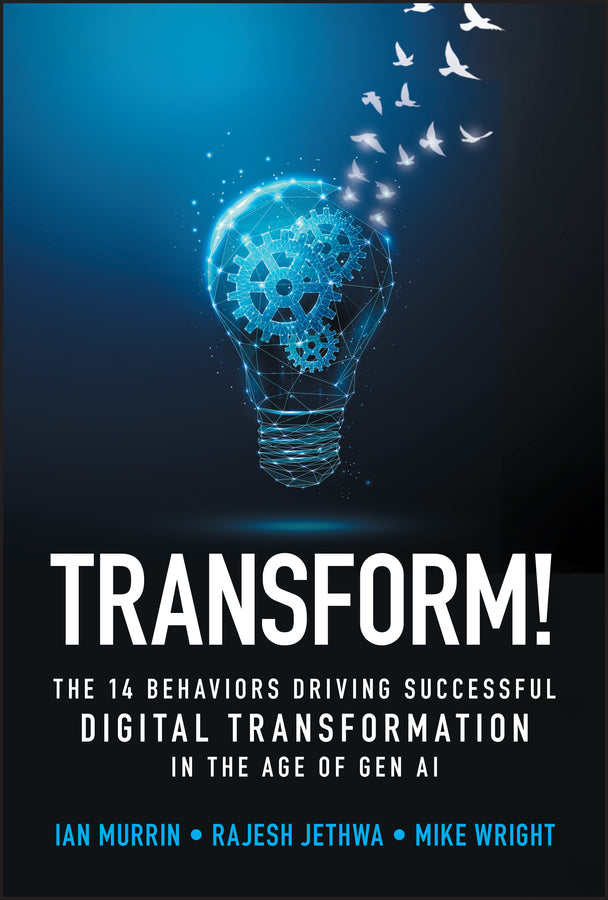
Transform!
The 14 Behaviors Driving Successful Digital Transformation in the Age of Gen AI
Ian Murrin (Author), Rajesh Jethwa (Author), Mike Wright (Author)
9781394374014, Wiley
Hardback, published 6 November 2025
288 pages
23.1 x 15.8 x 2.5 cm, 0.544 kg
Learn what separates success from failure in technology-led transformation initiatives Transform! explores the stark reality that only a small fraction of companies achieve their technology-led transformation objectives, with billions of dollars wasted each year. The book highlights the critical barriers to success, such as defining the right investment priorities and addressing workforce skills and attitudes. It also sheds light on the broader implications of this wastage, including the opportunity costs and the potential to fund global solutions like eradicating hunger. Through compelling case studies and data-driven insights, Transform! delivers key insights on: Transform! is an essential read for all business leaders and professionals looking for a reliable and practical guide to navigate the complexities of digital transformation.
Section I What’s the Problem Here? 1 Chapter 1 And Why Do I Care? 3 1.1 Time, Please 6 1.2 The Technical Debt Crises 10 1.3 How Big Is the Debt? 11 1.4 What Does This Mean for Me? 14 1.5 What’s in It for Me? 16 1.6 Not so SWIFT 21 1.7 Where Did It All Go Wrong? 23 1.8 Change 101 24 Chapter 2 Who Needs a Survival Guide? 27 2.1 US Inc. and UK PLC 30 2.2 Legacy Code, Legacy Thinking 31 Section II How Do We Solve It? 35 Chapter 3 The Importance of a Software- Centric Mindset 37 3.1 The Decline of the Big Three 38 Chapter 4 When It All Goes Wrong 45 4.1 When the Virtual Wheels Fell Off at Volkswagen 45 4.2 Sonos’s Sorry Tale 49 Chapter 5 The Common Pitfalls and How to Avoid Them 51 5.1 A Waterfall Approach to Improvement 51 5.2 Failing to Distinguish Between Hard Tasks and Complex Problems 54 5.3 Classifying the Problem Domain Correctly 55 5.4 Solving for the Wrong Problems 60 5.5 No Clarity Around the Definition of “Great” or How to Get There 61 5.6 The Vital Role of Testing 61 5.7 Lack of Psychological Safety 62 5.8 Pitfalls in Practice 63 Chapter 6 The 14 Behaviors Behind Successful TLT 75 Chapter 7 Real- World Effects: A Project Comparison 97 7.1 Paradise Lost: The Story of the Disastrous Post Office Horizon Project 98 7.2 “Big- Bang” ERP Transformation on a Global Scale 105 Section III What’s the Plan, Stan? 115 Chapter 8 Before You Start Your Transformation 117 8.1 Bringing All Four Pillars of Technology- Led Transformation Together 118 8.2 Do You Have a Change Mindset? 118 8.3 Sears: A Story of Failed Success 119 8.4 Tesla: A Story of Successful Failure 122 8.5 Are You Grooving in the Right Behaviors from the Outset? 126 Chapter 9 Have You Assessed the Risks? 129 9.1 Data Migration as a Risk 133 9.2 Lloyds Banking Group’s IT Failure 133 9.3 Some Practical Steps to Managing Project Risk More Effectively 134 9.4 Risk Management Tooling and Frameworks 134 Chapter 10 Cybersecurity and Data Integrity 139 10.1 Peak Loads and Capacity 140 Chapter 11 Setting Scope and Objectives 141 Chapter 12 Optimizing for Different Parameters to Address Changing Priorities 145 Chapter 13 Architecture in the Physical World 149 13.1 Leaning Tower of Pisa 149 13.2 St. Martin’s- in- the- Field 150 13.3 Managing the Madness 151 13.4 What Defines Modern Software Architecture? 153 Chapter 14 Program Governance and Project Contingency 157 14.1 A Case Study— Willis and KKR 157 Chapter 15 Agile Explained 163 15.1 The Agile Manifesto 165 15.2 You Say “Tomato” and I Say “Tomato” 166 15.3 What Is Agile Really About? 167 15.4 What Agile Is Not 169 15.5 The Importance of Domain Knowledge 170 15.6 Patterns and Anti- Patterns of Effective Agile Teams 171 15.7 Agile Team Roles, Ceremonies, and Practices 173 15.8 Goal- Gradient Effect 178 Chapter 16 Organizational and Team Structures 181 16.1 Information Flows and Conway’s Law 181 Chapter 17 Delivery Resourcing Strategy 185 17.1 Selecting the Team: The Insiders 185 17.2 Selecting the Team: The Third Parties 187 Chapter 18 Adopt a Proven Change Framework 189 18.1 From Nudge to Kotter 189 18.2 Maintaining Integrity of Leadership 191 Chapter 19 Getting Started and Keeping Going 193 19.1 Communicating Effectively About Progress 194 19.2 Maintaining Morale 194 19.3 Managing Risks 195 19.4 Responding to Problems 196 Chapter 20 Not- So- Minor Details 197 20.1 Early Adopters and Change Champions 197 20.2 Products, Not Projects 198 20.3 Non- Functional Requirements 199 20.4 Ensuring Third Parties Do Not Overstay Their Welcome 201 20.5 When Initiatives Do Happen, but They Don’t Scale 202 Chapter 21 What to Measure and What Not to Measure 205 Chapter 22 After the First Delivery 209 22.1 Celebrating the First Deployment 209 22.2 Planning for Phase 2 and Beyond 210 22.3 Measuring Benefit Capture 210 Section IV GenAI- Enabled Change and the Rise of the Machines 211 Chapter 23 This Could Take Forever 213 23.1 The Elephant in the Room 215 23.2 Running to Stand Still 216 23.3 Out with the Old, In with the New 217 Chapter 24 Enter the Machines 221 24.1 The Tipping Point 222 24.2 Likely GenAI Use- Cases for Information Technology Organizations 229 24.3 Use the Force, Luke 232 24.4 GenAI- Assisted Engineering: All Change, Please 235 24.5 No Silver Bullets 239 Appendix 241 Notes 245 Acknowledgments 253 About the Authors 259 Index 263
Subject Areas: Business & management [KJ]