Freshly Printed - allow 7 days lead
Couldn't load pickup availability
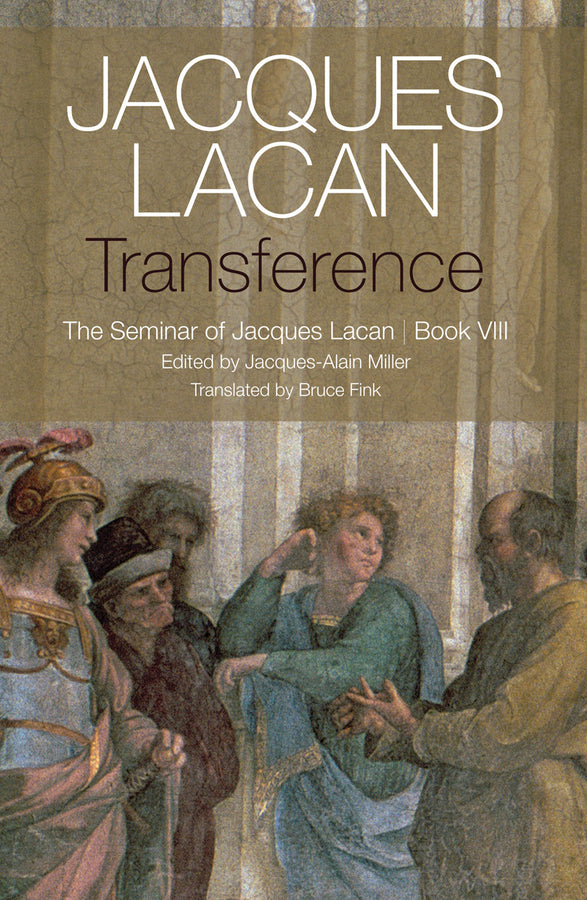
Transference
The Seminar of Jacques Lacan, Book VIII
Jacques Lacan (Author), Jacques-Alain Miller (Edited by), Bruce Fink (Translated by)
9781509523603, Polity Press
Paperback / softback, published 1 September 2017
464 pages
22.9 x 15.2 x 3.6 cm, 0.68 kg
"In this extraordinary text Lacan teaches us that to become Lacanians would be to miss the point. To understand transference, Lacan shows us with his usual wit and precision, is to understand how and why people get stuck in their relationships to people, and to ideas. This is Lacan at his breeziest and most incisive. He reveals once again, in his own inimitable way, that to talk well about psychoanalysis is always to talk about so much more than psychoanalysis."
—Adam Phillips, Psychoanalyst and writer
"Alcibiades attempted to seduce Socrates, he wanted to make him, and in the most openly avowed way possible, into someone instrumental and subordinate to what? To the object of Alcibiades's desire – ágalma, the good object.
I would go even further. How can we analysts fail to recognize what is involved? He says quite clearly: Socrates has the good object in his stomach. Here Socrates is nothing but the envelope in which the object of desire is found.
It is in order to clearly emphasize that he is nothing but this envelope that Alcibiades tries to show that Socrates is desire's serf in his relations with Alcibiades, that Socrates is enslaved to Alcibiades by his desire. Although Alcibiades was aware that Socrates desired him, he wanted to see Socrates's desire manifest itself in a sign, in order to know that the other – the object, ágalma – was at his mercy.
Now, it is precisely because he failed in this undertaking that Alcibiades disgraces himself, and makes of his confession something that is so affectively laden. The daemon of Αἰδώς (Aidós), Shame, about which I spoke to you before in this context, is what intervenes here. This is what is violated here. The most shocking secret is unveiled before everyone; the ultimate mainspring of desire, which in love relations must always be more or less dissimulated, is revealed – its aim is the fall of the Other, A, into the other, a."
Jacques Lacan
I. In the Beginning Was Love II. Set and Characters III. The Metaphor of Love: Phaedrus IV. The Psychology of the Rich: Pausanias V. Medical Harmony: Eryximachus VI. Deriding the Sphere: Aristophanes VII. The Atopia of Eros: Agathon VIII. From Epistéme to Mýthos IX. Exit from the Ultra-World X. Ágalma
Subject Areas: Literature: history & criticism [DS]