Freshly Printed - allow 10 days lead
Couldn't load pickup availability
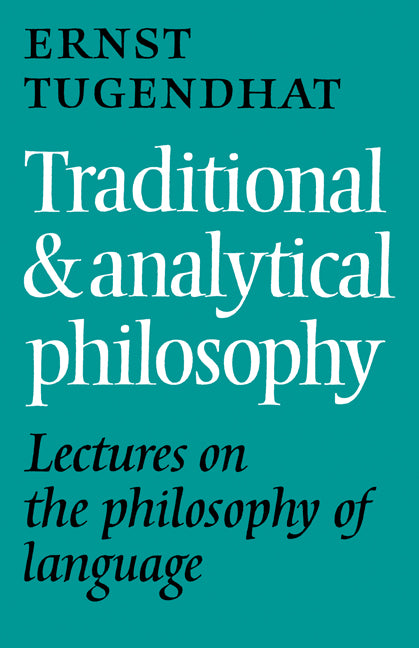
Traditional and Analytical Philosophy
Lectures on the Philosophy of Language
A study of some of the central and abiding questions of metaphysics and the philosophy of language by Ernst Tugendhat.
Ernst Tugendhat (Author), P. A. Gorner (Translated by)
9780521125734, Cambridge University Press
Paperback / softback, published 14 January 2010
452 pages
21.6 x 14 x 2.6 cm, 0.57 kg
A major study of some of the central and abiding questions of metaphysics and the philosophy of language by one of the most eminent contemporary German philosophers. Originally published in 1976, it was first translated into English in 1982. Ernst Tugendhat was trained in the Heideggerian modes of phenomenological and hermeneutical thinking. Yet increasingly he came to believe that the most appropriate approach was from within the framework of analytical philosophy. This book grew out of that conviction, and as such it brought a fresh perspective to some of the rarely examined assumptions and methods of analysis. Professor Tugendhat begins by showing how semantic analysis related to such 'traditional' conceptions of philosophy as Aristotle's and Kant's, and the manner in which it treats such 'traditional' problems as being and consciousness. From these considerations he develops a systematic, thorough and original theory of reference, predication and individuation, which make it an invaluable resource for anyone with an interest in the philosophy of language.
Preface
Translator's preface
Part I. Introduction: Confrontation of Analytical Philosophy with Traditional Conceptions of Philosophy: 1. A question of method
2. A philosopher in search of a conception of philosophy
3. Ontology and semantics
4. Has formal semantics a fundamental question?
5. Consciousness and speech
6. The argument with the philosophy of consciousness continued
7. A practical conception of philosophy
Part II. A First Step: Analysis of the Predicative Sentence: 8. Preliminary reflections on method and preview of the course of the investigation
9. Husserl's theory of meaning
10. Collapse of the traditional theory of meaning
11. Predicates: the first step in the development of an analytical conception of the meaning of sentences. The dispute between nominalists and conceptualists
12. The basic principle of analytical philosophy. The dispute continued. Predicates and quasi-predicates
13. The meaning of an expression and the circumstances of its use. Dispute with a behaviouristic conception
14. The employment-rule of an assertoric sentence. Argument with Grice and Searle
15. Positive account of the employment-rule of assertoric sentences in terms of the truth-relation
16. Supplements
17. 'And' and 'or'
18. General sentences. Resumption of the problem of predicates
19. The mode of employment of predicates. Transition to singular terms
20. What is it for a sign to stand for an object? The traditional account
21. The function of singular terms
22. Russell and Strawson
23. What is 'identification'?
24. Specification and identification. Specification and truth
25. Spatio-temporal identification and the constitution of the object-relation
26. Supplements
27. Results
28. The next steps
Notes
Bibliography
Indexes.
Subject Areas: Philosophy [HP]