Special Order - allow 2+ weeks lead
Couldn't load pickup availability
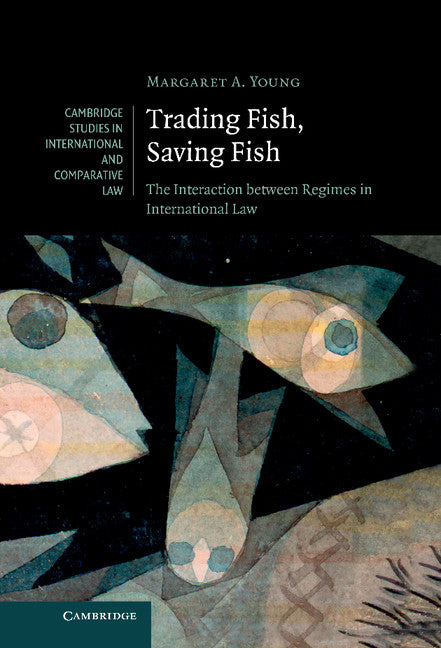
Trading Fish, Saving Fish
The Interaction between Regimes in International Law
Margaret Young outlines how efforts to avert the global fisheries crisis necessitate a new understanding of international law.
Margaret A. Young (Author)
9780521765725, Cambridge University Press
Hardback, published 14 April 2011
408 pages
22.9 x 15.2 x 2.4 cm, 0.71 kg
'Trading Fish, Saving Fish is an extremely insightful book and will reward careful reading, whether for a wider view of current fragmentation problems or for a highly specific consideration of aspects of fisheries law. On both counts the book represents scholarship of the most accomplished order and posits a valuable contribution to the emerging reconsideration of regimes and their functions within a fragmented international order, alongside important insights into the practical mechanics of fisheries governance.' Richard Caddell, Transnational Environmental Law
Numerous international legal regimes now seek to address the global depletion of fish stocks, and increasingly their activities overlap. The relevant laws were developed at different times by different groups of states. They are motivated by divergent economic approaches, influenced by disparate non-state actors, and implemented by separate institutions such as the World Trade Organization and the United Nations Food and Agriculture Organization. Margaret Young shows how these and other factors affect the interaction between regimes. Her empirical and doctrinal analysis moves beyond the discussion of conflicting norms that has dominated the fragmentation debate. Case-studies include the negotiation of new rules on fisheries subsidies, the restriction of trade in endangered marine species and the adjudication of fisheries import bans. She explores how regimes should interact, in fisheries governance and beyond, to offer insights into the practice and legitimacy of regime interaction in international law.
Part I. Trading Fish, Saving Fish: 1. Introduction
2. Relevant laws and institutions: an overview
Part II. Selected Case-Studies: 3. The negotiation of WTO rules on fisheries subsidies
4. The restriction of trade in endangered marine species
5. Adjudicating a fisheries import ban at the WTO
Part III. Towards Regime Interaction: 6. From fragmentation to regime interaction
7. A legal framework for regime interaction
8. Implications for international law.
Subject Areas: International economic & trade law [LBBM], Public international law [LBB], Law [L], International trade [KCLT], International relations [JPS]