Freshly Printed - allow 7 days lead
Couldn't load pickup availability
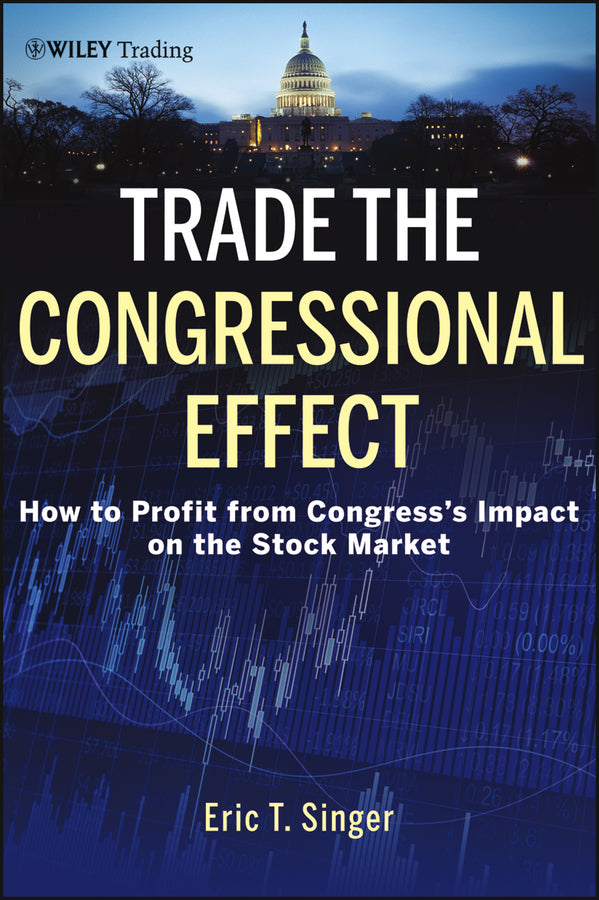
Trade the Congressional Effect
How To Profit from Congress's Impact on the Stock Market
Eric T. Singer (Author)
9781118362433, Wiley
Hardback, published 23 October 2012
224 pages
23.6 x 16 x 2.1 cm, 0.404 kg
An innovative investment approach that takes the actions of the U.S. Congress into consideration Historical research indicates that, more often than not, when Congress is in session there is a negative effect on equities markets (the "Congressional Effect") due possibly to investor uncertainty surrounding government action or inaction as well as the unintended consequences of Congressional legislative initiatives on the stock market. Author Eric Singer, a financial professional with over twenty-five years of experience, is an expert on this phenomenon, and with this new book he shares his extensive insights with you. Trade the Congressional Effect skillfully details how you can profit from Congress's impact on the stock market. Along the way, it puts this approach in perspective and gives you all the tools you'll need to profitably incorporate it into your investing endeavors. Singer walks you through the process of trading the Congressional Effect and provides practical guidance regarding the possible pitfalls and opportunities you'll face each step of the way. Supported by over forty-five years of real world data, the Congressional Effect has proven profitable to those who know how to use it. This timely guide will show you exactly what it takes to make this phenomenon work for you.
Acknowledgments xi Introduction 1 Our Damaged Economy 2 Congress’s Role in Wealth Destruction 8 Summary 9 Notes 10 CHAPTER 1 What Is the Congressional Effect? 13 How Was the Congressional Effect Discovered? 14 Early Returns Showing the Congressional Effect 19 The Smoot-Hawley Act: The Mother of All Congressional Effects 23 The Congressional Effect Data and Launching a Mutual Fund 24 Summary 26 Notes 26 CHAPTER 2 The Congressional Effect and the Limits of Modern Portfolio Theory 27 How MPT Has Been Used by Financial Advisers 30 Formulas Distort Valuation if Inputs Are Not Free Market Inputs 33 What Caused the Crash of 1987? 36 The Magnitude of the Crash of 1987 Refutes MPT 38 MPT Assumes All Daily Pricing Is Random, but the Congressional Effect Shows It Is Not 39 Summary 41 Notes 42 CHAPTER 3 Congressmen as Issues Entrepreneurs 43 The Time-Money-Vote Continuum: Congress as a Business 44 Congressmen as Traders and Real Estate Entrepreneurs: Making Money Outside Their Day Gig 54 Summary 57 Notes 58 CHAPTER 4 Behavioral Finance, the Stock Market, and Congressional Dysfunction 59 Overview of Behavioral Finance Concepts 60 Survey of Behavioral Finance Concepts 61 Congress’s Approach to Behavioral Finance 67 Summary 78 Notes 78 CHAPTER 5 If Congress Is Malfunction Junction, What’s Its Function? 81 Economic Lifeblood: Investment Capital Formation, the Stock Market, and Congress 81 Dodd-Frank Overview 90 Health Care Reform 95 Burning Coal and Other Energy Investors 103 Summary 110 Notes 110 CHAPTER 6 Where Will Washington Strike Next? 113 Where You Can Find Information 114 How to Leverage This Glut of Information 123 Summary 124 Notes 125 CHAPTER 7 Sidestepping Congress’s Wealth Destruction with a Macro Approach 127 11,832 Data Points Support the Congressional Effect Theory 128 Congress and the Tragedy of the Commons 130 Adam Smith, Call Your Office! 131 Summary 136 Notes 136 CHAPTER 8 Are Democrats or Republicans Better for Your Portfolio? 139 Who Gets the Credit for the Bull Market in 1980? 140 Unified Government Favors Nominal Returns 142 Split Government Favors Real Returns 145 Republican Congress vs. Democratic Congress 146 Filibuster-Proof Majorities Hurt Returns 147 Summary 148 Notes 149 CHAPTER 9 Leverging the Election Cycle 151 The Presidential Cycle and Real Returns 152 The 2012 Election and Beyond 156 Notes 157 CHAPTER 10 Are Lame Ducks, Impeachments, Resignations, Vetoes, and Litigated Elections Good for the Market? 159 President Bill Clinton 161 President Andrew Johnson 165 Resignations 167 Lame Duck Sessions 167 Litigated Elections 168 Vetoes 170 Summary 171 Notes 171 CHAPTER 11 More Ways to Dodge Congress’s Stray Bullets 173 Value Funds: Longer Time Horizons than Congress or the Somali Pirates 174 Gold Funds: Avoiding Congressional Debasement 177 Beyond Congress: International Funds 179 Reducing Global Security Risk 181 Summary 182 Notes 183 CHAPTER 12 ‘‘That Government Is Best that Governs Least’’ 185 Prognosis: Increasingly Partisan Politics Is Not Good for the Market 185 Conflicting Government Mandates Promote Market Instability 189 The Cumulative Effect of Unintended Consequences Is Congressional Wealth Destruction 191 Congress’s Dysfunctionality and the 2012 Election 193 What Happens When Congress Does Not Know the Price? 195 Congress Needs to Attract the Best Talent 197 In Conclusion 198 Notes 199 About the Author 201 Index 203
Subject Areas: Finance & accounting [KF]