Freshly Printed - allow 10 days lead
Couldn't load pickup availability
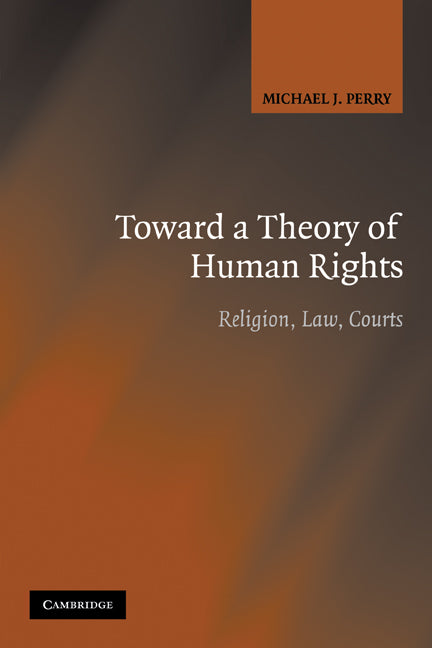
Toward a Theory of Human Rights
Religion, Law, Courts
Toward a Theory of Human Rights makes a significant contribution both to human rights studies and to constitutional theory.
Michael J. Perry (Author)
9780521684224, Cambridge University Press
Paperback / softback, published 18 August 2008
272 pages
22.9 x 15.2 x 1.6 cm, 0.4 kg
'Does religious belief undermine or support commitment to a moral and legal regime of human rights? No question is more urgent in our world today. Perry's argument cannot be ignored by any scholar working at the intersection of faith, law, and morality. Quite simply, Perry has changed the terms of the discussion.' M. Cathleen Kaveny, University of Notre Dame
Neither the morality of human rights nor its relation to the law of human rights is well understood. In this book, Michael Perry addresses three large issues. There is undeniably a religious ground - indeed, more than one religious ground - for the morality of human rights. But is there a secular ground for the morality of human rights? What is the relation between the morality of human rights and the law of human rights? Perry here addresses the controversial issues of capital punishment, abortion, and same-sex unions. What is the proper role of courts, in a liberal democracy, in protecting - and therefore in interpreting - constitutionally entrenched human rights? In considering this question, special attention is paid to the Supreme Court and how it should rule on issues such as capital punishment and abortion. Toward a Theory of Human Rights makes a significant contribution both to human rights studies and to constitutional theory.
Part I. The Morality of Human Rights: 1. The morality of human rights
2. The morality of human rights: a religious ground
3. The morality of human rights: a nonreligious ground?
Part II. From Morality to Law: 4. From morality to law
5. Capital punishment
6. Abortion
7. Same-sex unions
Part III. From Law to Courts: 8. Protecting human rights in a democracy: what role for the courts?
9. How should the Supreme Court rule?: capital punishment, abortion, and same-sex unions.
Subject Areas: Law [L], Human rights [JPVH], Religious ethics [HRAM1], Religious issues & debates [HRAM]