Freshly Printed - allow 7 days lead
Couldn't load pickup availability
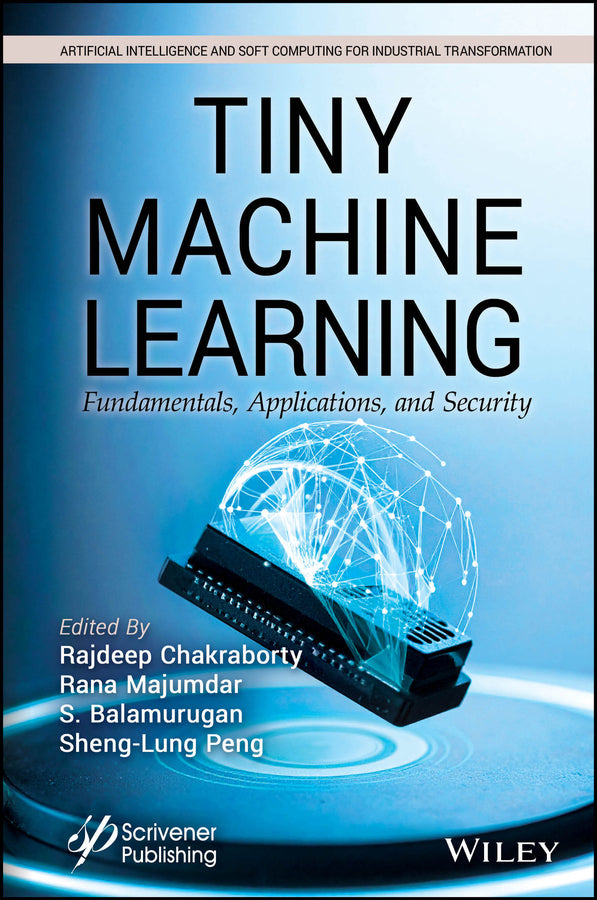
Tiny Machine Learning
Fundamentals, Applications, and Security
Rajdeep Chakraborty (Edited by), Rana Majumdar (Edited by), S. Balamurugan (Edited by), Sheng-Lung Peng (Edited by)
9781394347094, Wiley
Hardback, published 29 June 2026
528 pages
22.9 x 15.2 x 3.2 cm, 0.851 kg
Stay at the forefront of the embedded AI revolution by mastering the specialized hardware and software strategies needed to bring high-performance machine learning to the world’s most resource-constrained devices. TinyML (tiny machine learning), short for tiny machine learning, represents a groundbreaking intersection of machine learning and embedded systems, enabling the deployment of intelligent applications on resource-constrained devices. It empowers these devices to perform complex tasks, like image and speech recognition, locally without relying on cloud servers. This burgeoning field opens up many possibilities, from enhancing IoT devices to revolutionizing healthcare and intelligent infrastructure. As technology advances, TinyML promises to make our everyday devices more innovative, responsive, and efficient than ever before. By bringing inference to resource-constrained hardware, TinyML supports real-time decision-making while addressing critical concerns such as latency, power consumption, and data privacy. This book presents an overview of TinyML, including its core principles, applications, challenges, and future directions. It meticulously explores the fundamentals of machine learning and deep learning, providing a solid foundation for understanding how these techniques are adapted for tiny devices. By delving into the hardware, software, and algorithms that specifically cater to TinyML, the book addresses the unique challenges of running machine-learning models on devices with limited processing power and memory. Featuring expert insights and real-world case studies, this volume is an essential guide to researchers and industry professionals looking for solutions for today’s resource-constrained devices. Readers will find the volume: Audience Engineers, academics, researchers, and professionals in computer science, information technology, and electronics and communication.
Preface xxv Part I: Fundamentals 1 1 The Basics of TinyML: An Introductory Exploration 3 1.1 Introduction to TinyML 4 2 Advances in TinyML: A Systematic Review of Architectures, Algorithms, and Innovations 21 2.1 Introduction 22 3 Edge Intelligence and Trust: The Synergy of TinyML, IoT, and Blockchain in Modern Applications 51 3.1 Introduction 52 4 Use Cases of TinyML 87 4.1 Introduction 88 Part II: Applications 105 5 Advancing Smart Devices and IoT: Research Insights and Directions 107 5.1 Introduction 108 6 TinyML for Smart Devices and IoT: Enabling Efficient and Intelligent Applications 127 6.1 Introduction 128 7 Predictive Maintenance Using Tiny Machine Learning: A Revolutionary Approach to Proactive Equipment Maintenance 149 7.1 Introduction 150 8 TinyML and IoT in Agriculture: Boosting Real-Time Efficiency, Autonomy, and Resilience in Smart Farming 163 8.1 Introduction 164 9 TinyML and IoT for Predictive Maintenance and Real-Time Decision Support in Automotive Air Conditioning 191 9.1 Introduction 192 10 Automated Harm Detection: Enhancing Women's Safety in Real Time 207 10.1 Introduction 208 11 Butterfly Optimization with Random Forest for COVID-19 Prediction Using Lung Image 237 11.1 Introduction 238 Part III: Security 259 12 AI-Powered Resilience and Privacy Preservation in Cloud-IoT Environments for Smart Devices Using Fog Computing Methodologies 261 12.1 Introduction 262 13 Data Privacy and Transmission Security 279 13.1 Introduction 279 14 Security and Privacy Concerns for Blockchain-Enabled Federated Learning 321 14.1 Introduction 322 15 Adversarial Attacks and Defenses in Security 367 15.1 Introduction 368 16 Ethical and Technical Foundations of Privacy-Preserving Federated Learning 389 16.1 Introduction 390 17 Integrating Security Measures in CLAHE-Enhanced YOLOV8 Model for Underwater Object Detection 423 17.1 Introduction 424 18 TinyML Deployment for Resource-Constrained Devices in IoT Applications with Attribute-Based Encryption Scheme 457 18.1 Introduction 458 19 Deep Learning-Based Adversarial Attack Detection for Cloud-IoT Systems 475 19.1 Introduction 476 Bibliography 487
Darothi Sarkar and Monalisa Dey
1.2 Technological Underpinnings of TinyML 6
1.3 Real-World Applications of TinyML 11
1.4 Challenges and Limitations of TinyML 14
Sumanta Chatterjee, Aritra Banerjee, Tania Biswas and Somya Ranjan Bhoi
2.2 Background 24
2.3 Tiny Machine Learning 26
2.4 TinyML Operations 28
2.5 Application 32
2.6 Challenges and Proposed Solutions 40
2.7 Impacts of TinyML 43
2.8 Sustainable Development Through TinyML 45
2.9 Conclusion 47
Abhishek Bhattacharya, Soumi Dutta, Anupam Ghosh, Arijit Dutta, Prabuddha Chatterjee and Sangeeta Banik
3.2 Literature Review 59
3.3 Applications 65
3.4 Discussion 75
3.5 Conclusion 77
S. Sharmila Devi
4.2 Use Cases of TinyML 90
4.3 Conclusion 99
4.4 Future Scope 100
Ajay Verma, Nahida Majeed Wani and Girraj Kumar Verma
5.2 How Smart Devices Work 109
5.3 The Need for Smart Devices in the Real World 111
5.4 Properties of Smart Devices 112
5.5 Connection to the Internet of Things (IoT) 115
5.6 Security and Privacy: Keeping the IoT Landscape Safe 116
5.7 Trends and Research Opportunities in the Future 122
5.8 Conclusion 123
Neeta A. Ukirade
6.2 Tools and Frameworks for TinyML Development 130
6.3 Key Techniques in TinyML for IoT 133
6.4 Applications of TinyML in Smart IoT Devices 135
6.5 Challenges and Limitations 138
6.6 Future Directions 141
6.7 Conclusion 143
G. JayaLakshmi, Ch. JayaLakshmi and M. Ramesh
7.2 Predictive Maintenance: The Need for Proactivity 151
7.3 TinyML: Scope, Advantages, and Applications 154
7.4 TinyML in Predictive Maintenance: Key Components and Implementation Framework 157
7.5 Analyzing Real-World Applications and Case Studies of TinyML-Based Predictive Maintenance Systems 159
7.6 Conclusion 159
7.7 Future Scope 160
Shanthalakshmi M., Deepika N., Avvudaiyappan R.M. and Prince Raj J.
8.2 Smart Fertilizer Distribution Using Soil and Crop Data 167
8.3 Weed Detection Using TinyML and IoT 170
8.4 Animal Intrusion Detection in Crops 172
8.5 Disease Prevention and Detection 176
8.6 Enhancing Smart Irrigation with TinyML for Climate Prediction and Optimization Existing Systems 179
8.7 Conclusion 184
8.8 Future Scope 185
G. Bhavani and C. Jeyalakshmi
9.2 Architecture Overview 193
9.3 Technologies Enabling TinyML 198
9.4 Advantages of a Properly Functioning AC System 201
9.5 Advantages of TinyML in Real-Time Data Monitoring 201
9.6 Challenges 202
9.7 Conclusion 204
9.8 Future Scope 205
Shoban S., Rohith V., Shanthalakshmi M. and Deepika N.
10.2 Prior Knowledge 210
10.3 Related Works 212
10.4 Proposed Methodology 215
10.5 Challenges 232
10.6 Future Scope 233
Sivanantham Kalimuthu, Ramkumar N., Arun Prakash N., Boorneush M. and Dhusiyanth M.
11.2 Literature Survey 241
11.3 Proposed Research Methodology 243
11.4 Implementation Results 247
11.5 Conclusion 254
11.6 Future Scope 255
Biplab Gope and Soumen Santra
12.2 AI-Powered Resilience Mechanisms 264
12.3 Privacy Preservation Techniques 265
12.4 Fog Computing as an Enabler 265
12.5 Key Concepts 265
12.6 Results 266
12.7 Current Practices and Challenges 267
12.8 Challenges 268
12.9 Proposed Solutions 268
12.10 Applications and Use Cases 269
12.11 Technological Frameworks 270
12.12 Conclusion 270
12.13 Future Scope 273
Saptarshi Kumar Sarkar, Anupama Sen and Piyal Roy
13.2 Foundations of Data Privacy 283
13.3 Transmission Security 288
13.4 Emerging Threats to Data Privacy and Transmission Security 294Contents xvii
13.5 Impact of Emerging Technologies 300
13.6 Challenges in Ensuring Data Privacy and Secure Transmission 306
13.7 Practical Approaches to Enhancing Data Privacy and Transmission Security 312
13.8 Conclusion 316
Partha Ghosh, Ananya Biswas, Suradhuni Ghosh, Rima Bhowmik and Ankita Barua
14.2 Importance of Security and Privacy 324
14.3 Architecture of Federated Learning 326
14.4 Difference between Centralized Learning, Distributed Learning, and Federated Learning 327
14.5 Sources of Vulnerabilities in Federated Learning 329
14.6 Security Threats in Federated Learning 332
14.7 Defense Mechanism in Federated Learning System 337
14.8 Federated Learning Schemes 341
14.9 Federated Learning: An Approach to Healthcare in IIoE that Protects Privacy 342
14.10 Homomorphic Encryption (HE) Method in IIoE-Focused Federated Learning 343Contents xix
14.11 Blockchain-Powered Federated Learning 345
14.12 Decentralized Data Sharing in Healthcare 347
14.13 Public Key Infrastructure (PKI) for the System 351
14.14 Protecting Privacy with Cross-Chained Fl Techniques 352
14.15 Use of Blockchain-Enabled FL to Preserve Privacy 353
14.16 Challenges and Solutions 354
14.17 Open Research Challenges 358
14.18 Conclusion and Future Direction 360
Sudeshna Dey, Siddhartha Chatterjee, Sumita Gupta and Sima Das
15.2 Fundamentals of Federated Learning 370
15.3 Security and Privacy Threats in FL 373
15.4 Attacks in Federated Learning 374
15.5 Problems and Committing Directions 382
15.6 Conclusion 385
Muhammad Rifthy Kalideen
16.2 Foundations of Federated Learning 392
16.3 Ethical Foundations of Privacy in Federated Learning 396
16.4 Technical Foundations of Privacy-Preserving Federated Learning 402
16.5 Interplay Between Ethical and Technical Foundations 407
16.6 Case Studies and Real-World Applications 410
16.7 Future Directions and Emerging Trends 412
16.8 Conclusion 415
References 416
Niyati Sahoo, Sanjukta Mohanty and Arup Abhinna Acharya
17.2 Background 426
17.3 Related Works 435
17.4 Proposed Approach 438
17.5 Experiment and Results 450
17.6 Frequently Occurring Threats and Mitigation Policy 452
17.7 Conclusion 454
17.8 Future Scope 454
R. Lavanya and V. Thanigaivelan
18.2 Resource-Constrained Devices 461
18.3 Background for Attribute-Based Encryption 466
18.4 Related Work in ABE and Other Security Schemes 468
18.5 Local Interpretable Model-Agnostic Explanations 470
18.6 Conclusion 472
Amit Kumar, Sachin Ahuja and Ganesh Gupta
19.2 Background and Motivation 478
19.3 Deep Learning for Intrusion Detection in Cloud-IoT Systems 480
19.4 Case Study: Adversarial Attack Detection in Smart Grid Systems 483
19.5 Challenges and Future Directions 485
19.6 Conclusion 486
Index 489
Subject Areas: Computer science [UY]