Freshly Printed - allow 8 days lead
Couldn't load pickup availability
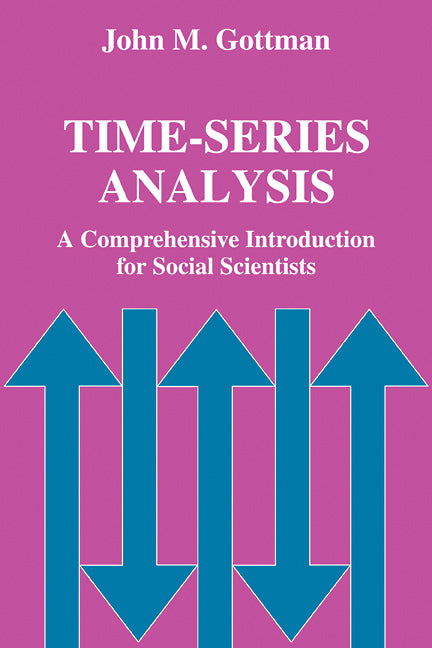
Time-Series Analysis
A Comprehensive Introduction for Social Scientists
This book is a comprehensive introduction to all the major time-series techniques, both time-domain and frequency-domain.
John M. Gottman (Author)
9780521103367, Cambridge University Press
Paperback / softback, published 19 March 2009
420 pages
22.9 x 15.2 x 2.4 cm, 0.61 kg
Since the 1970s social scientists and scientists in a variety of fields - psychology, sociology, education, psychiatry, economics and engineering - have been interested in problems that require the statistical analysis of data over time and there has been in effect a conceptual revolution in ways of thinking about pattern and regularity. This book is a comprehensive introduction to all the major time-series techniques, both time-domain and frequency-domain. It includes work on linear models that simplify the solution of univariate and multivariate problems. The author begins with a non-mathematical overview: throughout, he provides easy-to-understand, fully worked examples drawn from real studies in psychology and sociology. Other, less comprehensive, books on time-series analysis require calculus: this presupposes only a standard introductory statistics course covering analysis of variance and regression. The chapters are short, designed to build concepts (and the reader's confidence) one step at a time. Many illustrations aid visual, intuitive understanding. Without compromising mathematical rigour, the author keeps in mind the reader who does no have an easy time with mathematics: the result is a readily accessible and practical text.
Preface
Part I. Overview: 1. The search for hidden structures
2. The ubiquitous cycles
3. How Slutzky created order from chaos
4 Forecasting: Yule's autoregressive models
5. Into the black box with white light
6. Experimentation and change
Part II. Time-series models: 7. Models and the problem of correlated data
8. An introduction to time-series models: stationarity
9. What if the data are not stationary?
Part III. Deterministic and nondeterministic components: 10. Moving-average models
11. Autoregressive models
12. The complex behaviour of the second-order autoregressive process
13. The partial autocorrelation function: completing the duality
14. The duality of MA and AR processes
Part IV. Stationary frequency-domain models: 15. The spectral density function
16. The periodogram
17. Spectral windows and window carpentry
18. Explanation of the Slutzky effect
Part V. Estimation in the time domain: 19. AR model fitting and estimation
20. Box-Jenkins model fitting: the ARIMA models
21. Forecasting
22. Model fitting: worked example
Part VI. Bivariate time-series analysis: 23. Bivariate frequency-domain analysis
24. Bivariate frequency example: mother-infant play
25. Bivariate time-domain analysis
Part VII. Other Techniques: 26. The interrupted time-series experiment
27. Multivariate approaches
Notes
References
Index.
Subject Areas: Probability & statistics [PBT]