Freshly Printed - allow 10 days lead
Couldn't load pickup availability
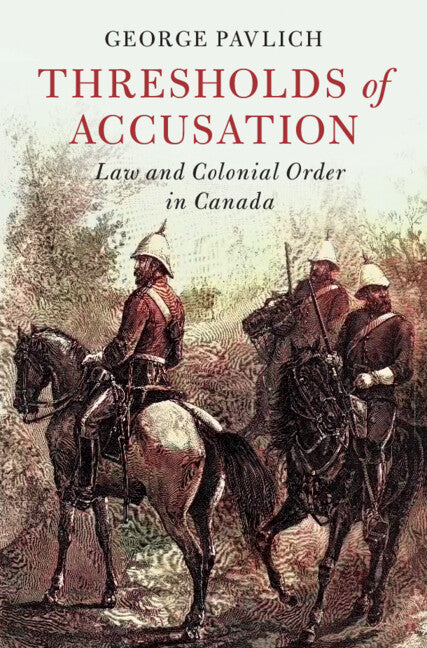
Thresholds of Accusation
Law and Colonial Order in Canada
Examines pretrial rituals of accusation that enabled colonial law and order to support possessive settler-colonialism across western Canada.
George Pavlich (Author)
9781009334044, Cambridge University Press
Hardback, published 28 September 2023
268 pages
23.5 x 15.8 x 2.2 cm, 0.55 kg
'The book's methodological and theoretical approaches provide fresh perspectives on the role of accusation in shaping colonial social orders and its enduring impact on contemporary legal systems. Pavlich's work is not just a historical account; it is a critical examination of the socio-political underpinnings of colonial legal frameworks. The book stands out for its depth, its critical lens on a pivotal historical period, and its implications for understanding and reimagining modern legal systems.' Amy Swiffen, International Journal of Semiotics and Law
This critical socio-legal history probes pretrial accusations through which colonial criminal law forged social orders for settler-colonialism across western Canada, focusing on Alberta, 1874–1884. Following military intelligence, a Northwest Mounted Police force was established to compel Dominion law. That force began by deploying accusatory theatres to receive information about crimes, arrest suspects, and decide via preliminary examination who to send to trial. George Pavlich draws on exemplary performances of colonial accusation to show how police officers and justices of the peace translated local social lore into criminal law. These performances reflected intersecting powers of sovereignty, disciplinarily, and biopolitics; they held accused individuals legally culpable for crimes and obscured social upheavals that settlers brought. Reflecting on colonial legacies within today's vast and unequal criminalizing institutions, this book proposes that we seek new forms of accusation and legality, learning from Indigenous laws that tackle individual and collective responsibilities for societal disquiet.
1. Grammars of critique and colonial accusation
2. Reconnaissance discourses for colonial law
3. Sovereign spectacles and criminal accusation
4. Justices of the peace at accusatory theatres
5. Training police accusers
6. Moulding accused individuals
7. Biopolitics and colonial accusation
8. Denouements and turned spades.
Subject Areas: Crime & criminology [JKV]