Freshly Printed - allow 8 days lead
Couldn't load pickup availability
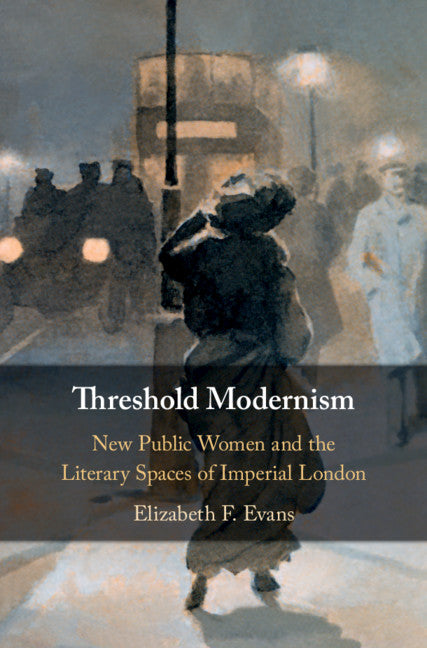
Threshold Modernism
New Public Women and the Literary Spaces of Imperial London
Reveals how changing ideas about gender and race shaped - and were shaped by - London and its literature.
Elizabeth F. Evans (Author)
9781108479813, Cambridge University Press
Hardback, published 6 December 2018
280 pages, 11 b/w illus.
23.5 x 15.7 x 1.7 cm, 0.58 kg
'Evans contributes to the ongoing debate on the nature and definition, and quantity of modernisms, revealing 'overlooked commonalities' even between H. G. Wells and Virginia Woolf. In advancing her arguments, Evans employs maps, spatial theory and work from understudied colonial writers of colour who gazed with outsiders' eyes on the teeming imperial metropolis; and she asks us to re-examine literary scholarship with fresh eyes, too.' The Times Literary Supplement
Threshold Modernism reveals how changing ideas about gender and race in late nineteenth- and early twentieth-century Britain shaped - and were shaped by - London and its literature. Chapters address key sites, especially department stores, women's clubs, and city streets, that coevolved with controversial types of modern women. Interweaving cultural history, narrative theory, close reading, and spatial analysis, Threshold Modernism considers canonical figures such as George Gissing, Henry James, Dorothy Richardson, H. G. Wells, and Virginia Woolf alongside understudied British and colonial writers including Amy Levy, B. M. Malabari, A. B. C. Merriman-Labor, Duse Mohamed Ali, and Una Marson. Evans argues that these diverse authors employed the 'new public women' and their associated spaces to grapple with widespread cultural change and reflect on the struggle to describe new subjects, experiences, and ways of seeing in appropriately novel ways. For colonial writers of color, those women and spaces provided a means through which to claim their own places in imperial London.
Introduction: London, 1880–1940: Liminal Sites and Contested Identities
1. Modern sites for modern types: locating the new public woman
2. Shops and shop girls: the modern shop, 'counter-jumpers', and the shopgirl's narrative evolution
3. Streets and the woman walker: when 'street love' meets Flânerie
4. Women's clubs and clubwomen: 'neutral territory', feminist heterotopia, and failed 'diplomacy'
5. New public women through colonial eyes: reverse imperial ethnography
Notes
Bibliography
Index.
Subject Areas: Gender studies: women [JFSJ1], Society & culture: general [JF], Modern history to 20th century: c 1700 to c 1900 [HBLL], Literary studies: fiction, novelists & prose writers [DSK], Literary studies: c 1800 to c 1900 [DSBF]